


Online PALS Certification Course: What Clinicians Need
.png)
The most popular advice about an online PALS certification course is often incomplete: “If it's online, it isn't valid.” That statement confuses online cognitive education with online-only skills validation. A credible course can move the knowledge portion to a digital platform while still requiring the hands-on assessment needed for a valid provider credential.
For busy nurses, physicians, paramedics, respiratory therapists, and other clinicians, that distinction matters. You need current pediatric emergency knowledge, practical performance, and documentation your employer will accept. This guide explains what PALS covers, how online learning works, what research says about digital healthcare education, and which questions to ask before enrolling.
Why Online PALS Certification Is Gaining Acceptance
Only in-person American Heart Association or American Red Cross classes can produce a valid PALS credential. That belief is outdated, but it contains one important warning: not every course marketed as “online PALS” follows a recognized certification pathway.
The healthcare education field has changed because clinicians already learn through digital modules, electronic references, simulation platforms, and remote continuing education. A 2017 BMJ Open review describes online learning as an established part of health professions education and highlights its practical advantages, including anytime-anyplace access, fewer logistical barriers, and individualized learning.
The key question isn't whether a course is online. The key question is whether it teaches current PALS content and verifies the physical skills required for the credential.
Acceptance depends on the credential pathway
The American Heart Association's HeartCode PALS model uses a blended format. Learners complete an online cognitive component, then complete a separate psychomotor skills assessment with a voice-assisted manikin or an AHA instructor before receiving a valid PALS provider eCard. That model demonstrates that online education and hands-on verification aren't competing ideas. They serve different purposes.
Practical rule: Ask whether “online PALS” means the entire credential is issued digitally, or whether it means online learning followed by a required skills evaluation.
Hospitals, clinics, and healthcare organizations increasingly recognize accredited online education because it can fit around shift work, clinical responsibilities, and geographically distributed teams. Acceptance still depends on the employer, licensing body, or credentialing department. You should confirm the exact requirement before purchasing any course, especially if your organization specifies an issuing body or skills-assessment format.
Why digital learning fits clinical work
A classroom places every learner on the same schedule. Online learning lets you pause a rhythm lesson, replay an explanation of an algorithm, and review difficult material when you're alert enough to absorb it. That flexibility doesn't lower the standard. It changes how you reach the standard.
Online education also helps organizations coordinate training across multiple locations. A hospital system can assign the same curriculum to staff while arranging practical verification separately. For individual clinicians, avoiding unnecessary travel and fixed classroom hours can make certification more accessible.
The industry is moving toward broader acceptance of online CE and certification, but quality control remains essential. Choose a provider that explains its guideline alignment, assessment process, credential issuer, renewal terms, and employer-acceptance policy in plain language.
What PALS Certification Covers and Who Needs It
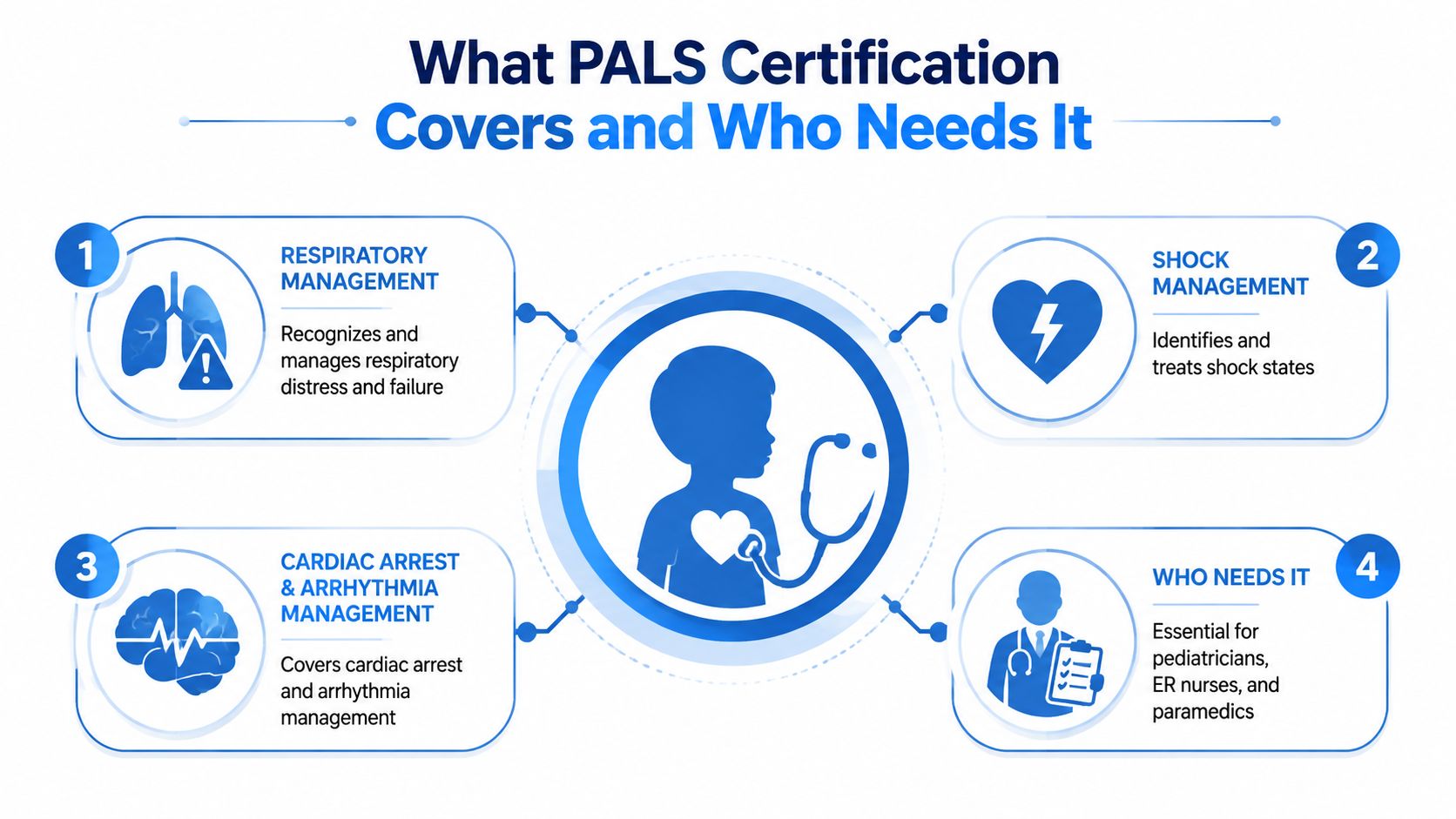
Pediatric Advanced Life Support, or PALS, prepares healthcare professionals to assess and manage serious emergencies in infants and children. Think of PALS as a structured response map. When a child deteriorates, the clinician must identify the problem, prioritize breathing and circulation, select appropriate interventions, and communicate clearly with the team.
PALS focuses on pediatric patients up to 18 years of age, excluding newborns, as reaffirmed in the 2025 pediatric resuscitation guidance. Newborn resuscitation follows a different educational framework, so clinicians working primarily with neonates should verify whether they need a separate neonatal course.
The clinical problems PALS addresses
A course generally builds decision-making around several connected emergencies:
- Respiratory distress and failure: You learn to recognize when a child is working harder to breathe and when that effort is no longer adequate.
- Shock: You assess whether circulation is failing and respond to the underlying pattern.
- Cardiac arrest: You follow organized resuscitation steps rather than improvising under pressure.
- Arrhythmias: You identify rhythm problems and connect rhythm findings with the child's clinical condition.
- Team-based care: You practice role clarity, closed-loop communication, and coordinated interventions.
The 2020 pediatric resuscitation update includes concrete changes that PALS learners must understand. When an advanced airway is in place, ventilation may be targeted at one breath every two to three seconds, or 20 to 30 breaths per minute. The same guidance states that giving epinephrine within five minutes from the start of chest compressions is reasonable, and it recommends continuous EEG monitoring when available for encephalopathic patients after cardiac arrest. These aren't trivia points. They affect what a team does during a time-critical event.
Who commonly needs PALS
PALS is intended for healthcare professionals who care for infants and children. That commonly includes:
- Nurses working in emergency, intensive care, pediatric, perioperative, or acute-care settings.
- Physicians who evaluate or treat pediatric emergencies.
- Paramedics and emergency responders who may stabilize a child before hospital arrival.
- Respiratory therapists who manage airway and ventilation emergencies.
- Other pediatric healthcare professionals whose employer requires advanced pediatric resuscitation training.
If you're a nurse deciding whether this credential fits your role, the PALS certification guide for nurses can help you connect course scope with workplace responsibilities. Your employer's policy remains the final authority on whether PALS is required and which provider it accepts.
Online Versus In-Person PALS Training
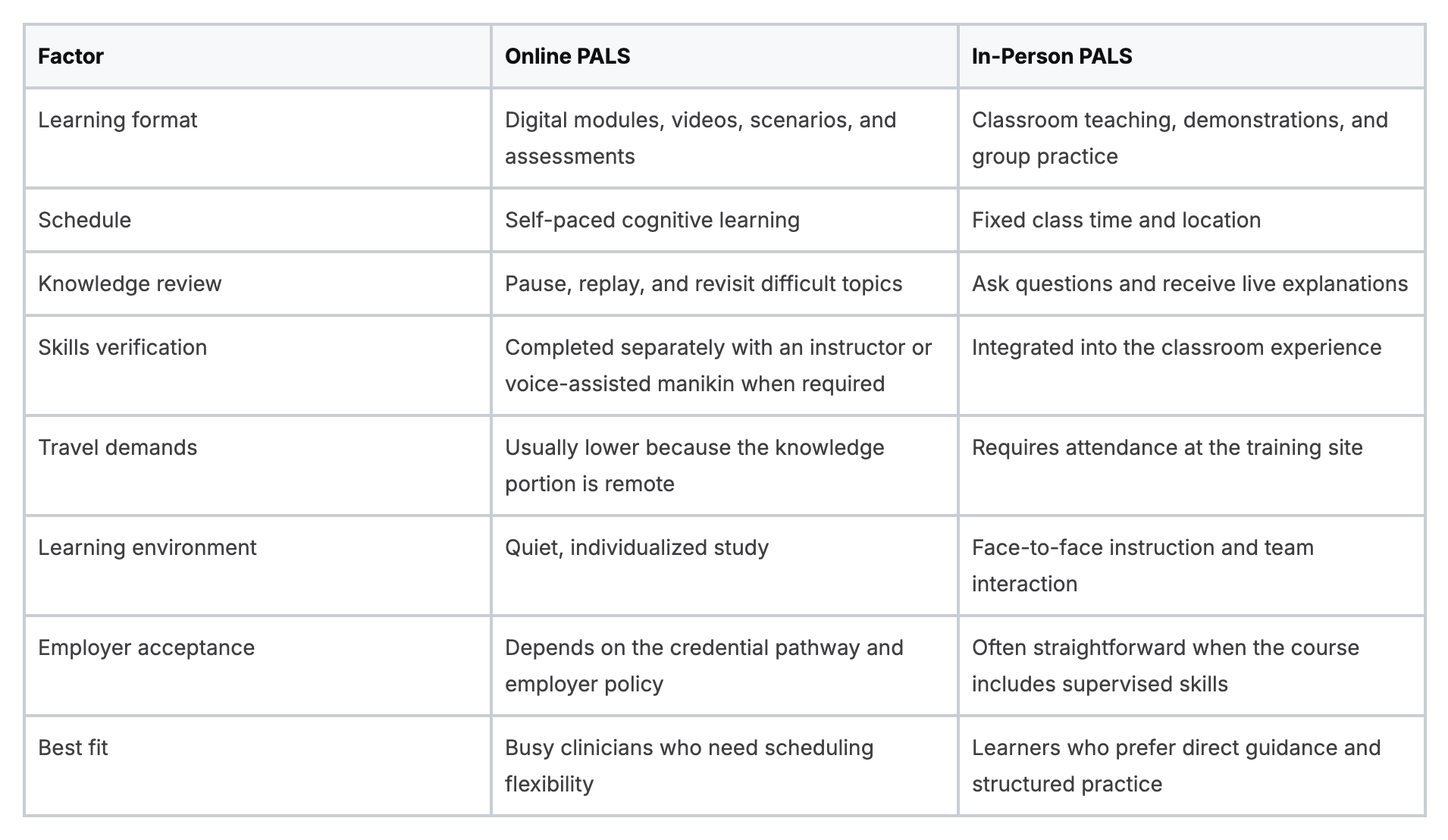
Online and classroom PALS training can both support effective learning. The difference is how the education is delivered and where practical performance is assessed.
Online study works well for clinicians with rotating shifts, family responsibilities, or long commutes. You can review material in manageable sessions and return to difficult topics instead of waiting for the next classroom explanation. In-person training offers immediate interaction, guided demonstrations, and a fixed learning rhythm.
The strongest comparison isn't “easy versus hard.” It's flexibility versus structure, with blended learning combining the advantages of both.
Online vs In-Person PALS Comparison
Quality and convenience can coexist
Online learning may reduce travel, facility, and scheduling burdens. Those savings are practical, especially for organizations coordinating staff across several sites. They don't mean the education is automatically better or worse. The content, assessment design, instructor support, and credential pathway determine quality.
The 2017 BMJ Open review describes online learning as useful for individualized, point-of-care education. A separate systematic review of online eLearning concluded that online learning can change knowledge, skills, attitudes, and satisfaction, with evidence indicating equivalence and possible advantages over traditional learning for knowledge and skills.
If you need broader foundational training, CPR AED & First Aid Certification is presented as 100% Online Certification for CPR, AED & First Aid. That course should be evaluated separately from PALS because each credential has its own requirements and employer expectations.
What Research Says About Online Healthcare Education
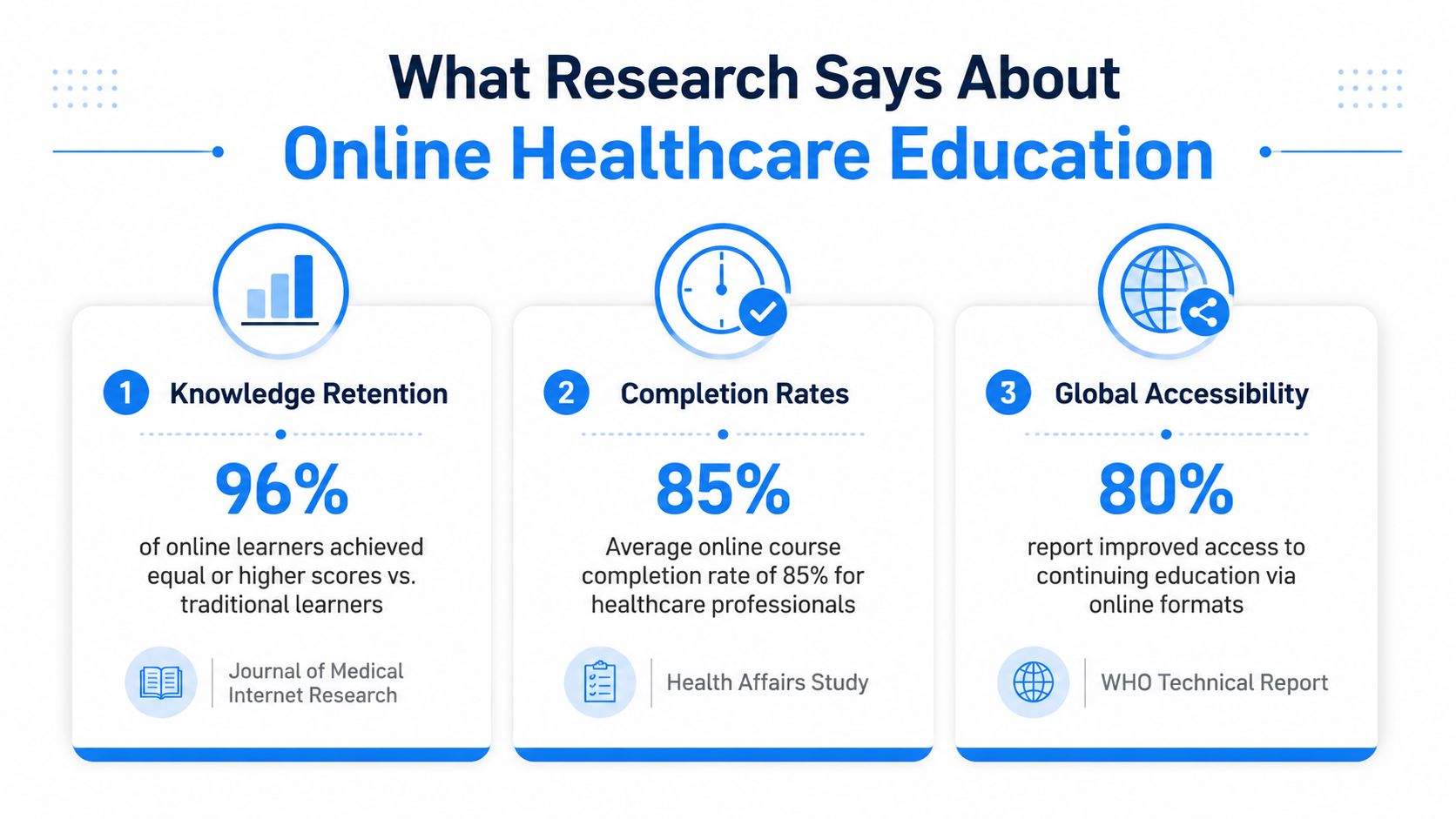
The evidence doesn't support the idea that online healthcare education is inferior. Research has examined online learning across knowledge, skills, behaviors, attitudes, and satisfaction, and the findings support a more practical conclusion: a well-designed online course can be as effective as traditional instruction for many learning outcomes.
A 2008 meta-analysis of internet-based learning in the health professions found large benefits compared with no intervention for knowledge, skills, and learner behaviors or patient effects. Compared with non-internet methods, the effects were small and heterogeneous, leading the authors to conclude that internet-based learning was broadly similar in effectiveness to traditional instruction.
That distinction matters. Online learning doesn't need to outperform every classroom course to be a valid choice. It needs to deliver accurate content, support active learning, and assess the outcomes that matter.
What clinicians gain from digital learning
Online formats offer several advantages that match clinical schedules:
- Control over pacing: You can spend more time on pediatric rhythms or medication principles and less time on familiar material.
- Repeatable explanations: You can replay a difficult lesson instead of relying on memory from a single classroom discussion.
- Reduced logistical barriers: You can study without arranging travel for the cognitive portion.
- Point-of-care access: You can review material when a question arises during preparation.
- Consistent delivery: Each learner receives the same core curriculum and assessment framework.
Research supports outcomes, not careless shortcuts
A PubMed-indexed evaluation of online continuing professional education found significant increases in continuing education knowledge and self-reported practice performance change, while describing online education as convenient for geographically and educationally diverse healthcare professionals.
The research supports online education as a serious learning format. It doesn't eliminate the need for hands-on verification when a certification pathway requires physical performance. For PALS, the sensible interpretation is straightforward: use online learning for knowledge acquisition, then complete the practical assessment required for credential validity.
Hospitals and professional organizations are recognizing this distinction more clearly. Acceptance is growing because institutions can evaluate the actual credential and assessment process rather than judging the learner's location during study.
Enrollment and Completion Process Explained
The smoothest online PALS experience starts with logistics, not the first lesson. Before enrolling, confirm what your employer requires, which device the course supports, and how you'll complete the separate skills assessment.
A desktop or laptop is often the safest choice for the online module. Recent AHA course-option guidance notes practical workflow considerations such as stable broadband, speakers or headphones, and, for some assessments, a webcam. Mobile access may be useful for selected review activities, but you shouldn't assume a phone can complete every required component.
A practical completion sequence
- Confirm the credential requirement. Ask your supervisor, credentialing office, or licensing authority whether it accepts the specific provider and whether skills verification must follow a particular format.
- Review renewal status. PALS certification is valid for two years. Renewal is commonly shorter than initial certification, with one published guide reporting roughly six to eight total hours for renewal versus about 14 hours for initial certification. That same guide describes a 50-question exam and an 84% passing threshold. Verify current requirements with your provider before scheduling.
- Prepare your workspace. Use a reliable computer, stable internet connection, functioning audio, and any required webcam. Download or review course materials before starting if your platform permits it.
- Complete the cognitive training. Work through the modules carefully. Keep a note of confusing algorithms, rhythm findings, and medication principles so you can revisit them before the exam.
- Schedule the skills assessment early. The hands-on session is a separate operational step in the blended pathway. Waiting until the online portion is complete can create avoidable delays if local appointments are limited.
- Finish the assessment and retain documentation. After passing the required components, confirm how your provider issues the eCard or certificate and save the credential where your employer can verify it.
Renewal needs advance planning
A recent guidance summary notes that many renewal candidates are eligible only while their current card remains active or has been expired for less than 30 days. Policies vary, so check your provider's rules before assuming you qualify for renewal. If the card has lapsed beyond the permitted window, you may need to complete the initial pathway again.
Use a PALS practice test to identify weak areas before the formal assessment. The most efficient study plan isn't just rushing through modules. It's completing focused review, testing recall, and reserving time for the hands-on appointment.
Common Questions About Online PALS Certification
Is an online PALS course valid by itself?
Usually, “online PALS” refers to the cognitive portion, not a complete provider credential issued without practical verification. In the standard AHA HeartCode pathway, you must complete the online learning and a separate psychomotor skills assessment with an instructor or voice-assisted manikin to earn a valid provider eCard.
Will my employer accept online PALS certification?
Acceptance depends on your employer's policy, credentialing process, and the issuing organization. Online education is widely used and increasingly accepted, but the phrase “online certification” can describe different products. Ask your employer whether it accepts the exact card, provider, and skills-assessment method before enrolling.
Is online learning as effective as classroom instruction?
For healthcare education, peer-reviewed evidence supports online learning as broadly comparable to traditional instruction. The internet-based learning meta-analysis found similar effectiveness when online learning was compared with non-internet methods, while other reviews report comparable or potentially stronger knowledge and skills outcomes in online formats.
The important qualification is assessment. Digital modules can teach recognition, algorithms, and decision-making. They can't replace a required physical demonstration of CPR, airway, or team performance.
What happens if my PALS card expires?
Renewal eligibility may depend on how long the card has been expired. Some guidance limits renewal eligibility to cards that are active or expired by less than 30 days, while a longer lapse may require the initial course. Contact the provider and your employer before selecting a renewal option.
Can I complete everything on a mobile phone?
Don't assume so. Course platforms may require a desktop or laptop, stable broadband, audio equipment, and sometimes a webcam. The hands-on verification still requires an instructor or voice-assisted manikin, regardless of the device used for cognitive study.
How should an organization evaluate a provider?
Review the course's guideline alignment, issuing organization, exam process, skills-verification procedure, renewal rules, technical requirements, and employer-acceptance policy. A credible provider explains what happens at every step instead of using “online” as a substitute for credential details.
An online PALS certification course can provide the same strong knowledge foundation as classroom education while giving clinicians more control over when and how they study. The credential remains credible when the course follows current guidance and includes the practical verification required by the pathway.
ProMed Certifications offers online healthcare certification courses that let clinicians complete review material and exams at their own pace, with PALS among its available options. Visit ProMed Certifications to review the course details, confirm the credential pathway, and choose a training format that matches your employer's requirements.
.avif)
Stay compliant with ProMed+
Certifications included: ACLS, BLS, PALS, CPR & Neonatal Resuscitation
Unlimited continuing education: over 200 hours of accredited CME
All-inclusive: One price. No surprises.
Get certified today

The Advanced Cardiac Life Support (ACLS) is an accredited online medical certification course that teaches medical professionals to respond to nearly all cardiopulmonary emergencies.

The Pediatric Advanced Life Support (PALS) Recertification instructs medical professionals on performing pediatric cardiopulmonary resuscitation in emergencies.

The Basic Life Support (BLS) Recertification is intended to teach healthcare professionals the basic steps of CPR and rescue breathing for adults, children, and infants.

Our online medical certification course for CPR, Automated External Defibrillator (AED), and First Aid is designed to teach adult, child, and infant CPR and AED use.

The Neonatal Resuscitation Certification trains medical professionals in performing resuscitation procedures and life-saving techniques for newborns at the time of delivery.

.png)
.png)
.png)