


Neonatal Resuscitation Course Guide for Healthcare Pros
.png)
The most popular advice about a neonatal resuscitation course is often too narrow: many clinicians still hear that only an in-person American Heart Association or American Red Cross class will count. That isn't universally true. What matters is whether the course reflects current neonatal resuscitation guidance, verifies learning appropriately, provides documentation your employer accepts, and helps you perform when a newborn needs support.
Nurses, midwives, respiratory therapists, and physicians may encounter these situations in labor and delivery, the NICU, emergency departments, or well-baby settings. A credible course should prepare you to recognize ineffective breathing, organize a team, begin ventilation promptly, and escalate care without losing time. It should also address a reality that certification cards can hide: hands-on performance fades faster than many clinicians expect.
This guide explains how neonatal resuscitation training developed, what a modern course covers, how the 2025 update changes expectations, and how to compare online and classroom options. It also looks at accreditation, skill refreshers, and the practical questions to ask before enrolling. Online CE and certification are now valid, accessible options for many healthcare professionals, and ProMed is part of that broader shift toward flexible, technology-supported education.
Why a Neonatal Resuscitation Course Matters More Than Ever
A newborn can shift from apparently stable to needing respiratory support within moments. That speed is why neonatal resuscitation training belongs to more than neonatologists and NICU specialists. Nurses, midwives, respiratory therapists, physicians, and other clinicians who attend births, receive distressed newborns, or support the resuscitation team need preparation matched to their responsibilities.
Approximately 10% of newborns need help beginning to breathe at birth, according to the American Family Physician summary of neonatal resuscitation guidance. Most of these situations do not require advanced intervention. They do require a delivery team that recognizes ineffective breathing early and acts before the newborn's condition worsens.
Who should take neonatal resuscitation training
Your role and work setting should guide the course level you choose.
- Labor and delivery nurses lead preparation, assessment, ventilation support, documentation, or team coordination.
- Midwives are the primary clinician at some births and need immediate access to a structured algorithm.
- Respiratory therapists support airway management, oxygen delivery, and advanced ventilation.
- Physicians in obstetrics, pediatrics, neonatology, emergency medicine, and family medicine direct or perform resuscitation.
- NICU and emergency clinicians encounter newborns after the delivery-room transition and need a shared team language.
The first minute matters because ventilation is the central intervention for inadequate respiratory effort or a heart rate below 100 beats per minute. Current neonatal resuscitation guidance places positive-pressure ventilation before an immediate move to compressions in this situation. The sequence works like a practiced checklist: assess, ventilate when indicated, reassess the response, and escalate care when needed. Speed matters, but organized technique matters just as much.
Moving beyond the AHA-or-nothing assumption
The American Academy of Pediatrics' NRP history shows how formal newborn resuscitation education became standardized and continued to change through major updates in 2000, 2006, 2010, and 2025.
That history supports a practical conclusion: a certificate represents completion, not complete readiness. Hospitals and credentialing teams accept different providers, so verify the exact employer requirement before enrolling. An accredited online course is a credible option when it presents current content, verifies learning, provides a certificate that others can confirm, and explains how hands-on skills are assessed or refreshed.
Practical rule: Choose the course your employer accepts, then choose the format that lets you study and practice consistently.
The right neonatal resuscitation course should fit your shift pattern without weakening the learning experience. It should help you understand the algorithm, rehearse time-critical decisions, and return for refreshers before familiar skills become difficult to perform. A course card is the record of training. Repeated practice is what keeps the response ready.
Where Neonatal Resuscitation Training Came From
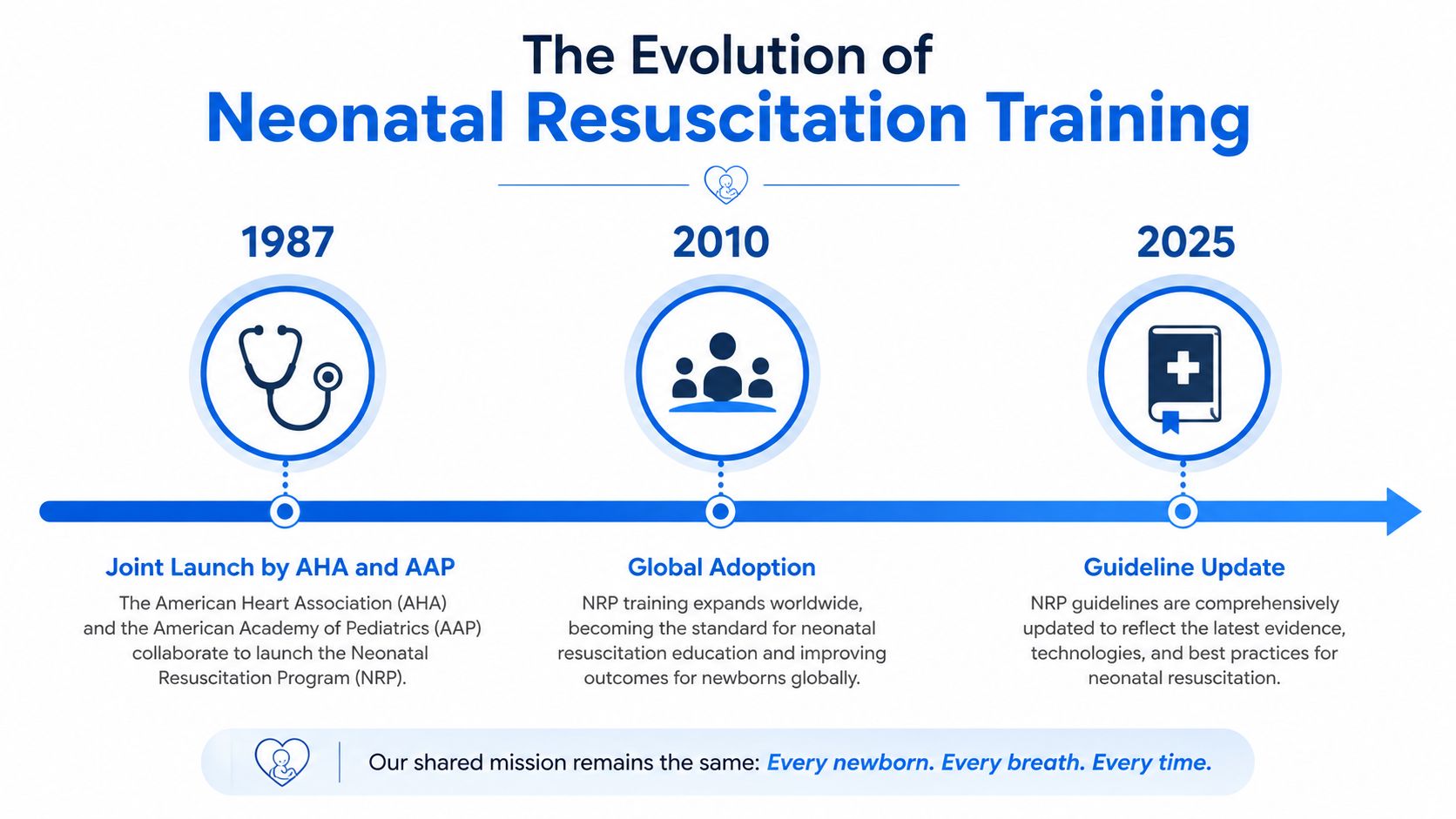
The modern Neonatal Resuscitation Program began in 1987, when the American Academy of Pediatrics established the program to address the growing need for structured newborn resuscitation training. Within one year, it had expanded to 48 U.S. states and Canada, with 184 National Faculty members and 876 hospital-based instructors, according to the AAP account of NRP history.
The story started earlier. A formal Neonatal Education Program developed at the Drew Postgraduate Medical School in Los Angeles in the mid-1970s. That foundation shows that neonatal resuscitation education evolved over more than a decade before NRP launched. The field grew because delivery-room teams needed more than individual experience. They needed shared terminology, defined roles, and a sequence that could be practiced before an emergency occurred.
A living standard instead of a static card
Neonatal resuscitation guidance changes as clinical evidence changes. Updates have addressed issues such as thermal care, delayed cord clamping, oxygen use, airway choices, and the first steps of the algorithm. The 2025 update places greater emphasis on physiologic assessment, earlier pulse oximetry, a reasonable ventilation rate of 30 to 60 breaths per minute, and the option of a laryngeal mask as the primary interface for infants born at 34 weeks or more, as described in the 2025 AHA emergency cardiovascular care highlights.
Course delivery has changed, too. Blended learning now pairs self-paced digital study with instructor-led practice and simulation. That model reflects how clinicians learn best when they can review complex decisions, then apply them under observation.
A neonatal resuscitation course isn't a relic from a textbook. It's a clinical education standard that has been repeatedly revised to match delivery-room needs. For learners, that means checking the version and algorithm used by a course matters as much as checking the certificate it issues.
What a Neonatal Resuscitation Course Actually Covers
A delivery-room resuscitation team works much like a pit crew. One person assesses the newborn, another manages the airway, another tracks time and heart rate, and someone else prepares equipment or medications. The goal isn't speed for its own sake. The goal is coordinated action in the correct sequence.
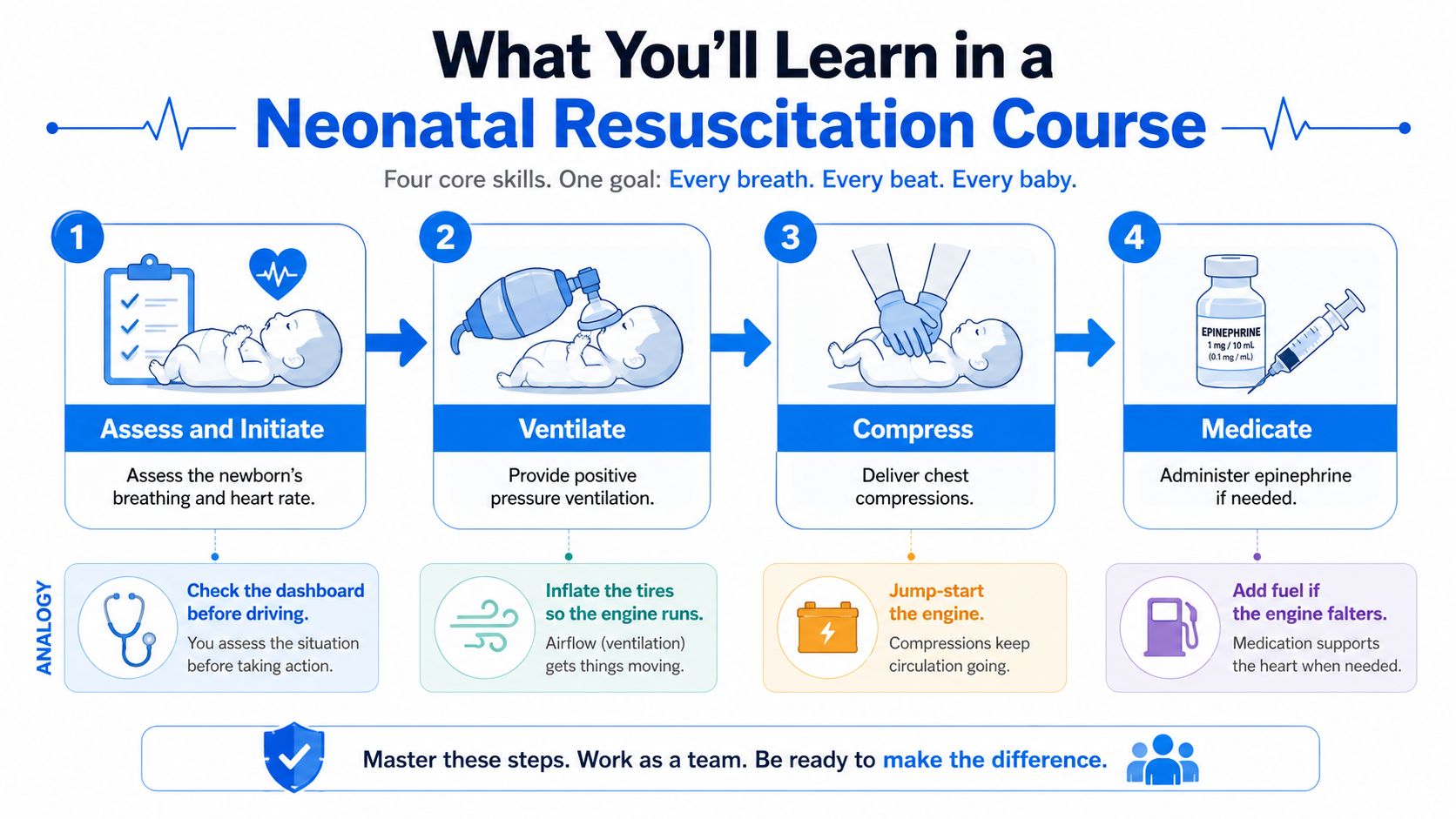
A modern course generally organizes learning around four connected blocks.
Preparing before the birth
Preparation starts before the newborn arrives. Learners review equipment checks, team briefing, role assignment, thermal regulation, and communication. The team should know who will manage ventilation, who will monitor the heart rate, who will document, and who will obtain additional equipment.
The course also addresses special circumstances, including prematurity, meconium, delayed cord clamping, and anticipated airway difficulty. These topics help clinicians avoid improvising when the birth carries known risks.
Assessing and choosing the next step
The initial assessment asks whether the newborn is term, has good tone, and is breathing or crying. If the newborn is vigorous, routine care may continue. If not, the team moves through warming, drying, positioning, stimulation, and reassessment.
When respiratory effort is inadequate or the heart rate is below 100 beats per minute, positive-pressure ventilation becomes the critical intervention. Term infants generally begin with 21% oxygen, while preterm infants under 35 weeks' gestation generally begin with 21% to 30% oxygen, based on the neonatal resuscitation review in PMC.
Ventilating, compressing, and medicating
Learners practice mask placement, airway positioning, oxygen titration, and troubleshooting ineffective ventilation. They also review intubation and supraglottic airways, including the 2025 option of a laryngeal mask as a primary interface for eligible infants.
If effective ventilation doesn't raise the heart rate and it remains below 60 beats per minute, chest compressions are added with a coordinated 3 to 1 compression-to-ventilation ratio. The course may then cover vascular access, epinephrine dosing, reassessment, and post-resuscitation care.
Practicing as a team
Manikins, scenario simulations, and Megacode-style cases turn the algorithm into observable behavior. You'll practice closed-loop communication, time calls, equipment handoffs, and decisions under pressure.
For a plain-language overview of the clinical process, see what neonatal resuscitation means. Learners considering a Neonatal Resuscitation Certification can use the course format to review material, complete the exam, and receive a card in as quick as one hour or less, according to the catalog description.
Here's a short visual explanation of the core sequence:
The knowledge domains don't change because a learner studies online. The important question is whether the course gives you meaningful practice, feedback, and a reliable way to verify hands-on performance.
Online vs In-Person Neonatal Resuscitation Course Options
The online-versus-classroom debate becomes clearer when you compare the features that affect working clinicians. In-person instruction offers immediate access to a manikin and a live instructor. Online learning gives you control over timing, repetition, and location. Neither format automatically guarantees quality.
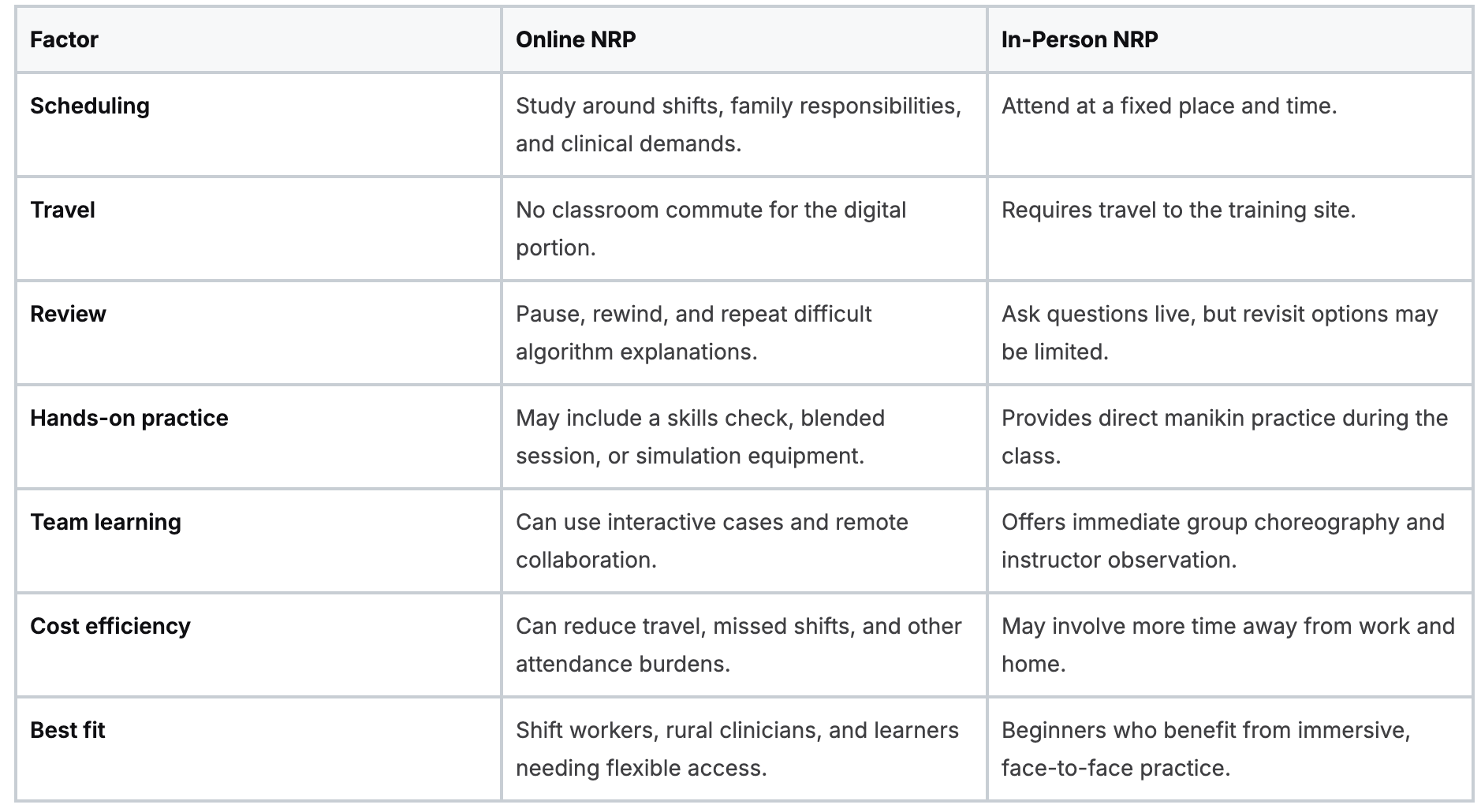
Online study works particularly well when your schedule is unpredictable. You can pause after a night shift, repeat an oxygen-titration module, or revisit airway troubleshooting without waiting for the next classroom date. That flexibility removes barriers that have little to do with clinical competence.
In-person training still has a clear strength: tactile practice with a manikin and immediate feedback. A new delivery-room clinician may value seeing how an experienced instructor corrects mask seal, head position, ventilation technique, and team communication.
The strongest online options address that limitation instead of ignoring it. Some use blended designs with a short skills check, local practice, or simulation equipment. Others focus on interactive decision-making and structured assessment. Online CE and certification are valid and increasingly accepted when the course meets the institution's requirements.
For working clinicians, a well-built online neonatal resuscitation course can equal or exceed classroom training on flexibility, time efficiency, review access, and practical usability. Format is less important than design, verification, and continued practice.
Why Online Neonatal Resuscitation Training Works Just as Well
Online healthcare education works because learning quality depends on instructional design, not on a classroom wall. A strong digital course can show an algorithm, ask you to make a decision, explain the consequence, and let you repeat the scenario until the sequence becomes familiar.
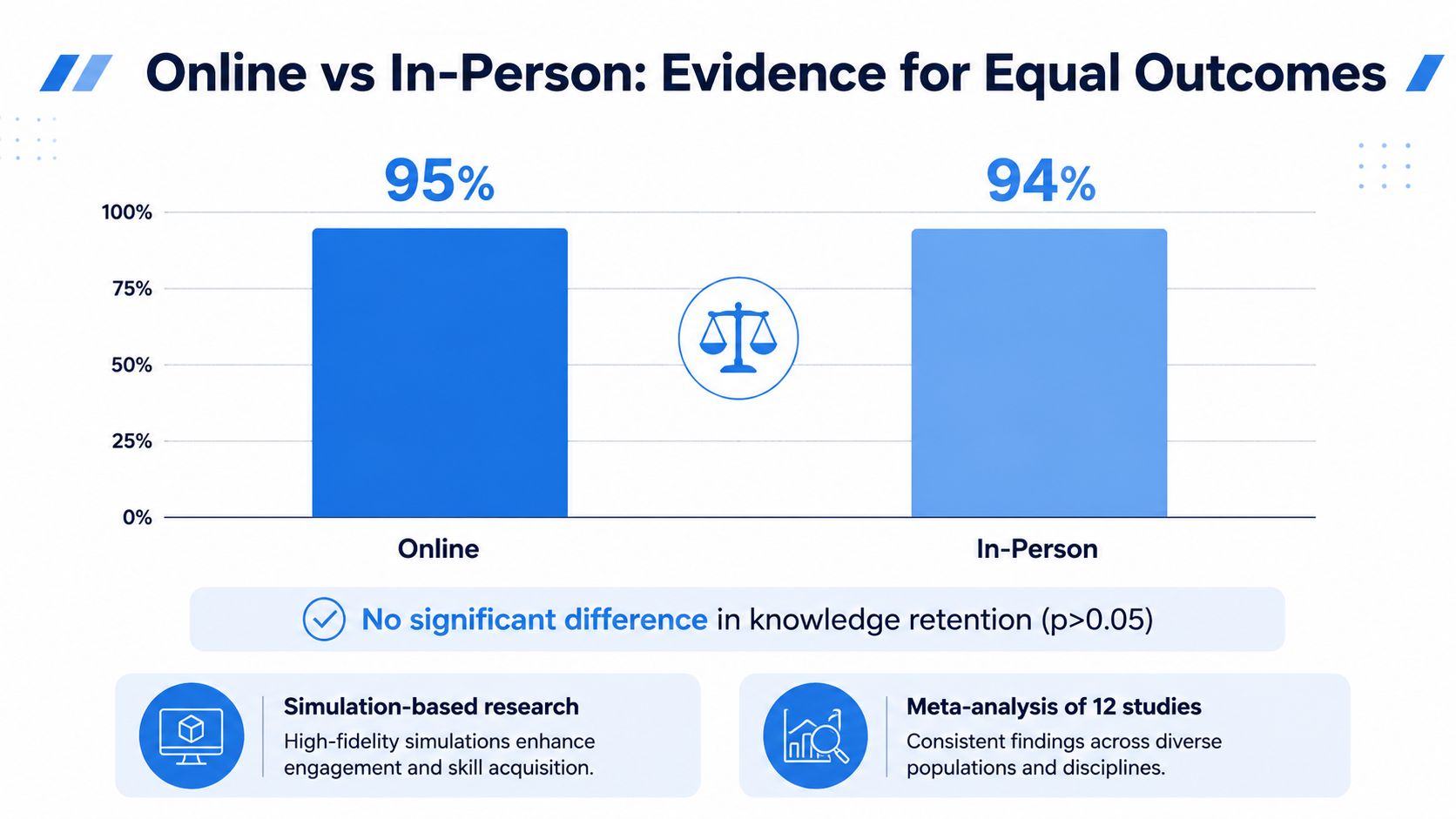
Evidence across healthcare continuing education supports that position. A systematic review of randomized trials included 15 eligible studies. Among six studies comparing electronic continuing education with no intervention or placebo, four showed a statistically significant advantage for electronic education, while two showed no significant effect. The review reported that positive effects on knowledge lasted up to 12 months, and effects on practice lasted up to 5 months, according to the PubMed review of electronic continuing education.
A controlled trial of 48 internet CME activities involving more than 100,000 physicians reported an average effect size of 0.75 and a 45% increased likelihood that participants selected evidence-based answers on clinical case vignettes compared with non-participants. Interactive case-based activities showed a 51% increased likelihood, compared with 40% for text-based updates.
What simulation adds
Neonatal resuscitation requires more than factual recall. You need to recognize a changing heart rate, create an effective mask seal, coordinate ventilation, and communicate clearly. Simulation research supports repeated practice as a way to improve those behaviors.
A systematic review found that high-fidelity simulation produced a large improvement in skill performance, with an SMD of 1.63 and a 95% confidence interval of 0.49 to 2.77, plus a moderate improvement in knowledge, with an SMD of 0.69 and a 95% confidence interval of 0.42 to 0.96, according to the systematic review of neonatal resuscitation simulation.
That same evidence base describes an observational workflow improvement after enhanced simulator training and local champions. Median time to first ventilation fell from 118 seconds to 101 seconds, while ventilation pauses fell from 28% to 16%. The result also showed why training must continue, only 16% of newborns still received ventilation within the first minute.
Online learning supports the cognitive side of this work through branching cases, video demonstrations, timed checks, and repeatable review. Blended learning can add the psychomotor side through a skills session or simulation kit.
For a broader discussion of the changing certification requirements, read online medical certification versus in-person learning. The credible default is no longer “classroom only.” It's education that gives you current knowledge, realistic decisions, observable skills, and a plan for reinforcement.
Acceptance, Accreditation, and How Long Skills Really Last
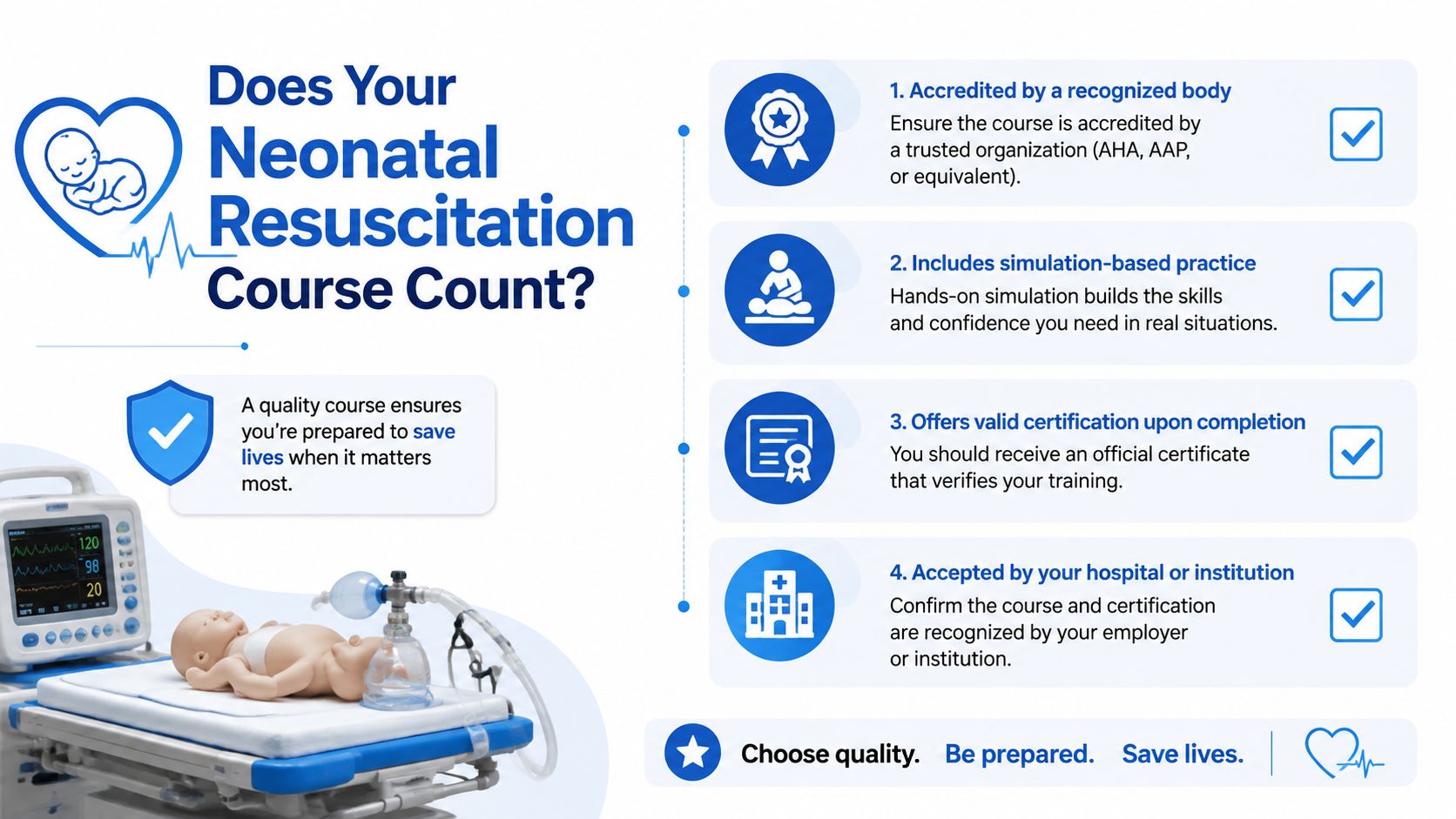
The idea that only AHA or Red Cross in-person classes count is outdated. Those organizations are important providers, but they aren't the only possible route to accepted healthcare education. Your hospital, credentialing committee, licensing body, or clinical manager may set specific requirements, so acceptance should be verified before payment or enrollment.
Accreditation is not a decorative badge. It indicates that an organization or course follows defined standards for education, assessment, documentation, or continuing education. A course can be convenient and still require careful review.
Four checks before you enroll
Look for these markers in the course description and completion documents:
- Current guideline alignment: The content should reflect the current neonatal resuscitation algorithm, including relevant 2025 changes.
- Verifiable documentation: The provider should issue a certificate or card that an employer can confirm.
- Clear skills verification: The course should explain whether hands-on performance is assessed online, during a skills session, or through a blended pathway.
- Institutional acceptance: Ask your employer or credentialing office whether the provider and format meet its policy.
The certificate itself isn't the same as readiness. Observational evidence cited in the 2025 European Resuscitation Council neonatal life support guidance indicates that technical skills can decay within 3 to 6 months, and specific ventilation skills may need refreshers every 1.5 to 4.5 months, depending on the task. The 2025 ERC neonatal life support guidance distinguishes knowledge retention from hands-on performance, which is why annual retraining may be too sparse for some skills.
Build practice into your calendar
Treat the course card as a starting point. Schedule a refresher around six months, use short micro-simulation drills between formal certifications, and practice mask seal, airway positioning, ventilation, and team communication during local training opportunities.
If your role also requires advanced cardiovascular response training, ACLS Certification is described by ProMed as an online course that can be completed on your schedule, with an exam and card available in as quick as one hour or less.
For renewal planning, see neonatal resuscitation program renewal. An accredited online neonatal resuscitation course can meet the same acceptance expectations as classroom training when your employer approves it and you maintain the practical skills that the certificate alone cannot preserve.
Choosing the Right Neonatal Resuscitation Course for You
Start with a short self-audit. Your answer should reflect your clinical reality, not a generic preference for online or classroom learning.
Ask yourself:
- Where might I resuscitate a newborn? Labor and delivery, NICU, emergency care, transport, and well-baby settings create different practice needs.
- How often do I work predictable hours? A fixed classroom may suit a regular schedule. A self-paced course may be more realistic around rotating shifts.
- Have I performed newborn ventilation before? Experienced clinicians may need focused renewal. First-time learners should look for stronger simulation and feedback.
- What does my employer require? Confirm the provider, documentation, course version, and skills-validation pathway before enrolling.
Check the 2025 content
A current course should address physiologic assessment, earlier pulse oximetry, ventilation at 30 to 60 breaths per minute, and the laryngeal mask option for infants born at 34 weeks or more, where applicable. It should also teach the core priority clearly: effective ventilation comes before compressions when the newborn has inadequate breathing or a heart rate below 100 beats per minute.
Compare the learning experience
Look beyond “online” or “in person.” Examine whether the course includes:
- Interactive decisions: You should make choices, not only read slides.
- Algorithm review: Complex steps should be explainable and repeatable.
- Skills verification: The course should state how practical performance is assessed.
- Assessment transparency: You should understand the exam process and documentation.
- Renewal support: Reminders and refresher guidance can help prevent avoidable lapses.
ProMed's neonatal resuscitation offering is listed as 100% online. Its catalog description says learners can complete review material, take the exam, and receive a card in as quick as one hour or less. That format may suit clinicians who need flexible access, but employer acceptance and any required hands-on component should still be confirmed before enrollment.
Use this five-minute decision checklist:
- Current: Does the course reflect the 2025 update?
- Accepted: Will your hospital or credentialing office accept it?
- Practical: Does it include meaningful skills verification?
- Flexible: Can you complete it around your shifts?
- Sustainable: Does it support refreshers after completion?
A neonatal resuscitation course should make you more prepared, not just more documented. Choose the option that combines current guidance, credible verification, realistic practice, and a schedule you can maintain.
ProMed Certifications offers an online Neonatal Resuscitation Certification pathway for healthcare professionals who need a flexible way to review the material, complete the exam, and receive documentation. Visit ProMed Certifications to review the course option and take the next step toward current, accessible neonatal resuscitation education.
.avif)
Stay compliant with ProMed+
Certifications included: ACLS, BLS, PALS, CPR & Neonatal Resuscitation
Unlimited continuing education: over 200 hours of accredited CME
All-inclusive: One price. No surprises.
Get certified today

The Advanced Cardiac Life Support (ACLS) is an accredited online medical certification course that teaches medical professionals to respond to nearly all cardiopulmonary emergencies.

The Pediatric Advanced Life Support (PALS) Recertification instructs medical professionals on performing pediatric cardiopulmonary resuscitation in emergencies.

The Basic Life Support (BLS) Recertification is intended to teach healthcare professionals the basic steps of CPR and rescue breathing for adults, children, and infants.

Our online medical certification course for CPR, Automated External Defibrillator (AED), and First Aid is designed to teach adult, child, and infant CPR and AED use.

The Neonatal Resuscitation Certification trains medical professionals in performing resuscitation procedures and life-saving techniques for newborns at the time of delivery.

.png)
.png)
.png)