


Top 10 Magazines on Nursing for 2026
You’re busy enough keeping patients safe. So why does staying current still feel like a second job?
That’s the gap many nurses run into. There’s no shortage of magazines on nursing, journals, newsletters, and alerts. The challenge is choosing a few that help you grow, instead of adding more tabs to your browser and more guilt to your week. If you’ve ever saved an article “for later” and never returned to it, you’re not the issue. Your system is.
The good news is that you don’t need to read everything. You need the right mix. A broad publication can keep you aware of the profession. A specialty journal can sharpen your clinical judgment. A leadership or education title can help you move into your next role. Then, when you’re ready to turn insight into action, accredited online CE helps you document what you’ve learned without needing to sit in a classroom on your day off.
That last point matters. Quality education isn’t tied to a physical room anymore. Many healthcare professionals and institutions now recognize accredited online CE and certification pathways as practical, rigorous, and professionally valid. The old idea that only in-person options from a small set of organizations count is outdated. Nurses need flexible learning that fits real schedules, and modern online platforms deliver that without lowering standards.
Below are 10 strong magazines on nursing, plus a simple way to use each one strategically for career growth. Think of them less like casual reading and more like tools in a professional toolkit.
1. American Nurse Journal
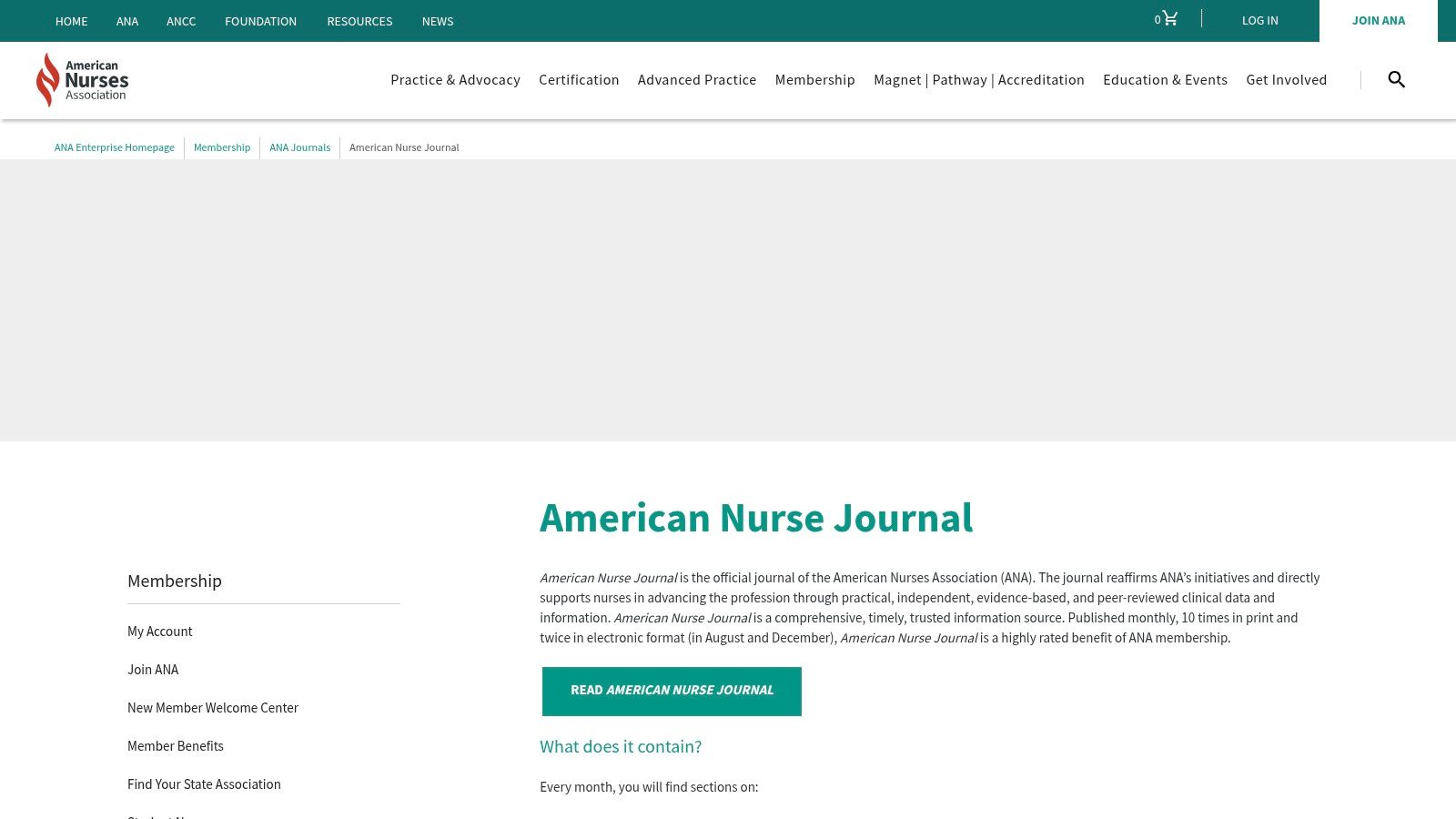
What should you read if you want one publication that keeps you oriented without burying you in specialty detail? American Nurse Journal is a strong starting point because it reflects the day-to-day realities of nursing while also showing the bigger professional picture.
It works well for nurses who want context before depth. You might be caring for patients in med-surg, working in ambulatory care, teaching students, or stepping into management. In each of those roles, you need more than isolated tips. You need a reliable way to notice what the profession is talking about, where practice expectations are shifting, and which topics deserve closer study.
Why it works well for general professional growth
Because the journal is connected to the American Nurses Association, it often helps readers connect bedside care with larger professional issues such as advocacy, staffing concerns, and policy. That matters for career growth. A nurse who understands the wider profession is usually better prepared to join committees, explain practice changes, or choose the next step with intention instead of guesswork.
Its publishing rhythm helps, too. Regular print and digital issues give you a steady stream of reading, which is much easier to use than a pile of random saved articles. A journal like this works like a monthly professional check-in.
Here is a practical way to use it:
- Scan for direction: Read it to identify broad themes shaping nursing across settings.
- Choose one growth track: If an article points you toward a new role or specialty, compare that interest with your own license needs using this guide to nursing continuing education requirements by state.
- Turn reading into proof: Follow up with accredited online CE on the same topic so the article becomes more than inspiration. It becomes documented progress.
That last step is where many nurses build real momentum. Reading shows you where to focus. Online CE lets you study that topic on your own schedule and earn credit in a format that employers, licensing boards, and healthcare organizations now widely accept as a normal professional standard. For busy nurses, that flexibility is not a shortcut. It is a practical way to keep learning going.
One caution is helpful here. American Nurse Journal gives you range more than specialty depth. If you need detailed ICU protocols, emergency care updates, or oncology-specific evidence, you will probably pair it with a narrower title later. As a professional home base, though, it gives you a clear map before you start choosing side roads.
2. AJN The American Journal of Nursing
Some magazines on nursing are quick reads. AJN The American Journal of Nursing isn’t built that way, and that’s part of its value.
AJN has been around since 1900, and it carries that long-standing editorial seriousness into each issue. When you open it, you’re stepping into a publication that serves bedside nurses, advanced practice nurses, and educators who want more than summaries. You get clinical reviews, original research, ethics, legal issues, and professional commentary in one place.
Best for nurses who want depth, not just updates
If American Nurse Journal is like a well-organized briefing, AJN is more like a deeper seminar. It asks for more attention, but it gives more back. That makes it a good fit for nurses preparing for advancement, committee work, evidence-based practice projects, or state licensure planning.
One practical use is tying AJN reading to your renewal calendar. Read an article on a topic connected to your license, then check your own requirements using this guide to nursing continuing education requirements by state. That turns “I should stay current” into a concrete workflow.
Here’s where AJN shines:
- Clinical range: It covers many patient care environments rather than only one niche.
- Professional relevance: Ethics and legal content can help when policy changes affect your documentation or scope.
- Archive value: Its long-running archive makes it useful when you need context, not just the newest headline.
AJN can feel dense if you only want a quick bedside refresher during a short break. Some full-text content also sits behind a subscription barrier. Still, if you’re trying to become the nurse on your unit who reads beyond the headline, AJN earns its place.
Read AJN when you want to think more carefully, not more quickly.
That’s a different goal, and a worthwhile one.
3. Nursing2025
If your favorite kind of education is practical, visual, and immediately usable, Nursing2025 is easy to like. It’s designed for busy clinicians who need bedside-ready help, not a long academic warm-up.
This is the journal you open when you want a clean refresher on a skill, medication issue, or patient care topic. It tends to feel more like a strong unit in-service than a research seminar. For many nurses, that’s exactly the sweet spot.
A strong bedside companion
Think of Nursing2025 as the “show me how” publication on this list. It’s well suited for staff nurses, preceptors, and anyone who learns best through clear structure and application.
Its value becomes obvious in common situations:
- Skill refreshers: You need a quick review before performing or teaching a procedure.
- Pharmacology support: You want a more approachable update before diving into CE modules.
- Staff education: You’re helping orient a new nurse and need readable material with practical takeaways.
Because it’s clinically oriented and accessible through the LWW and NursingCenter ecosystem, it fits well into modern self-paced learning. That’s important. A lot of nurses no longer have the time or desire to wait for a scheduled classroom session for every competency review. Online education now fills that gap well, especially when it’s accredited, self-paced, and aligned with current clinical standards.
Where it fits in a learning routine
A simple model works well here. Read one Nursing2025 article, identify one gap in confidence, then complete a related online CE lesson or certification review from home. That pairing is efficient because the reading gives context and the online training gives structure.
Its tradeoff is that it usually won’t offer the same research depth as more academic journals. But that’s not a flaw. It’s a design choice. For bedside relevance, it’s one of the more approachable magazines on nursing available today.
4. Critical Care Nurse
What do you read when a patient’s condition can change in minutes, and small details shape the next decision? Critical Care Nurse is built for that kind of practice.
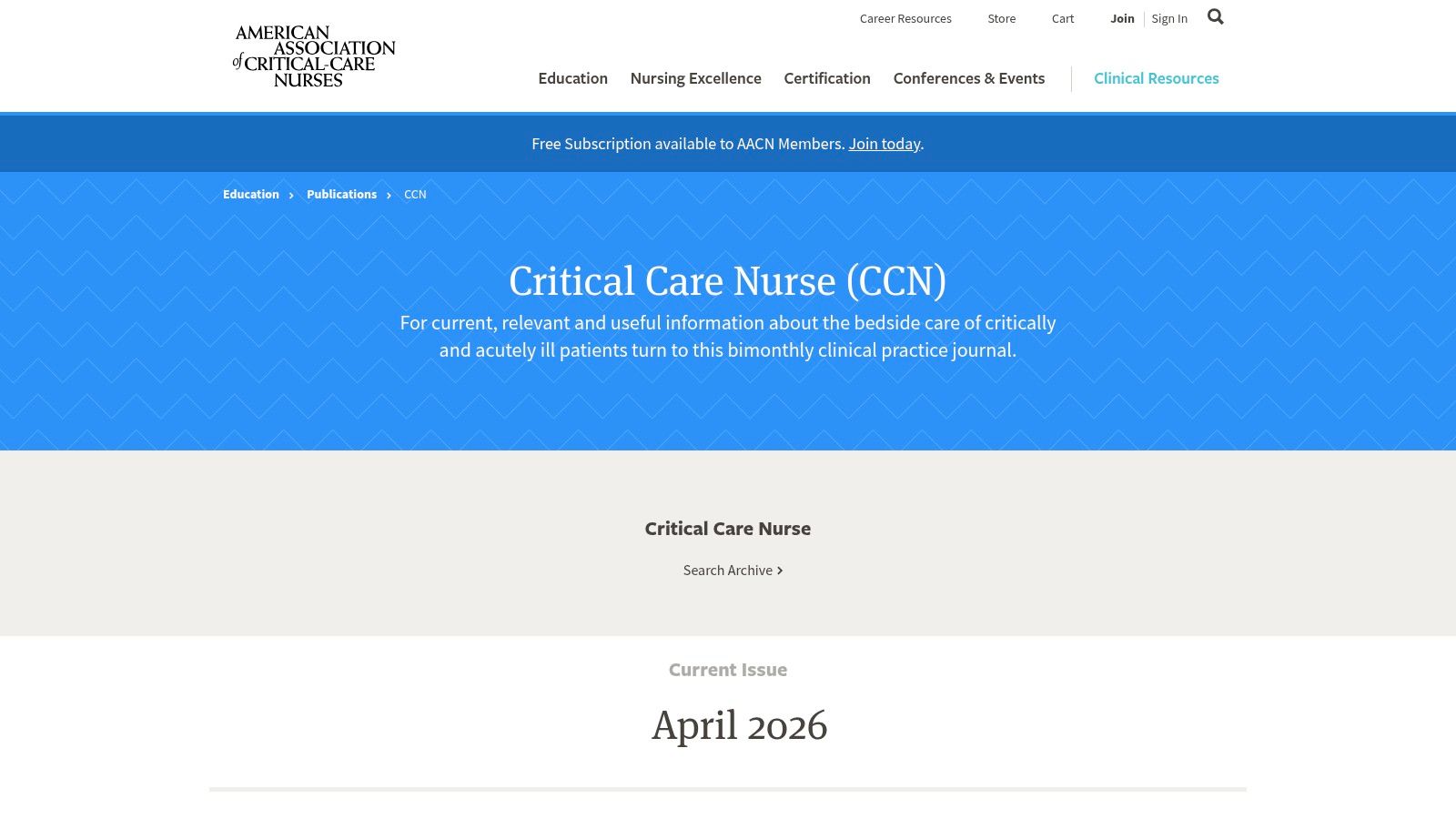
Published by the American Association of Critical-Care Nurses, it centers on bedside care for acutely and critically ill patients. That focus makes it a strong fit for ICU nurses, progressive care nurses, and ED nurses who regularly care for unstable patients.
Why this journal earns a place in a career-growth plan
Broad nursing magazines help you stay informed. Critical care practice asks for something narrower and more precise. You are often managing multiple signals at once, including hemodynamics, sedation, ventilation, and family communication under stress. A specialty journal helps organize that complexity the way a good monitor organizes vital signs. It does not replace judgment. It helps you sharpen it.
Its real value shows up in how you use it. Read one article to update your understanding of a high-risk topic. Then pair that reading with a focused online learning step at home, such as AACN education, certification review, or a refresher on what BLS certification covers for frontline clinicians. That combination works well because the article gives clinical context, while online CE gives you structure, flexibility, and documented progress.
That matters more than it used to. Many nurses build skills in shorter, repeatable sessions instead of waiting for a scheduled in-person class. Accredited online education is now a widely accepted standard because it fits real work schedules and still supports current competency expectations.
Best use case
Use this journal if you want to:
- Improve pattern recognition: Articles can help you connect assessment findings with likely next steps before a situation escalates.
- Support specialty certification goals: It fits naturally with AACN learning pathways and exam preparation.
- Teach more effectively on the unit: Case-based content can give preceptors and charge nurses solid material for debriefs, huddles, and informal teaching.
The tradeoff is clear. If you do not practice in high-acuity settings, much of the content may feel too specialized. For critical care nurses, that specialization is the advantage.
5. Journal of Emergency Nursing
Emergency nursing has its own tempo. You triage fast, reprioritize constantly, and work in a setting where “routine” can flip in seconds. That’s why Journal of Emergency Nursing deserves a place on this list.
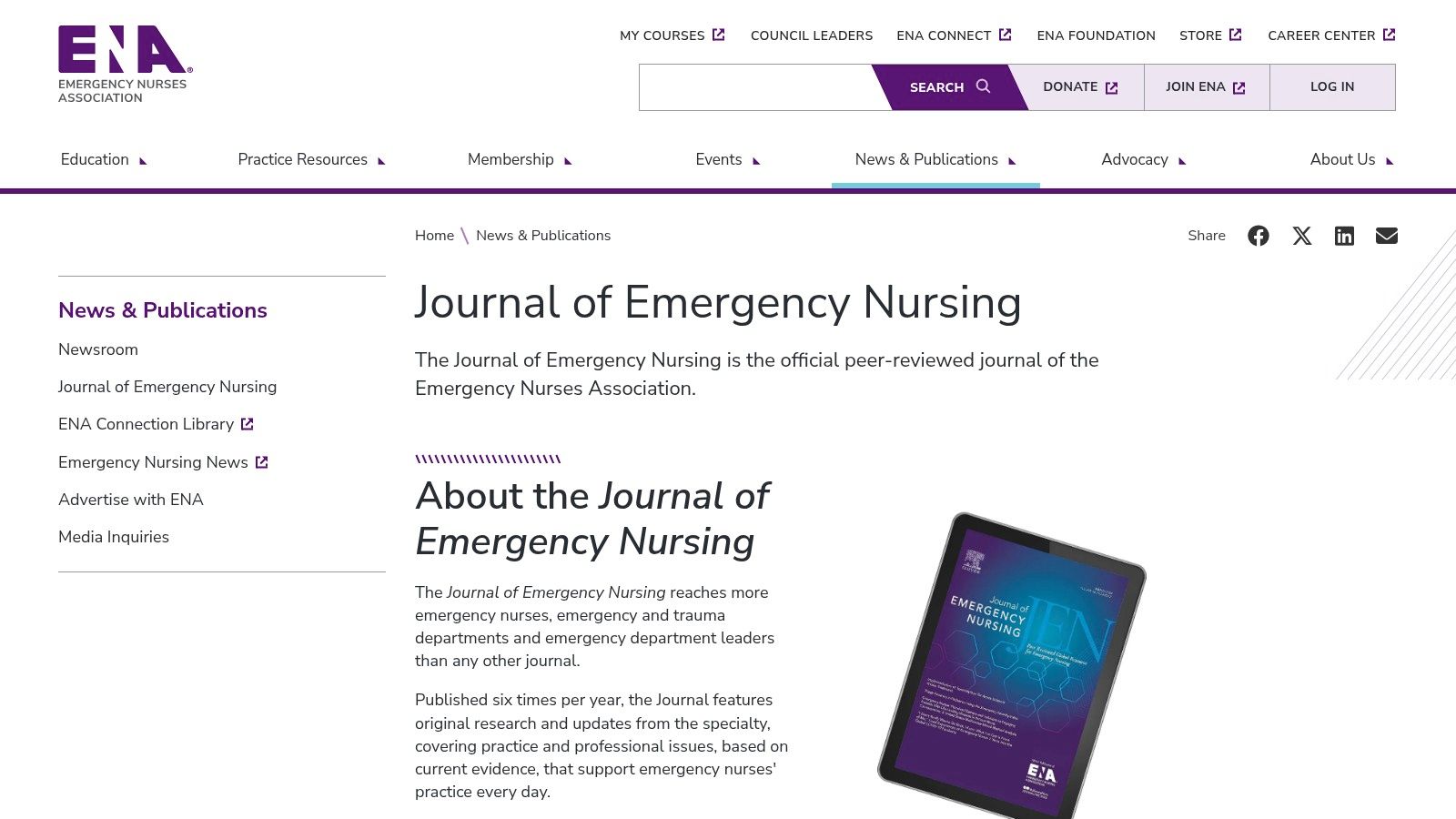
As the official journal of the Emergency Nurses Association, it focuses on the concerns that shape real ED practice, including trauma, pediatrics, triage, disaster readiness, and emergency care operations. It serves staff nurses, educators, and leaders who need specialty-specific reading that still connects to daily work.
A practical fit for fast-moving environments
Some publications are valuable because they make you slow down and reflect. This one is valuable because it helps you think clearly in a fast system. If you’re in the ED, that’s a major distinction.
The journal’s close connection with ENA education also helps. Research articles and practice pieces don’t sit in isolation. They can feed directly into competency review, unit education, and certification planning.
In emergency care, useful reading isn’t reading you admire. It’s reading you apply on your next shift.
That’s where this title stands out. It’s especially helpful for nurses who want their professional reading to map directly onto what happens at the bedside, in triage, or during surge planning.
Its limitation is predictably the same as most association-based specialty titles. Non-members may hit paywalls, and nurses outside emergency practice may not need that level of ED-specific focus. But if emergency care is your lane, this journal is a strong professional companion.
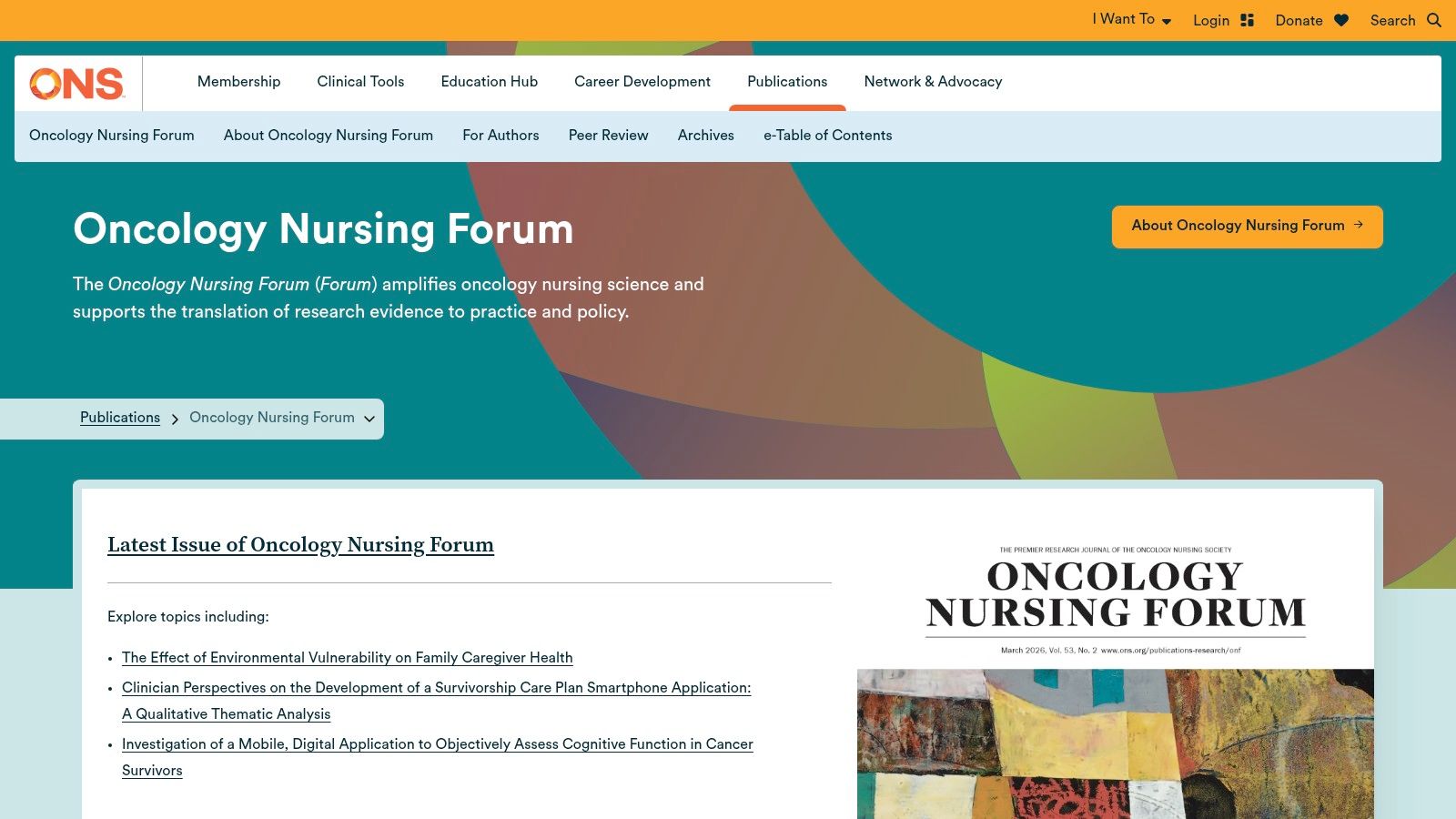
6. Oncology Nursing Forum
Oncology nursing asks for precision, endurance, and strong communication. Patients often move through diagnosis, treatment, symptom management, survivorship, or end-of-life care over long periods, and nurses support each stage. Oncology Nursing Forum matches that complexity well.
This journal, published by the Oncology Nursing Society, is research-focused and clinically grounded. It’s useful for infusion nurses, inpatient oncology teams, outpatient clinics, navigators, and survivorship programs that need specialty evidence rather than broad summaries.
Where it adds the most value
The best oncology reading helps you connect science with patient-centered care. That means symptom management, treatment education, communication, and long-term support all matter. If you want a broader companion resource on that side of care delivery.
A major bibliometric analysis of the top 1,000 most-cited nursing articles found that literature reviews made up 21% of those highly cited works, compared with 7% in the broader nursing literature, according to the PubMed Central analysis of nursing’s top-cited articles. That matters in oncology because synthesis is often what clinicians need most. You don’t always need ten separate studies. You need a trustworthy interpretation you can use in practice.
Good for specialist growth
This journal works especially well if you’re trying to:
- Deepen specialty identity: Useful when oncology is becoming your long-term focus.
- Support patient teaching: Strong evidence helps you explain treatment and side effects more confidently.
- Guide quality improvement: Research-based articles can inform survivorship and symptom management initiatives.
Outside oncology, its usefulness drops quickly. Inside oncology, it’s one of the strongest magazines on nursing for evidence-informed specialty growth.
7. Nurse Educator
How do you get better at teaching when your job already asks you to care, document, coach, and adapt all at once? Nurse Educator helps answer that question by focusing on how nurses learn, teach, assess, and retain knowledge.
That focus gives it a different role from a bedside practice journal. It serves the nurse who builds orientation, refines simulation, improves clinical instruction, or wants to teach more clearly in everyday practice. Faculty can use it to strengthen curriculum and evaluation. Hospital educators can use it to shape onboarding, competency review, and preceptor development.
Teaching skill changes patient care in an indirect but powerful way. A good educator works like a multiplier. One well-designed learning experience can improve how dozens of nurses assess, communicate, and respond on the floor.
That is also why this journal fits so well with online continuing education. Modern nursing education now includes self-paced modules, virtual discussion, simulation design, and blended learning models. For working nurses, that format is often more realistic than trying to fit every course into a classroom schedule. It also reflects a broader shift in professional education. Online CE is no longer a shortcut or a second-tier option. When it is accredited, current, and thoughtfully designed, it is a standard way to build and maintain competence.
Best for nurses who build learning
Nurse Educator is especially useful if your work includes creating or improving learning experiences:
- Clinical educators: Use it to improve orientation, annual competencies, and unit-based teaching plans.
- Faculty members: Useful for course design, student assessment, and teaching strategy.
- Preceptors and charge nurses: Helpful if you want a clearer method for coaching newer nurses at the bedside.
Its limitation is straightforward. Nurses looking mainly for disease-specific updates may find it too focused on instruction. Nurses who want to grow into educator, preceptor, or staff development roles will likely find it one of the most practical magazines on nursing for long-term career growth.
8. Journal of Hospice and Palliative Nursing
Few areas of nursing require more communication skill than hospice and palliative care. Clinical judgment matters, but so do timing, language, family support, and symptom relief. Journal of Hospice and Palliative Nursing addresses that blend well.
This journal supports nurses who work in hospice, palliative consult services, home care, oncology crossover roles, and settings where serious illness care is part of everyday practice. Its content often reflects the true complexity of caring for people whose goals, symptoms, and family needs may shift over time.
Strong for whole-person care
A good palliative nurse needs more than technical knowledge. You need frameworks for communication, quality improvement, and interdisciplinary care. This journal is valuable because it treats those as central skills, not side topics.
That makes it especially useful for nurses who want their reading to support both practice and presence. It can also pair well with online CE, because many nurses in palliative and hospice roles need flexible education they can complete around emotionally demanding schedules. Self-paced study is often the more humane format, and it’s fully compatible with high standards when the content is accredited and well designed.
Good palliative reading helps you do two things at once. Improve symptom care and improve how you walk with patients through difficult decisions.
Its main limitation is scope. If serious illness care isn’t a meaningful part of your work, this journal may feel too specialized. But for the nurses who need it, it offers a rare combination of evidence, compassion, and practical application.
9. Nurse Leader
What changes when your patient assignment becomes a unit, a budget, or a staffing plan? Nurse Leader is built for that shift.
This publication focuses on the part of nursing work that sits above any single patient encounter. You will see articles on workforce strategy, finance, policy, quality, operations, and new technology. For charge nurses preparing for the next role, new managers learning fast, or directors responsible for outcomes across teams, that focus matters.
Clinical journals teach you how to care for the patient in front of you. A leadership journal helps you understand the system around that care. It works like switching from a bedside lamp to the room lights. You still need the close view, but you also need to see staffing patterns, turnover risks, budget pressure, and organizational priorities at the same time.
That wider view is what makes Nurse Leader useful for career growth.
It can also help you use continuing education more strategically. If a magazine article shows you a gap in budgeting, quality improvement, conflict management, or retention planning, you can follow it with online CE in that exact topic. That pairing is practical for working nurses because self-paced online learning is now a widely accepted standard, especially when the course is accredited and designed for professional practice. In other words, the journal helps you spot what to learn next, and flexible CE helps you build that skill on your schedule.
Best for nurses who influence people, process, and outcomes
Nurse Leader is especially useful for:
- Managers and directors: Articles often connect staffing, retention, finance, and quality in ways that support day-to-day decisions
- Aspiring leaders: It helps you learn the language of administration before you are fully responsible for it
- Committee chairs and nurse educators: It gives context for why organizational decisions shape workflow, policy, and culture
The limitation is straightforward. If you want hands-on clinical instruction, this will not be your first stop. If your role includes guiding teams, improving systems, or preparing for leadership, it becomes a smart regular read.
10. Minority Nurse Magazine
Where do you turn when you need career direction, representation, and practical encouragement, not another dense research paper? Minority Nurse Magazine fills that role well.
This digital publication centers on diversity, equity, career pathways, scholarships, and workforce issues affecting nurses from underrepresented backgrounds. It is free to subscribe to and easy to share, which makes it useful for individual nurses, faculty, mentors, and hiring teams.
Why it earns a place in a smart learning plan
A strong professional reading list should not function like a single textbook. It should work more like a well-stocked clinical bag. One resource helps you sharpen clinical judgment. Another helps you understand systems, opportunities, and barriers that shape a nursing career over time.
That is where Minority Nurse adds value. It helps readers see real career routes, hear from nurses with similar backgrounds, and find opportunities that might otherwise stay hidden. For a student or early-career nurse, that kind of guidance can change what feels possible. For leaders and educators, it offers a clearer view of how representation, support, and access affect recruitment and retention.
It also pairs well with online continuing education. A magazine article may help you identify a gap in cultural competence, health equity, communication, or leadership confidence. Then accredited, self-paced online CE lets you build that skill on your own schedule. That combination works well because online learning is now a widely accepted standard for working nurses who need flexibility without giving up quality.
Best use of this magazine
Minority Nurse is especially useful for:
- Students and early-career nurses: Career stories, scholarship information, and mentorship-focused content can make the profession feel more approachable
- Nurse educators and mentors: Articles can spark discussion about representation, belonging, and professional identity
- Recruiters and leaders: The publication gives practical perspective on workforce inclusion and long-term retention
Its role is clear. Minority Nurse is not a substitute for peer-reviewed clinical journals. It is a career development resource that helps complete the picture. Used alongside specialty journals and accredited online CE, it can help nurses build both competence and confidence.
Top 10 Nursing Magazines Comparison
.png)
Build Your Lifelong Learning Toolkit
What if the smartest way to keep up with nursing is not reading more, but reading with a plan?
Each publication in this guide can play a different role in your growth. One helps you track the profession at a high level. Another keeps your specialty knowledge sharp. A third supports the direction you want your career to take, whether that means teaching, leadership, advocacy, or a new clinical focus. Once you assign each magazine a job, professional reading feels less like a pile of tabs and more like a well-packed clinical bag.
A simple system works well for many nurses. Choose one broad publication, one specialty publication, and one career-focused resource. That gives you three working lenses: what is changing across nursing, what matters in your practice area, and what skills you want to build next.
The goal is not to read everything. The goal is to create a rhythm you can keep.
That rhythm also protects your attention. Nurses already sort through policy updates, unit changes, charting demands, and patient care decisions. Adding random article reading on top of that can feel like trying to drink from a fire hose. A small, repeatable toolkit helps you focus on what supports safer practice, license renewal, certification goals, and long-term career progress.
Online CE fits naturally into that system. Journal reading often gives you the reason a topic matters. Accredited online education helps you apply it, document it, and turn interest into action. Used together, they form a practical workflow instead of two separate chores competing for your time.
That pairing matters because nursing knowledge has expanded for decades, and the profession now expects clinicians to keep learning in ways that match real working lives. As noted earlier, nursing scholarship has a long history and a deep evidence base. The challenge for working nurses is not whether good information exists. The challenge is accessing it in a format that fits twelve-hour shifts, family responsibilities, rotating schedules, and mental fatigue after demanding clinical days.
Online learning solves part of that problem because it gives you control. You can review material at 6 a.m. before a shift, revisit a module after your kids are asleep, or complete a certification update on a free weekend without waiting for a classroom date. That flexibility is one reason online CE is now widely accepted across healthcare. When the course is accredited, current, and instructionally sound, the format supports the same end point as in-person education: stronger judgment, safer care, and documented progress.
Here is what that looks like in practice. You read a Journal of Emergency Nursing article that reminds you your trauma knowledge needs a refresh. You notice a Nurse Leader piece that makes budgeting and staffing feel less mysterious, so leadership training starts to seem possible instead of distant. You read about symptom management or serious-illness communication and realize you want more confidence in those conversations. In each case, the magazine sparks the question, and online CE gives you a realistic next step.
That is the strategic advantage many nurses miss. Publications help you scan the horizon and spot gaps. Flexible online learning helps you close those gaps while the motivation is still fresh.
If you want a toolkit that lasts, keep the journals that sharpen your thinking and pair them with accredited study options that fit your schedule. That approach turns reading into career growth, not just information collecting. It also makes professional development feel more manageable, because each article can lead to a specific action instead of joining a growing folder you mean to revisit later.
If you’re ready to turn reading into real progress, ProMed Certifications makes it easy to complete accredited CE and certifications online, on your schedule. You can access over 200 hours of nursing CE, earn instant certificates, use automated reporting where available, and add online ACLS, BLS, PALS, CPR, or Neonatal Resuscitation in one flexible system. For busy healthcare professionals, it’s a practical way to stay compliant, current, and confident without putting life on hold.
.avif)
Stay compliant with ProMed+
Certifications included: ACLS, BLS, PALS, CPR & Neonatal Resuscitation
Unlimited continuing education: over 200 hours of accredited CME
All-inclusive: One price. No surprises.
Get certified today

The Advanced Cardiac Life Support (ACLS) is an accredited online medical certification course that teaches medical professionals to respond to nearly all cardiopulmonary emergencies.

The Pediatric Advanced Life Support (PALS) Recertification instructs medical professionals on performing pediatric cardiopulmonary resuscitation in emergencies.

The Basic Life Support (BLS) Recertification is intended to teach healthcare professionals the basic steps of CPR and rescue breathing for adults, children, and infants.

Our online medical certification course for CPR, Automated External Defibrillator (AED), and First Aid is designed to teach adult, child, and infant CPR and AED use.

The Neonatal Resuscitation Certification trains medical professionals in performing resuscitation procedures and life-saving techniques for newborns at the time of delivery.

.png)
.png)
.png)