


A Clinician's Guide to Lidocaine Dose ACLS Protocols

When you're running a code, every second is critical. The correct lidocaine dose for ventricular fibrillation (VF) or pulseless ventricular tachycardia (pVT) starts with an initial IV/IO bolus of 1 to 1.5 mg/kg. If that stubborn arrhythmia persists, you can follow up with a second dose of 0.5 to 0.75 mg/kg, but be careful not to exceed a total of 3 mg/kg. This guide will help you master the specifics so you can act with confidence when it matters most.
Understanding the Lidocaine Dose in ACLS
In the world of Advanced Cardiac Life Support, lidocaine is a workhorse—a crucial second-line antiarrhythmic. You'll typically reach for it when dealing with shock-refractory VF or pVT, making it a key alternative to amiodarone. Its whole job is to stabilize the heart's chaotic electrical activity by blocking sodium channels, which can be just what's needed to terminate a life-threatening rhythm and get things back on track. Think of it like a reset button for the heart's electrical system.
.png)
This medication is a cornerstone of the adult cardiac arrest algorithm, and knowing the proper dosing is completely non-negotiable for any rescuer. According to the ACLS protocols we all work under, that standard dosing begins with an initial intravenous (IV) or intraosseous (IO) push of 1 to 1.5 mg/kg.
If that first dose doesn't get the job done, a smaller second dose of 0.5 to 0.75 mg/kg can be administered. Just remember to keep a running total—the cumulative dose must not go over 3 mg/kg.
To make these numbers easier to recall in a high-stress situation, here’s a quick-reference table.
ACLS Lidocaine Dosing at a Glance (Adult)
This table breaks down the standard weight-based dosing for lidocaine during cardiac arrest (VF/pVT) and for maintenance infusion, per current ACLS guidelines.

Getting these guidelines down cold is absolutely essential for running an effective resuscitation. For busy professionals, staying current with these life-saving protocols is easier than ever. High-quality, accredited online ACLS certification offers the flexibility you need without sacrificing educational quality—a fact increasingly recognized by healthcare institutions nationwide.
Clinical Indications for Lidocaine in Cardiac Arrest
Knowing when to reach for lidocaine is every bit as important as knowing the dose. When you're in the thick of a cardiac arrest, lidocaine acts as a critical second-line antiarrhythmic.
Its main job in ACLS is to manage ventricular fibrillation (VF) or pulseless ventricular tachycardia (pVT) that just won't quit, even after you've delivered shocks and pushed epinephrine. This is what we call shock-refractory VF/pVT. In these high-stakes moments, lidocaine stands as a primary alternative to amiodarone, and some recent studies suggest its outcomes are comparable.
How It Works: The Mechanism Behind the Medication
Lidocaine is a Class Ib antiarrhythmic. The easiest way to think of it is as a stabilizer for a heart that's electrically out of control. It works by blocking sodium channels in the cardiac muscle cells.
This action shortens the action potential duration and dials down the automaticity of ventricular cells. In plain English, it calms the chaotic electrical storm causing VF and pVT. By stabilizing the cardiac membrane, it helps keep these deadly rhythms from coming back.
When you understand the mechanism, you're not just a robot following an algorithm. You gain the clinical foresight to know what to expect, letting you make confident, life-saving calls under extreme pressure.
Beyond Pulseless Rhythms: Broader Applications
While its starring role is in cardiac arrest, lidocaine has other important uses. You can also use it for patients who aren't in cardiac arrest but are dealing with dangerous ventricular arrhythmias.
Specifically, it’s indicated for stable monomorphic ventricular tachycardia with a pulse. In this scenario, your patient is awake and has a blood pressure, but the rhythm is a ticking time bomb. You need to intervene to prevent them from sliding into pVT or VF.
Knowing these different clinical situations is foundational. It ensures you're giving the right drug for the right reason, at the right time. This is the kind of practical, real-world knowledge that accredited online certification courses are designed to provide—fitting top-tier education into the demanding schedules of today's healthcare providers.
Calculating and Administering Lidocaine Doses
Translating ACLS guidelines into real-world action demands precision, especially when you’re pushing meds. Getting the lidocaine dose right isn't just a box to check—it's a critical step that directly impacts your patient's safety and the effectiveness of your intervention. The process all starts with a straightforward, weight-based formula.
For an adult in VF/pVT, the initial bolus dose of lidocaine is 1 to 1.5 mg per kilogram (kg) of body weight. This simple calculation helps tailor the dose to the individual, giving you the best shot at a therapeutic effect while keeping the risks in check.
Weight-Based Calculation Examples
Let's break down what this looks like in practice for a couple of different patients.
- For a 70 kg (154 lb) patient:
- Calculation: 70 kg x 1.5 mg/kg = 105 mg
- You’d administer 105 mg as your initial IV push.
- Calculation: 100 kg x 1.5 mg/kg = 150 mg
- In this case, the initial dose would be 150 mg.
It’s crucial to remember to use the patient's ideal body weight for these calculations, particularly in obese patients. Dosing based on actual weight in this population can easily lead to excessive medication levels and bump up the risk of lidocaine toxicity.
This flowchart quickly lays out the sequence of events where a lidocaine dose fits into the ACLS protocol.
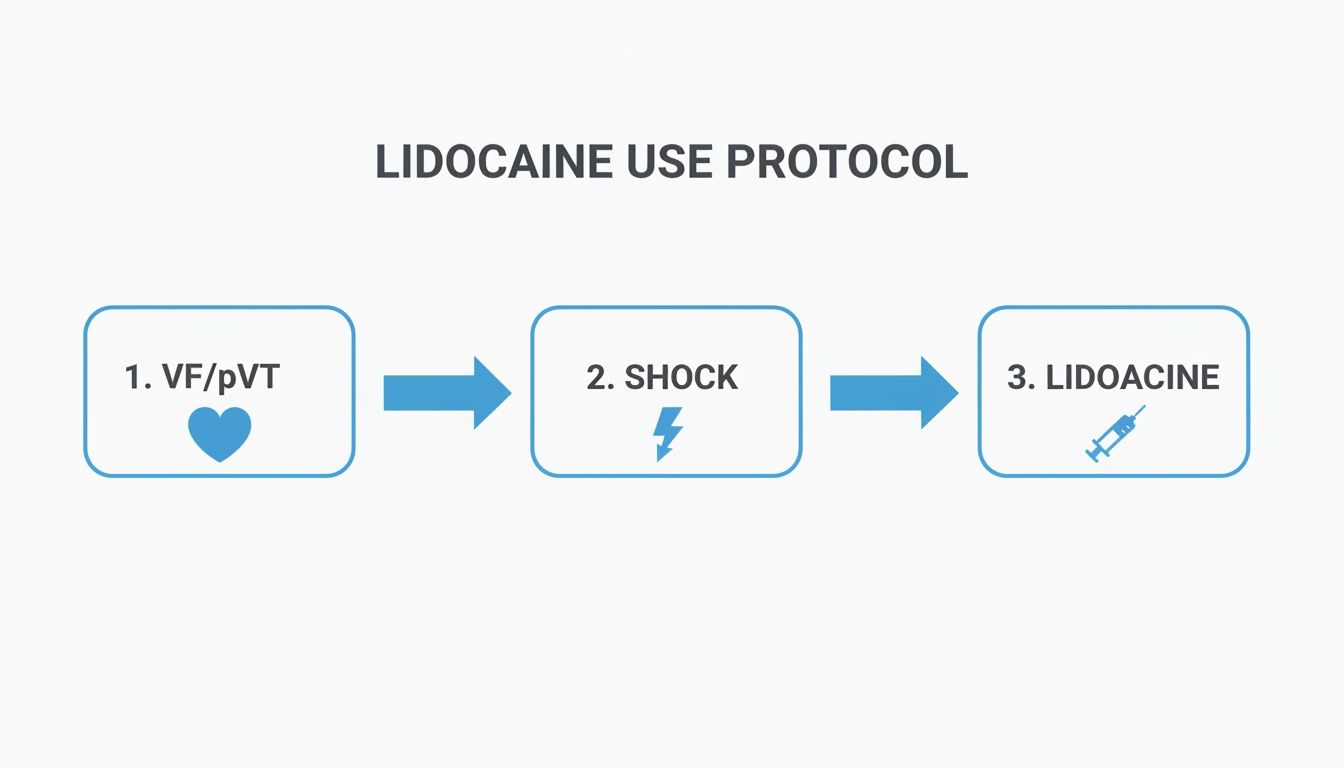
As the visual shows, lidocaine comes into play for shock-refractory VF/pVT, after your initial defibrillation attempts haven't done the trick.
Proper Administration Technique
Once you have the dose calculated, proper administration is everything. You'll typically be drawing the medication from a vial, often at a concentration of 100 mg/5 mL (20 mg/mL).
Example: To get a 105 mg dose from a 20 mg/mL vial, you would divide 105 mg by 20 mg/mL, which gives you 5.25 mL.
After drawing up the correct volume, follow these steps for a safe and effective delivery:
- Push the dose rapidly through the intravenous (IV) or intraosseous (IO) line.
- Immediately follow it with a 20 mL flush of normal saline.
- Elevate the extremity for 10-20 seconds to help the drug hit central circulation faster.
Nailing these steps is essential for any healthcare provider working in emergency settings. To stay sharp, modern, accredited online ACLS courses are a great way to practice these skills and ensure you’re ready for anything. Peer-reviewed studies show these programs deliver equal or superior knowledge retention and patient care outcomes compared to in-person classes, with the added benefit of flexibility for your demanding schedule.
Lidocaine Versus Amiodarone: A Modern Comparison
For years, the debate over using amiodarone or lidocaine for shock-refractory VF/pVT has been a hot topic in ACLS circles. Amiodarone often got top billing as the primary go-to, but that conversation is starting to change. Fresh evidence is putting lidocaine back in the spotlight, reminding us it's a powerful and equally effective alternative.
The real question isn't about which drug is universally "better." It's about which one is the right call for the patient in front of you at that moment. Making that decision means you have to know their distinct profiles inside and out, from how they work to their potential downsides.
A Head-to-Head Look
Amiodarone is a complex drug with a broad mechanism, acting as a potassium, sodium, and calcium channel blocker all at once. Lidocaine, on the other hand, is a more straightforward Class Ib antiarrhythmic that works primarily by blocking sodium channels. This fundamental difference affects everything, including their side effect profiles and how long they stick around in the body.
Thinking through these differences is key to making a sound clinical judgment during a code.
Lidocaine vs Amiodarone for Shock-Refractory VF/pVT

Ultimately, both drugs have their place, but lidocaine’s simpler profile and recent supporting data make it a strong contender.
Evolving Evidence and Clinical Outcomes
The push to reconsider the lidocaine dose in ACLS isn't just based on anecdotal experience; it's backed by some pretty significant research. A landmark 2023 study that looked at in-hospital cardiac arrests found that lidocaine actually had a notable advantage. The data showed that lidocaine patients had 3.3% higher survival to discharge and 3.1% better favorable neurologic outcomes compared to those who received amiodarone.
This growing body of evidence confirms what many seasoned clinicians have seen firsthand: lidocaine is a reliable and effective agent for shutting down ventricular arrhythmias. For a complete overview of amiodarone's role, check out our detailed guide on amiodarone in ACLS.
Mastering the nuances of both medications is a hallmark of an expert rescuer. Staying current with these evolving guidelines is easier than ever. High-quality online ACLS certifications offer the same accredited, guideline-compliant training as traditional classes but with the flexibility that busy professional schedules demand. This ensures you can integrate the latest evidence-based practices into your care, confidently and conveniently.
Setting Up and Managing a Lidocaine Infusion
Getting ROSC (Return of Spontaneous Circulation) is a massive victory, but your work isn't done. The next critical step is often starting a continuous lidocaine infusion to head off any recurring ventricular arrhythmias. This maintenance drip is all about providing a steady, therapeutic level of the drug to keep the heart's rhythm stable.
The standard maintenance lidocaine dose in ACLS is a continuous infusion between 1 to 4 mg per minute. The real goal here is to dial in the lowest effective dose that successfully puts a stop to ectopy and keeps the rhythm in check.
Preparing the Infusion
To get the infusion ready, you'll mix a standard concentration. A very common approach is to add 2 grams (2,000 mg) of lidocaine to a 500 mL bag of D5W (that's 5% Dextrose in Water).
This mix gives you a concentration of 4 mg/mL.
- The Math: 2,000 mg / 500 mL = 4 mg/mL
Once you have this concentration, setting the pump rate becomes much simpler. For instance, to deliver an order for 2 mg/minute, you would program the infusion pump to run at 30 mL/hour.
Pro Tip: Always, always double-check your math with a partner. Then, clearly label the IV bag with the drug name, the final concentration, and all the necessary patient details. It's a simple habit that serves as a crucial safety net.
Dose Adjustments and Monitoring
No two patients are alike, and adjusting the dose is absolutely essential for safety. For certain patient populations, the standard lidocaine dose might be too high and could lead to toxicity if you're not careful.
You'll need to think about reducing the dose for these key groups:
- Patients with hepatic impairment: Lidocaine is metabolized by the liver, so if liver function is poor, the drug can build up to dangerous levels.
- Patients with heart failure or cardiogenic shock: When cardiac output is reduced, drug clearance slows way down, which ramps up the risk of toxicity.
- Patients over 70 years of age: Age-related changes in metabolism and clearance mean a lower dose is often the safer, more effective choice.
While the infusion is running, keep a close watch on the patient’s cardiac rhythm, blood pressure, and neurological status. This constant vigilance is what allows you to catch and manage any adverse effects before they become serious problems.
Recognizing and Managing Lidocaine Toxicity
Lidocaine is a powerful tool in your ACLS toolkit, but it’s one that demands respect. Its therapeutic window is notoriously narrow, meaning the line between an effective dose and a toxic one is incredibly thin. This isn't a drug you can set and forget; constant vigilance is non-negotiable.
Being able to spot the early signs of toxicity is a core competency for any clinician who administers lidocaine.
Toxicity almost always shows up with neurological symptoms first. A great way to remember the classic signs is the mnemonic SAMS:
- Slurred speech
- Altered central nervous system (think confusion, drowsiness, dizziness)
- Muscle twitching
- Seizures
Immediate Actions for Suspected Toxicity
If you even suspect toxicity, you have to act fast. Your initial steps are straightforward but absolutely critical:
- Stop the Infusion: This is the single most important thing you can do. Immediately shut off the lidocaine.
- Provide Supportive Care: Get back to basics. Focus on the patient's airway, breathing, and circulation (the ABCs). Give them supplemental oxygen and keep a close eye on their vitals.
- Manage Seizures: If the patient begins to seize, treat them right away with benzodiazepines like lorazepam or diazepam, following your facility's protocols.
The risk of toxicity is exactly why the lidocaine dose in ACLS has been so carefully fine-tuned over the years. Modern guidelines put a hard cap on the total dose at 3 mg/kg, a standard that was adopted worldwide after 2010. This was a major shift from older, pre-1990s protocols where higher doses were common until data revealed seizure risks in 5-10% of patients getting over 4 mg/kg.
Mastering these safety protocols is a fundamental skill that high-quality, accredited online certifications—like those from providers such as ProMed Certifications—drive home. They are at the forefront of the industry shift toward accessible education, delivering the same rigorous, guideline-based training you'd get in a classroom but with the flexibility that today's healthcare professionals demand.
Is Online ACLS Certification a Valid Option?
Absolutely. Mastering skills like calculating the correct lidocaine dose in ACLS is non-negotiable, and that means your training has to be top-notch. For a long time, the outdated belief was that only in-person classes, typically from the AHA or Red Cross, were valid. However, that's simply not true anymore. The healthcare landscape has evolved, and the general industry consensus is shifting rapidly.
High-quality online certifications are now widely recognized by hospitals, clinics, and healthcare systems for being just as effective—and far more convenient—than traditional courses. Numerous peer-reviewed studies and industry articles have confirmed that online learning delivers knowledge retention, patient care outcomes, and learner flexibility that are equal or even superior to sitting in a classroom.
This shift really just reflects a wider acceptance of flexible, tech-driven education that doesn't sacrifice quality. It gives working professionals the power to stay current with the latest guidelines on a schedule that actually fits their life.
Providers like ProMed Certifications are at the forefront of this change, offering courses that are fully aligned with the most current ILCOR and AHA standards. This gives busy professionals the flexibility they need without compromising on the critical, life-saving knowledge required in the field. These programs prove that convenience and credibility aren't mutually exclusive. It’s a future-focused approach that ensures you can confidently apply your skills, whether you're calculating a precise lidocaine dose in ACLS or running a full-blown code.
Common Questions About Lidocaine in ACLS
Even with a solid grasp of the ACLS algorithms, some specific questions about lidocaine tend to pop up in the heat of the moment. Getting these details straight ahead of time can make all the difference when you're managing a code.
What Is The Pediatric Dose for Lidocaine in ACLS?
When you're running a pediatric code for VF or pulseless VT, the initial lidocaine dose is 1 mg/kg IV or IO. If that first dose doesn't convert the rhythm, you can give repeat doses, but it's crucial to track your total. The cumulative dose must not go over 3 mg/kg.
Once you've achieved ROSC, the next step is a maintenance infusion, which you'll run at a rate of 20-50 mcg/kg/minute.
Can Lidocaine Be Given Through an Endotracheal Tube?
Yes, it can, but this should be your last resort. If you've tried and failed to get IV or IO access, you can administer lidocaine via an endotracheal (ET) tube. The big drawback here is that absorption is notoriously unpredictable.
Because of this, the ET dose is much higher—you'll need to give 2 to 2.5 times the standard IV dose. To administer it, dilute the medication in 5-10 mL of sterile water or normal saline before instilling it down the tube.
Are There Major Contraindications for Lidocaine in Cardiac Arrest?
In a true cardiac arrest, the immediate, life-threatening nature of VF/pVT trumps most relative contraindications. You have to stop the lethal arrhythmia.
That said, you should still be aware of them. Be cautious with patients who have a known hypersensitivity to amide-type anesthetics. Other red flags include Adams-Stokes syndrome or any severe heart block where the patient doesn't have a pacemaker. In a pulseless patient, however, the potential benefit of giving lidocaine almost always outweighs these risks.
Mastering ACLS protocols means staying current with reliable, high-quality training. This guide lays the framework for understanding lidocaine, but comprehensive certification is the next step. ProMed Certifications offers fully accredited online courses accepted nationwide, giving you the flexibility you need without sacrificing the quality you trust. Get certified or recertified today.
.avif)
Stay compliant with ProMed+
Certifications included: ACLS, BLS, PALS, CPR & Neonatal Resuscitation
Unlimited continuing education: over 200 hours of accredited CME
All-inclusive: One price. No surprises.
Get certified today

The Advanced Cardiac Life Support (ACLS) is an accredited online medical certification course that teaches medical professionals to respond to nearly all cardiopulmonary emergencies.

The Pediatric Advanced Life Support (PALS) Recertification instructs medical professionals on performing pediatric cardiopulmonary resuscitation in emergencies.

The Basic Life Support (BLS) Recertification is intended to teach healthcare professionals the basic steps of CPR and rescue breathing for adults, children, and infants.

Our online medical certification course for CPR, Automated External Defibrillator (AED), and First Aid is designed to teach adult, child, and infant CPR and AED use.

The Neonatal Resuscitation Certification trains medical professionals in performing resuscitation procedures and life-saving techniques for newborns at the time of delivery.

.png)
.png)
.png)