


Continuing Education for Nurses in Michigan: A 2026 Guide

Your renewal date is getting closer. You know Michigan requires continuing education, but the details can blur together fast. How many hours? Which topics? Do online courses count? What do you save in case of an audit?
That stress is common, especially when you're balancing shifts, family, charting, and everything else that comes with nursing. The good news is that continuing education for nurses in Michigan is manageable once you break it into clear parts and stop treating it like a last-minute project.
It also helps to reframe CE. This isn't just paperwork for the state. Done well, it sharpens judgment, keeps you current, and can make you more versatile in your role. For busy nurses, modern online CE has become the most practical way to stay compliant without putting the rest of life on hold.
Navigating Your Michigan Nursing License Renewal
Most Michigan nurses hit the same point every renewal cycle. You open your calendar, see the deadline coming, and realize you need a clean plan. Not a pile of tabs and half-finished courses. A plan.
Michigan’s nursing renewal rules are detailed, but they’re not mysterious once you organize them. Start with your license cycle, then match your required topics, then choose courses from an approved provider, and keep your records in one place. That’s the whole job.
A lot of confusion comes from mixing up general CE hours with topic-specific requirements. Another common problem is waiting too long and then trying to piece everything together in a rush. If you want a practical overview of the renewal process itself, this guide on how to renew your nursing license is a helpful companion.
Practical rule: Treat renewal like a two-year workflow, not a two-week emergency.
Online CE fits this approach well. You can complete coursework in smaller sessions, revisit material when needed, and avoid the travel and scheduling problems that come with in-person events. For most working nurses, that makes compliance far more realistic.
Your Michigan CE Requirements at a Glance
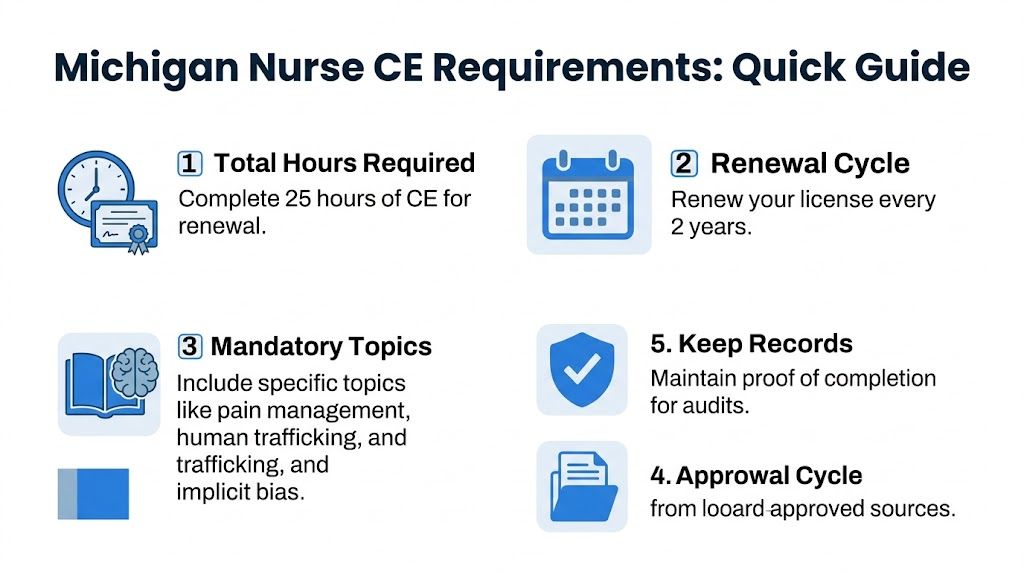
The core rule is straightforward. Michigan nurses must complete 25 contact hours every two years, and that applies to RNs, LPNs, and APRNs under the state’s CE framework.
The checklist most nurses need
Here’s the simplest way to think about continuing education for nurses in Michigan:
- Total CE hours: You need 25 contact hours during each 2-year renewal cycle.
- Pain and symptom management: At least 2 of those hours must cover this topic.
- Implicit bias: Since June 1, 2022, nurses must complete implicit bias training. The rule is 2 initial hours within the 5 years prior to issuance, then 1 hour per year of the license cycle, which totals 2 hours in a two-year renewal period.
- Human trafficking training: This is a one-time requirement at initial licensure. It can be completed through CE, but it does not count toward the 25 hours.
- Daily limit: Michigan allows no more than 12 credit hours in a 24-hour period.
That last rule matters more than people realize. It means you can't solve everything with one marathon weekend of clicking through modules. The state wants learning to be meaningful and paced.
Two areas that often confuse nurses
First, nurses sometimes assume all required education counts toward the main CE total. That isn’t always true. The one-time human trafficking training is required, but it does not count toward your 25 renewal hours.
Second, many nurses hear “implicit bias training” and wonder whether it has to be live. Michigan allows it in synchronous or asynchronous formats like webinars under the same state-aligned summary of requirements, which is one reason online learning works so well for compliance.
A simple way to track it
Use a running list during your cycle:
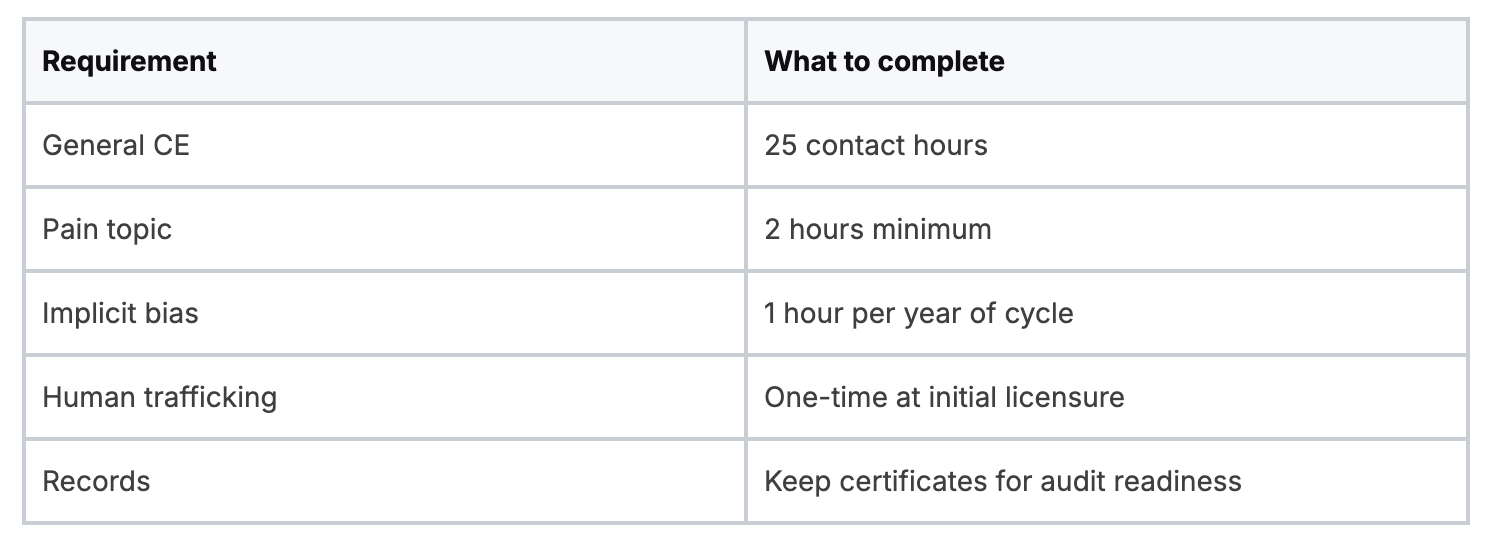
If you build your CE plan around that table, you’ll avoid most renewal mistakes before they start.
Decoding Michigan's Mandatory CE Topics
Michigan doesn’t just require hours. It requires attention to certain issues that affect patient safety and care quality in daily practice. When nurses understand why these topics were chosen, the rules feel less arbitrary.
.png)
Pain and symptom management
This is the most prominent content requirement in Michigan CE. Nurses must complete 2 hours in this area, and the purpose is practical. According to Michigan State University’s nursing CE summary, this requirement directly addresses the opioid crisis. The same source notes that education on multimodal analgesia and proper assessment can reduce opioid use by 30 to 50 percent and improve patient outcomes by 25 percent in palliative settings.
That sounds abstract until you translate it into bedside decisions. Pain education helps nurses assess more accurately, recognize when a patient’s distress is changing, and support plans that don’t rely only on opioids.
A strong course in this topic should cover things like:
- Assessment skills: Using a structured way to evaluate pain and symptoms instead of relying only on general impressions.
- Multimodal care: Understanding how non-opioid approaches fit into symptom management.
- Clinical judgment: Recognizing when escalation, reassessment, or provider communication is needed.
Implicit bias training
Implicit bias training is another area that can feel vague until you connect it to practice. In nursing, bias can show up in communication, assumptions about pain reporting, discharge teaching, trust, and whether a patient feels heard.
Michigan requires this training because equitable care depends on self-awareness as much as technical skill. A useful course won’t just define bias. It should help you notice patterns in your thinking and apply more deliberate communication strategies at the bedside.
The best CE on bias gives you language and reflection tools you can use on your next shift, not just vocabulary for a quiz.
For online learners, this topic often works especially well in self-paced formats because you can pause, reflect, and revisit scenarios instead of moving at the pace of a classroom.
Human trafficking awareness
This is a one-time requirement tied to initial licensure, but it’s still worth understanding because it reflects a larger point about nursing compliance. Michigan CE is built around public protection.
Human trafficking training helps nurses identify warning signs and respond appropriately when patients may be experiencing exploitation. In many settings, nurses are among the few clinicians who have repeated contact with vulnerable patients. That makes pattern recognition important.
What to look for in a course
Not all CE feels equally useful. For mandatory topics, choose content that includes:
- Clear learning objectives: You should know what skills or knowledge you’re expected to gain.
- Practice-based examples: Nursing scenarios make the content stick.
- Completion records: Certificates should clearly show the topic and hours awarded.
When those pieces are in place, required topics stop feeling like boxes to check. They become refreshers in areas where nursing decisions carry real weight.
Choosing Approved CE Courses Online vs In-Person
Once you know your requirements, the next decision is where to complete them. Here, many nurses still run into outdated advice.
Some employers or coworkers still talk as if in-person CE is automatically more legitimate. Or they assume only AHA or American Red Cross classroom formats carry real weight. That’s not how continuing education approval works. What matters is whether the course comes from an appropriately accredited provider and whether it meets your state’s content rules.
What “approved” actually means
For Michigan nurses, the practical question is simple. Is the provider recognized through the accreditation framework accepted for nursing CE, and does the course document the correct contact hours and topic coverage?
That’s the standard. Not whether you sat in a hotel conference room on a Saturday.
A credible provider should make these points easy to verify:
- Accreditation status: The provider should clearly state its nursing CE accreditation.
- Course details: The listing should show contact hours, subject matter, and completion requirements.
- Documentation: Your certificate should be clear enough to support renewal and any audit questions.
Why online CE makes sense for working nurses
Online education is often the most efficient option because it removes barriers that have nothing to do with learning quality. You don’t need to drive across the state, rearrange shifts, or give up a full day off for a short course.
It also lets you learn in a way that matches real nursing life. You can complete a module after work, during a quiet morning, or over several shorter sessions. That flexibility matters because consistency usually beats cramming.
Online CE isn't a lesser version of learning. For many nurses, it's the format that makes consistent, well-documented education possible.
A simple comparison
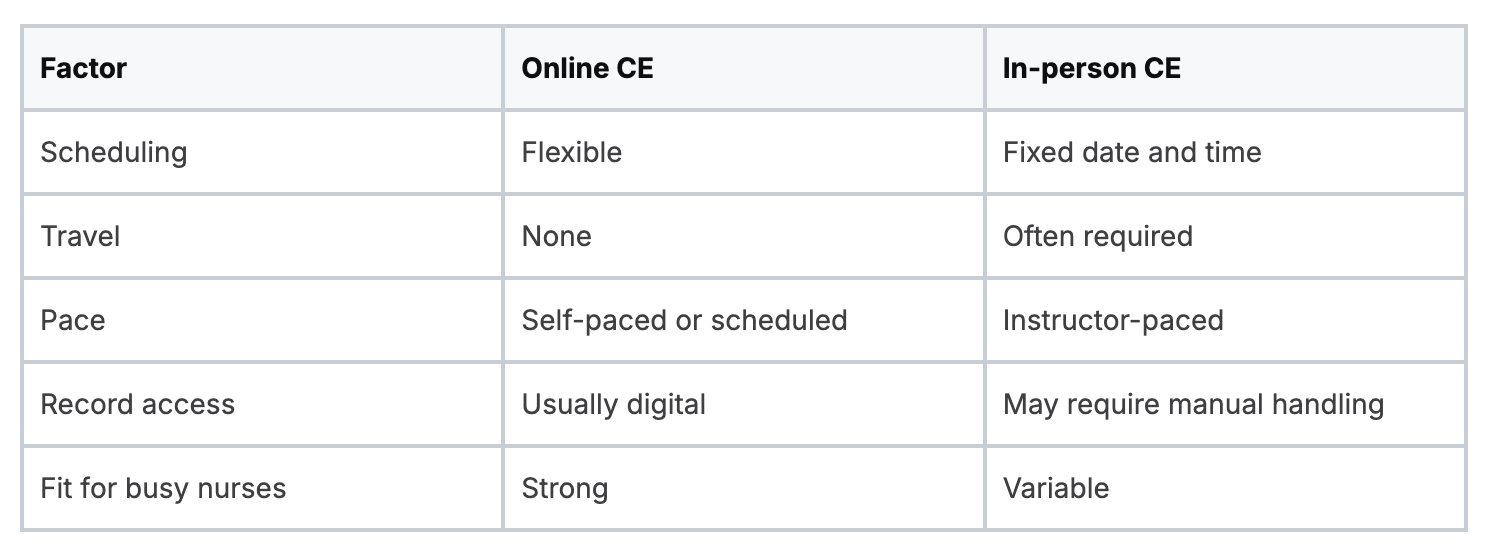
This doesn’t mean in-person CE has no value. Some nurses like live discussion or hands-on structure. But for standard license renewal, accredited online education is a valid, practical, and widely accepted choice.
The healthcare field has moved well beyond the idea that quality only happens in a classroom. For CE and many certifications, online learning is part of the modern standard.
Your Step-by-Step Plan for Stress-Free CE Compliance
The easiest renewal cycles start early and stay organized. You don’t need a complicated system. You need a repeatable one.
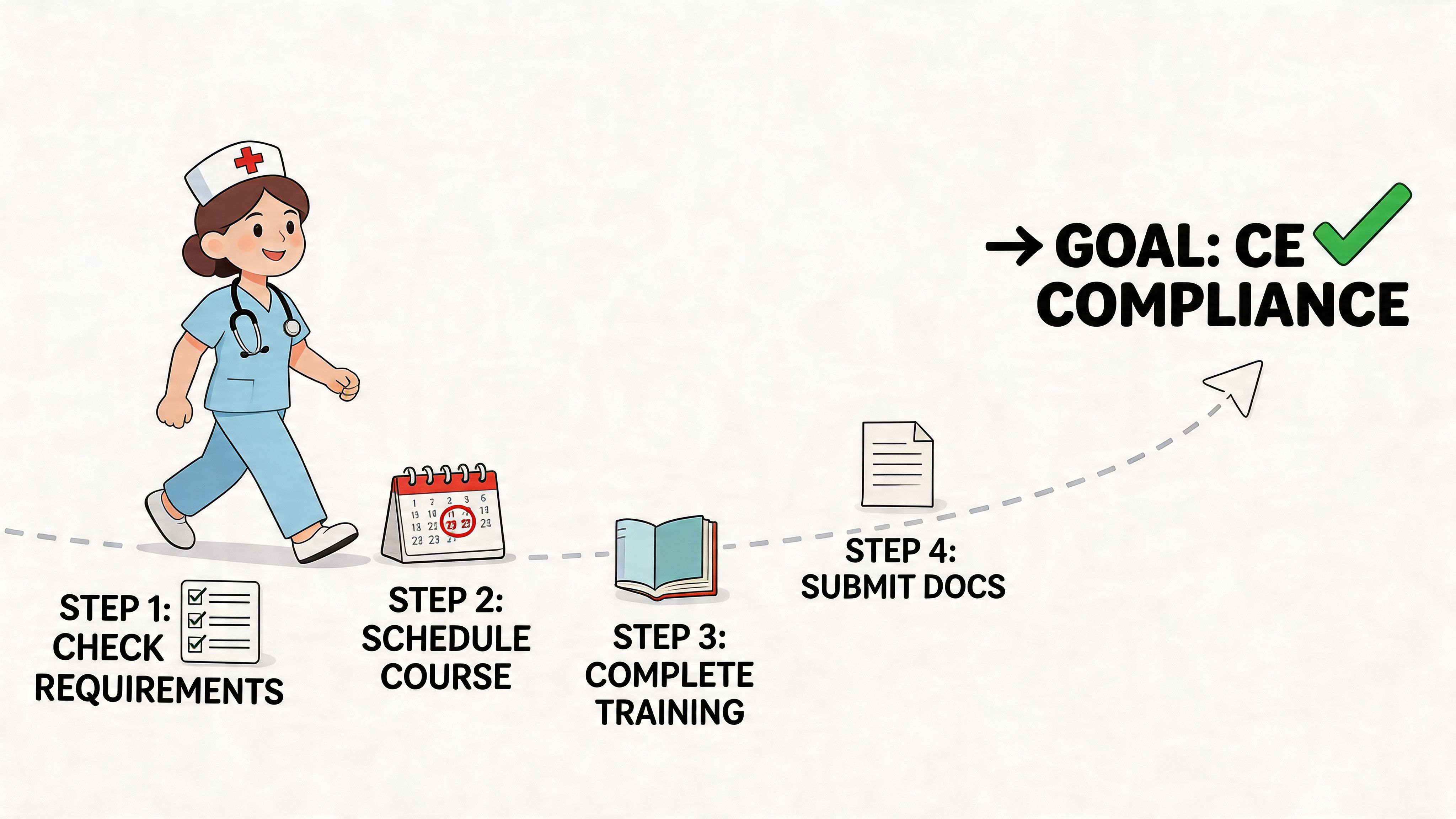
Step 1: check your timeline and gaps
Start with your renewal date. Then list what you still need. Don’t just count total hours. Separate your general hours from your mandatory topic hours so you can see any gaps right away.
This avoids one of the most common problems in continuing education for nurses in Michigan. A nurse may complete plenty of CE, then realize too late that a required subject was missed.
Step 2: choose a provider that matches your reality
If you live in a rural area, work rotating shifts, or don’t want CE to take over your schedule, online access matters. A 2025 Michigan Nurses Association survey showed 40% of rural nurses struggle with CE access, according to Michigan State University’s continuing education overview. That’s exactly where self-paced online learning helps.
When you compare providers, look for practical features, not just course titles:
- A complete catalog: It’s easier when required topics and elective hours are in one place.
- Instant certificates: You should be able to download proof of completion right away.
- Reporting support: Administrative help can save a lot of stress later.
- Course access on any device: That matters when your schedule changes by the week.
One option in this category is ProMed Certifications, which offers online nursing CE, instant certificates, certification bundles, and automated reporting tools. For nurses who want one platform instead of multiple vendors, that kind of setup can simplify compliance.
Step 3: spread the work across your cycle
Don’t wait until the end. Michigan’s daily hour limit already pushes nurses away from cramming, but spacing your CE out also makes the content easier to absorb.
A simple rhythm works well:
- Complete one required-topic course early.
- Add general CE during slower points in your schedule.
- Save every certificate as you go.
- Review your transcript well before renewal.
Small blocks of CE completed regularly are easier to manage than one intense catch-up sprint.
Step 4: use tools that reduce admin work
The content is only half the job. Documentation matters too. Many nurses underestimate how much easier renewal feels when records are centralized and easy to retrieve.
Step 5: review before you attest
Before you submit renewal paperwork, do one final check. Confirm you finished the required content, downloaded your certificates, and can quickly prove completion if asked.
That last review takes minutes. It can prevent a major headache later.
Reporting Your CE Hours to the Michigan Board
Finishing your courses is important. Proving you finished them matters just as much.
Michigan nurses should treat CE records like any other licensure document. If the Board asks, you need to be able to produce clear proof of completion. That means keeping certificates organized and making sure your records match what you completed during your renewal cycle.
What reporting looks like in practice
At renewal, nurses typically attest that they completed the required education. That attestation is not the same thing as forgetting the paperwork afterward. You still need documentation ready if the Board reviews your file.
Digital tracking helps. Instead of storing certificates in random email folders or on an old desktop, keep them in one system you can access quickly. If you’re new to this process, this guide to setting up and using a CE Broker account for license tracking explains the workflow clearly.
Manual tracking vs automated tracking
Both approaches can work. One just creates more work for you.
- Manual record keeping - Save every certificate, organize files, retrieve them later
- Automated reporting support - Complete the course and verify records posted correctly
If your CE provider reports completion automatically, that can remove a lot of friction. You still need to be attentive, but you won’t be rebuilding your paper trail at renewal time.
What to save
Keep records that clearly show:
- Your name
- Course title
- Topic area
- Contact hours earned
- Completion date
A clean digital record is one of the simplest ways to make renewal feel routine instead of risky.
Nurses who handle this step well usually do one thing differently. They don’t treat documentation as an afterthought.
Common CE Pitfalls and How to Avoid Them
Most CE problems aren’t caused by hard rules. They come from avoidable habits.
Pitfall one, waiting too long
Procrastination turns a manageable task into a scramble. Once you’re close to the deadline, your choices narrow. Courses may not fit your schedule, records feel harder to organize, and the stress level rises fast.
The fix is simple. Start earlier than feels necessary. Even a few hours completed well ahead of renewal changes the whole experience.
Pitfall two, focusing on hours but missing the right topics
Some nurses assume any 25 hours will do. Michigan doesn’t work that way. If you miss a required subject, a full transcript can still leave you short on compliance.
A checklist solves this. Track mandatory categories separately from elective content.
Pitfall three, choosing the wrong provider
If a provider doesn’t clearly document accreditation and contact hours, you’re creating risk for yourself. Nurses sometimes pick a course because it’s fast or cheap, then realize later that the documentation isn’t solid enough.
Before you enroll, verify the basics. If the provider’s approval information is hard to find, move on.
Pitfall four, misunderstanding lapsed-license reentry
This one catches returning nurses off guard. A standard renewal bundle may not be enough if your license has been inactive for an extended period. According to Michigan nurse return-to-practice guidance, state rules may require extra hours in areas such as pharmacology and critical thinking, and that detail has become more important alongside a 15% rise in reactivation applications in 2025.
That matters because reentry often involves more than earning general CE. You may need to show refreshed competence in core clinical areas.
A quick avoidance plan
- Start early: Don’t leave required topics for the final month.
- Check category coverage: Make sure mandatory subjects are documented.
- Use organized records: Save proof the day you complete each course.
- Ask reentry questions early: If your license lapsed, confirm whether extra requirements apply before buying a generic bundle.
Nurses who avoid these pitfalls usually don’t work harder. They just plan earlier and choose tools more carefully.
Frequently Asked Questions About Michigan Nursing CE
Do specialty certifications count toward my CE?
Yes. Michigan allows some specialty-related achievements to count toward CE. You may claim up to 25 hours for obtaining or maintaining certain certifications, such as clinical nurse specialist or nurse practitioner certifications. Michigan also allows 10 hours for passing a national specialty exam.
What happens if I get audited?
If the Board selects you for an audit, you’ll need to submit proof that you completed your required education. That’s why organized certificates and reliable tracking matter so much. Nurses who keep digital records throughout the cycle usually handle audits with far less stress than nurses who try to reconstruct everything later.
Can I use CE I completed for another state license?
Often, yes, if the course came from a nationally recognized accredited provider and fits Michigan’s rules. The key issue isn’t where you first intended to use the course. It’s whether the education meets Michigan’s standards and includes the specific required topics tied to your renewal.
Is online CE really acceptable?
Yes. For standard nursing CE, online coursework is a valid option when it comes from an appropriate accredited provider and meets state requirements. For many nurses, it’s also the most realistic format because it supports flexible scheduling, easier record access, and steady completion across the renewal cycle.
If you want one place to complete nursing CE and online certifications with flexible access, ProMed Certifications offers a practical option for busy healthcare professionals. You can complete coursework on your schedule, keep digital records organized, and build a simpler renewal routine without relying on in-person classes alone.
.avif)
Stay compliant with ProMed+
Certifications included: ACLS, BLS, PALS, CPR & Neonatal Resuscitation
Unlimited continuing education: over 200 hours of accredited CME
All-inclusive: One price. No surprises.
Get certified today

The Advanced Cardiac Life Support (ACLS) is an accredited online medical certification course that teaches medical professionals to respond to nearly all cardiopulmonary emergencies.

The Pediatric Advanced Life Support (PALS) Recertification instructs medical professionals on performing pediatric cardiopulmonary resuscitation in emergencies.

The Basic Life Support (BLS) Recertification is intended to teach healthcare professionals the basic steps of CPR and rescue breathing for adults, children, and infants.

Our online medical certification course for CPR, Automated External Defibrillator (AED), and First Aid is designed to teach adult, child, and infant CPR and AED use.

The Neonatal Resuscitation Certification trains medical professionals in performing resuscitation procedures and life-saving techniques for newborns at the time of delivery.

.png)
.png)
.png)