


CE Number Search: A Guide to Finding Your Credits
.png)
Your license renewal date is close. You open your email, search your downloads folder, and start scanning certificates for the one detail your board wants. Then the confusion starts. Is the number on the certificate the CE approval number, the course ID, or just an internal record number?
That's where a careful CE number search matters. For healthcare professionals, this isn't just paperwork. It affects renewal timing, compliance, and peace of mind.
A lot of people also carry an outdated assumption into this process. They worry that if their course was online, it might somehow count less than an in-person class. In healthcare CE, that belief no longer holds up. Online education is a valid, practical format, and the broader industry is moving toward wider acceptance of accredited online CE and certifications.
Why Your CE Number Search Matters More Than Ever
You already know the feeling. A board renewal reminder lands in your inbox, and suddenly you're trying to remember where you took that course, whether the credit was reported, and which number belongs in the registry search field.
That stress usually has less to do with learning and more to do with tracking. The education itself is often the easy part. The hard part is matching the right certificate to the right reporting system.
Online CE has made that process much easier for many clinicians. It fits real schedules, especially when shifts change, staffing runs tight, or family responsibilities cut into classroom time. Just as important, online learning is not a lesser option. A peer-reviewed study on future physicians found no significant difference between virtual and in-person active learning for positive educational impacts (p = 0.7), participation (p = 0.2), or teamwork (p = 0.1), supporting the use of online education for core CE competencies in healthcare, according to this peer-reviewed medical education study.
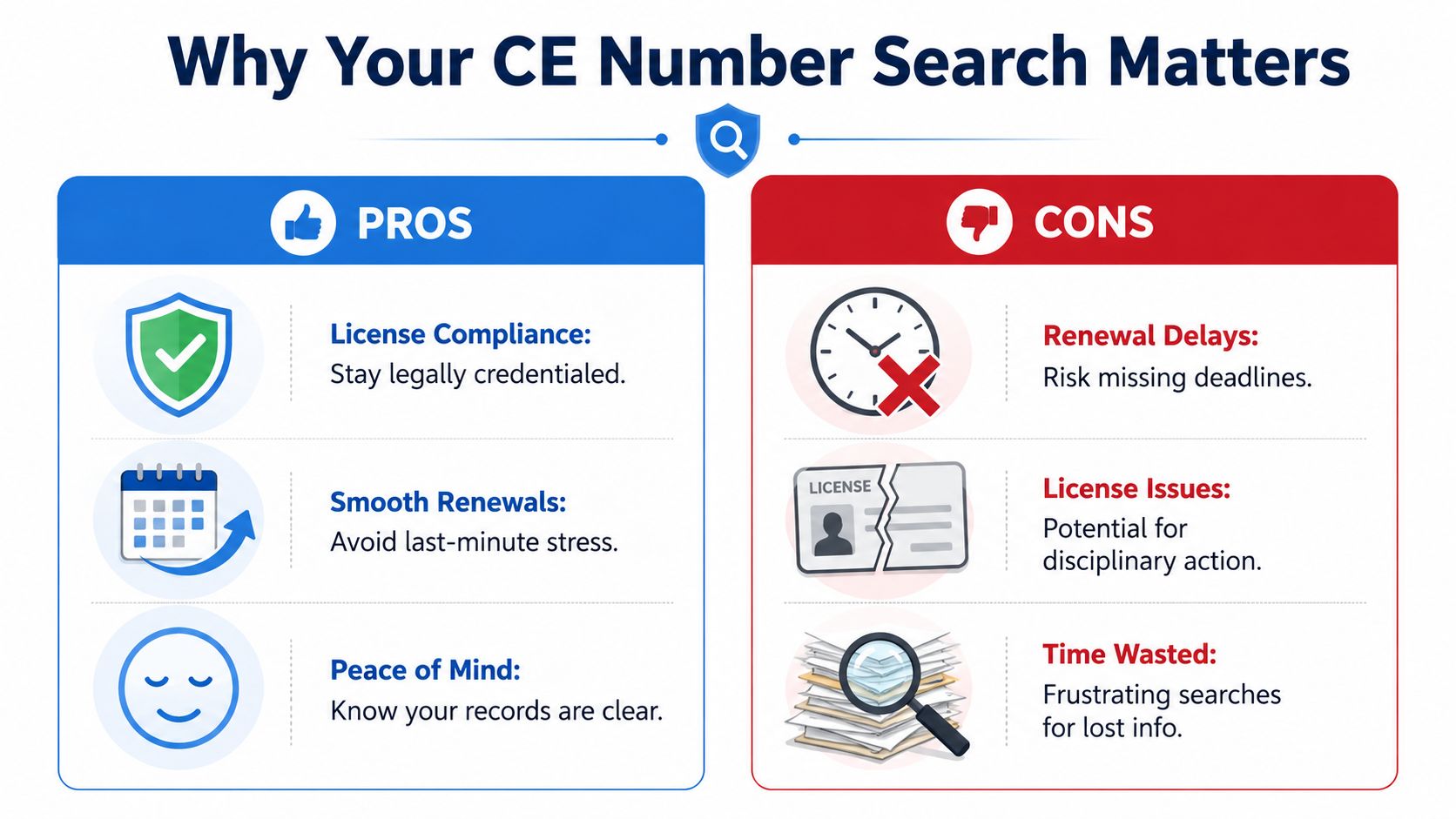
Why this search affects more than paperwork
A CE number search helps you confirm a few things at once:
- Your credit is traceable so you can match the completed course to your board record.
- Your certificate has the right identifier rather than just a provider's internal reference.
- Your renewal file is cleaner if questions come up later.
Practical rule: If you completed the course but can't prove the approval details quickly, treat that as an active problem, not a minor admin task.
For nurses working across different requirements, a state-by-state reference point can help. This overview of nursing continuing education requirements by state is useful when you're trying to understand what your board expects before you start searching for the number itself.
The old in-person-only belief doesn't help you
Many clinicians were told that only classroom training from a small set of legacy organizations counts. That's too simplistic. Accredited online CE and certifications are widely used, and many hospitals, clinics, and employers recognize them when they meet the required standards. AHA and American Red Cross courses are not the only valid path.
Your ProMed Dashboard Your Central CE Hub
If you completed a course through an online platform, your account dashboard is usually the first place to look. That's the fastest route for a CE number search because it keeps your completed courses, certificates, and account history in one place.
Here's what that looks like in practice.

Start with completed courses
Log in and go straight to the area that lists your finished training. Don't start by searching old email attachments unless you have to. In most cases, the dashboard record is clearer than an inbox search because it ties the certificate to your account.
Look for the COMPLETED label under My Learning.
If you took ACLS Certification, the course is designed for online completion on your schedule, and the certificate is part of the account record after you finish. That matters because retrieval is often easier when the course provider stores your completion documents in one place.
Download the certificate before you search elsewhere
Once you find the course entry, open or download the certificate. Read the full document before entering any number into a board registry. Healthcare professionals often move too fast here and grab the first number they see.
Use this quick checklist:
- Find the course title and make sure it matches what you completed.
- Check your name and completion date so you don't upload the wrong certificate.
- Look for accreditation language or approval details near the bottom or in smaller print.
- Separate the CE approval number from internal identifiers if more than one number appears.
Keep the PDF in a folder you can find again. A simple naming format, such as course name plus completion date, saves time later.
Think of the dashboard as your records room
A dashboard isn't just a place to print a certificate. It's your ongoing record of what you completed and when. That's especially useful if you hold more than one credential or complete CE in bursts between shifts.
If you don't see the number immediately, don't assume it's missing. Sometimes the certificate shows a provider reference number prominently, while the actual approval information appears in smaller text or in supporting course details. That distinction becomes important when you move into state reporting.
How to Navigate CE Broker and State Board Registries
State registries create a second layer in the CE number search process. Your provider may issue the certificate, but your board or a third-party tracking system decides how that credit appears in your renewal record.
That's why there isn't one universal CE number lookup tool for every healthcare professional in every state. Approval and reporting are often state-specific.
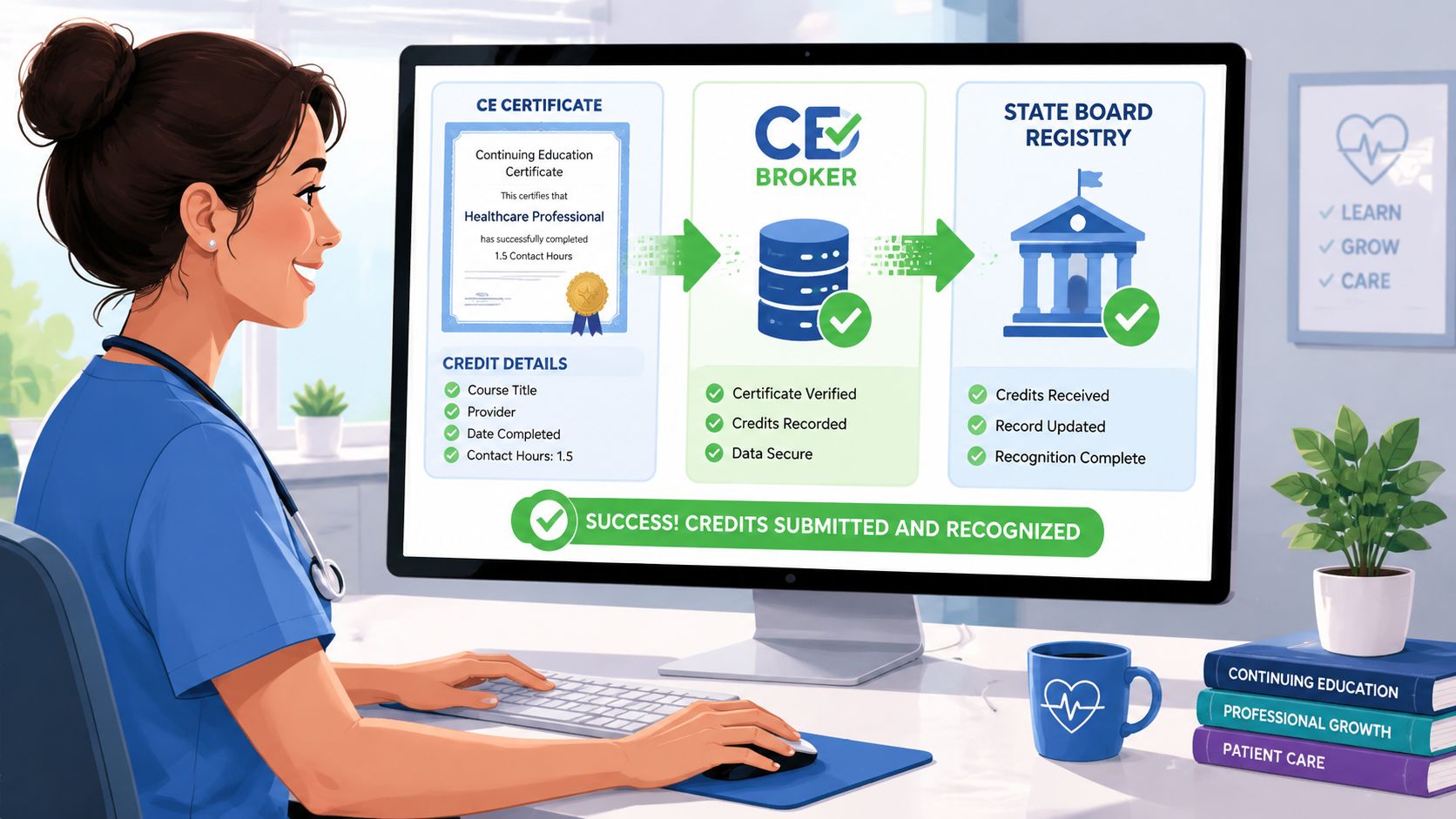
What these registries actually do
A registry such as CE Broker is not the course itself. It's the tracking environment where reported credits may appear for board review. Some boards rely on direct reporting. Others expect you to retain documentation and submit proof if asked.
The key point is accuracy. Data from the National Association of Boards shows that over 60% of license renewal issues stem from mismatched or unverified CE approval codes, which is why careful documentation matters.
A practical search workflow
When you log into a state registry or board portal, use a consistent order:
- First, verify your license profile. Make sure you're searching under the correct profession, state, and license number.
- Next, review reported courses. Look for the course title, completion date, and provider name before focusing on any number.
- Then compare your certificate to the registry listing. A near match can still be wrong if the approval code or course details don't align.
- Finally, save screenshots or confirmation pages. That gives you backup if the board record changes or a renewal question comes up later.
Some professionals expect a search field labeled “CE number.” In reality, the system may ask for provider, course name, date, or approval code. That's one reason people get stuck.
Why state-specific verification trips people up
A nurse licensed in one state may report CE differently than a nurse licensed in another. The same goes for physicians and allied health professionals. Boards don't always use the same naming conventions, and some online providers report automatically while others give you the certificate for self-reporting.
If you use CE Broker, it helps to understand the account side before renewal season. This walkthrough on managing a CE Broker account can make that process less frustrating.
If a registry search doesn't return your course, don't enter random numbers until something works. That usually creates more confusion, not less.
Online education fits this reporting environment well because digital platforms make records easier to access, store, and compare. That's part of why online CE keeps gaining traction across healthcare settings.
Decoding Your Certificate CE Number vs Course ID
This is the mistake that causes a lot of unnecessary trouble. You open a certificate, see a number, and assume that's the number your board wants. Sometimes it is. Sometimes it absolutely isn't.
A CE approval number and a course ID serve different purposes.
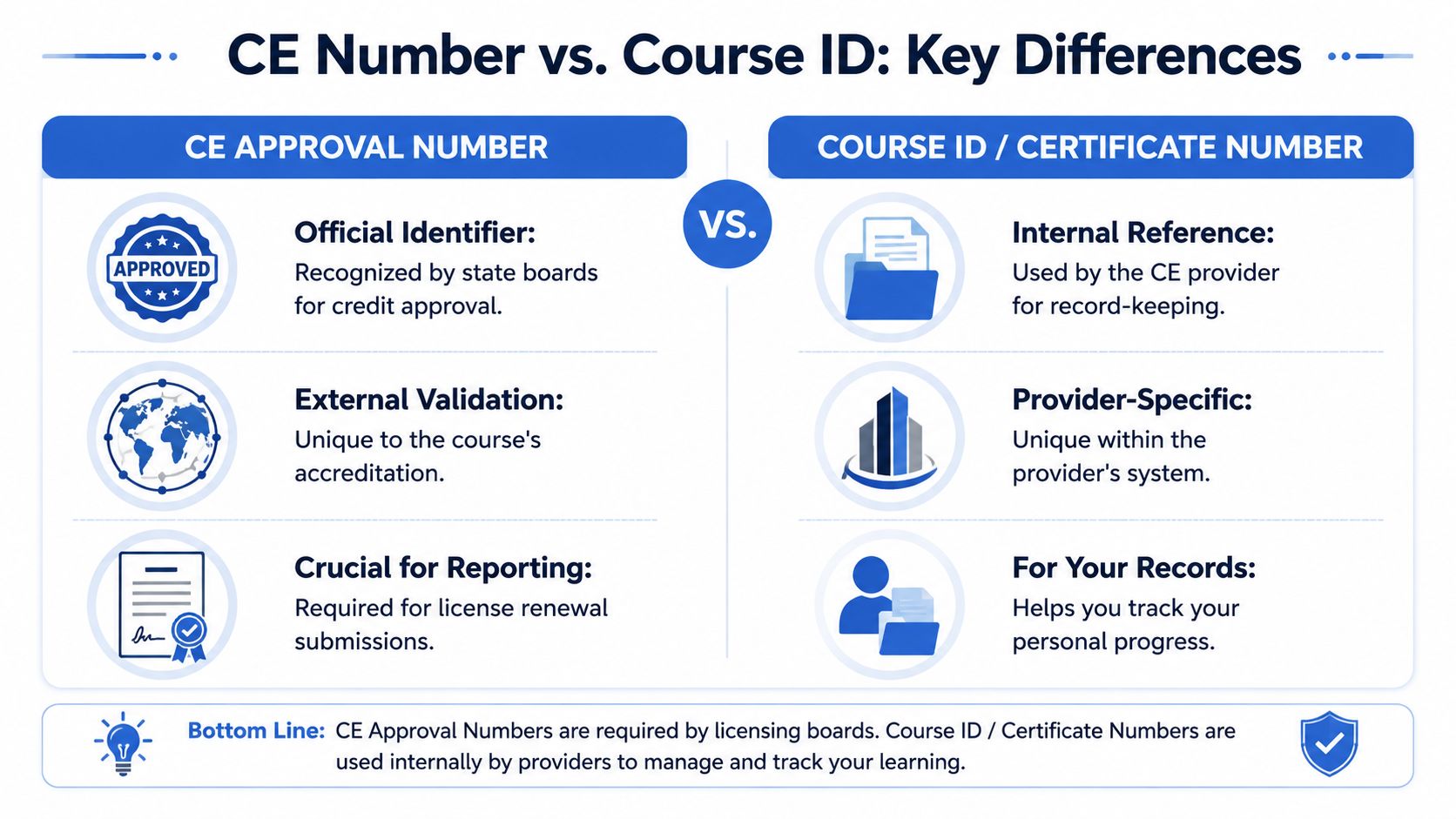
The simple way to think about it
Think of the CE approval number as the course's official compliance credential. It ties the education activity to an approval or accreditation framework recognized by the relevant reporting body.
Think of the course ID or certificate number as the provider's filing system. It helps the provider identify the course or your completion record, but it may not be the number your board wants.
A 2025 report from the American Dental Association found that 45% of CE verification failures happened because users entered course IDs instead of official CE approval codes when searching for their session, according to the ADA credit verification guidance.
What to scan for on the page
When you inspect a certificate, look for cues rather than just numbers.
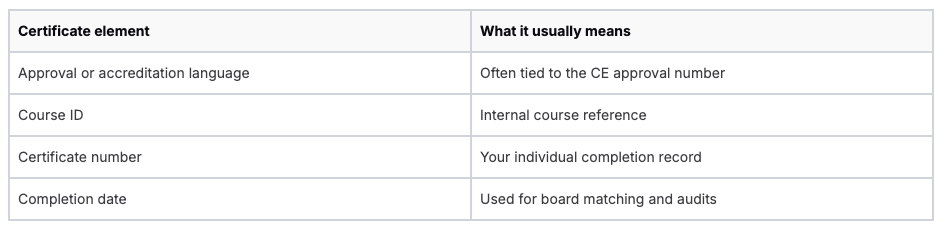
Some certificates place the provider's internal number near the top because it's visually prominent. The approval detail may sit lower on the page in smaller text. That layout misleads people all the time.
The safest habit is to match the number to the label beside it. Never rely on position alone.
Why this matters more with online systems
Online CE platforms make education easier to complete, but they also generate multiple identifiers across dashboards, certificates, emails, and reporting systems. That's not a flaw in online education. It's just the reality of digital records.
The good news is that once you know what each identifier means, the process gets much easier. And no, the fact that a course was online does not make it less legitimate. Online CE and certification pathways are widely used, accepted, and often easier to document than paper-heavy classroom models.
What to Do When You Cannot Find Your CE Number
If the number still isn't clear, slow down and troubleshoot in order. Most CE number search problems come from looking in the wrong place, using the wrong identifier, or relying on an old copy of a certificate.
Start with the easiest checks
Try these steps before contacting anyone:
- Reopen the account dashboard. The certificate stored in your account may contain more detail than the emailed version.
- Compare all documents from the course. Sometimes the certificate, receipt, and course completion page each show different identifiers.
- Review the fine print. Approval information may appear near accreditation language rather than next to the course title.
Contact the provider with specific questions
If you still can't identify the correct number, contact the course provider and be precise. Ask whether the number on your certificate is the CE approval number, a course ID, or a certificate number. If your board rejected a submission, say exactly what field you entered and what message you received.
For busy clinicians, this is one place where online learning can help. For nurses with irregular shifts, online continuing education offers self-paced flexibility and access to a broader range of specialized global courses, making it especially practical compared with limited local in-person options.
If your board still won't accept it
Use a simple escalation path:
- Ask the provider to confirm the correct reporting identifier in writing.
- Check your board portal for manual upload options.
- Keep the certificate and any support email together in case you need to document the exchange.
- Review common renewal questions through resources like these nursing continuing education credit FAQs.
A missing number doesn't automatically mean the course is invalid. It usually means the documentation needs clarification.
Embrace the Future of Continuing Education
A good CE number search comes down to three habits. Keep your certificates organized, know the difference between approval numbers and internal course IDs, and verify your credits in the system your board uses.
That's the administrative side. The bigger shift is educational. Online CE and certifications are not second-tier options for healthcare professionals. They're a practical, credible format that aligns with how clinicians practice. The evidence base and industry direction both support that reality, and the old idea that only in-person AHA or Red Cross classes count is no longer a reliable rule.
Hospitals, clinics, and individual professionals are increasingly comfortable with accredited online education because it reduces scheduling friction while preserving learning quality. That matters when you need to maintain compliance without stepping away from patient care longer than necessary.
The healthcare workforce doesn't need more bureaucracy. It needs education that's accessible, well documented, and easy to retrieve when renewal season arrives. That's why modern online CE keeps moving from alternative option to normal practice.
If you want a simpler way to complete training and keep your records easier to access, ProMed Certifications offers online medical certification and continuing education options designed for healthcare professionals who need flexible scheduling, digital certificates, and a more straightforward path to staying current.
.avif)
Stay compliant with ProMed+
Certifications included: ACLS, BLS, PALS, CPR & Neonatal Resuscitation
Unlimited continuing education: over 200 hours of accredited CME
All-inclusive: One price. No surprises.
Get certified today

The Advanced Cardiac Life Support (ACLS) is an accredited online medical certification course that teaches medical professionals to respond to nearly all cardiopulmonary emergencies.

The Pediatric Advanced Life Support (PALS) Recertification instructs medical professionals on performing pediatric cardiopulmonary resuscitation in emergencies.

The Basic Life Support (BLS) Recertification is intended to teach healthcare professionals the basic steps of CPR and rescue breathing for adults, children, and infants.

Our online medical certification course for CPR, Automated External Defibrillator (AED), and First Aid is designed to teach adult, child, and infant CPR and AED use.

The Neonatal Resuscitation Certification trains medical professionals in performing resuscitation procedures and life-saving techniques for newborns at the time of delivery.

.png)
.png)
.png)