


Arm Pain & Heart Attacks: Spot Critical Signs

That sudden, unexplained ache in your arm—is it just a pulled muscle, or could it be something far more serious? We've all seen it in movies: the classic sign of a heart attack where someone clutches their chest and their arm. There's a very real reason for this.
It’s a phenomenon called referred pain, and it’s a critical concept for any healthcare provider to master.
When Arm Pain Signals a Heart Attack
Think of your body’s nervous system as a complex highway system. During a heart attack, the heart is in distress and sends out urgent pain signals. These signals travel up the spinal cord on the same nerve pathways that relay sensory information from your arm, shoulder, and even your jaw.
When these jumbled signals arrive at the brain, it can't quite pinpoint the source. The brain essentially gets its wires crossed and interprets the pain as coming from the arm, when the real problem is in the heart.
While crushing chest pain is the symptom everyone knows, arm pain is a huge red flag that no one can afford to miss. Recognizing the connection is often the first step in a rapid, life-saving clinical assessment. With a heart attack, every single second is critical. The faster you spot the signs, the sooner you can act.
Distinguishing Cardiac from Non-Cardiac Pain
Of course, not every ache in your arm is a cardiac emergency. The key is to look at the pain in context—what does it feel like, and what else is happening?
Here are some telltale signs that should make you suspect a cardiac origin:
- Type of Pain: The pain is often described as a deep, heavy pressure or a dull ache, not a sharp, stabbing pain that gets worse when you move the arm.
- Accompanying Symptoms: This is a big one. Arm pain from a heart attack rarely travels alone. It’s often joined by chest discomfort, shortness of breath, nausea, lightheadedness, or breaking out in a cold sweat.
- Triggers: The pain might pop up or get worse with physical activity and doesn't get better if you rest or change positions.
Clinical data shows that left arm pain accompanies chest symptoms in up to 57% of heart attack alerts. Considering there are roughly 805,000 heart attacks in the U.S. each year, that's a lot of arm pain that needs to be taken seriously. You can learn more about these warning signs in our guide on the signs of cardiac arrest.
For healthcare professionals, quickly piecing these clues together is vital for triggering ACLS protocols, like getting a rapid ECG, which can make all the difference in patient outcomes.
Arm Pain Red Flags for Heart Attack
To help quickly sort through the symptoms, here's a quick-reference table. It's designed to help both seasoned providers and informed patients tell the difference between a likely muscle pull and a potential cardiac event that needs immediate attention.

This table isn't a substitute for a medical diagnosis, but it’s a powerful tool for triage. If you or a patient has arm pain that falls into the "High-Risk" column, it's time to treat it as a potential cardiac emergency until proven otherwise.
The Science Behind Referred Cardiac Pain
To get to the bottom of the arm pain heart attack connection, we need to take a look at how our body’s nervous system is wired. This strange sensation isn't some random fluke; it's a predictable, albeit confusing, mix-up in the body's complex communication network. The official term for this is referred pain.
Think of your nervous system as a massive highway system. Nerves from all over your body are like streams of traffic, all merging onto the same major freeways to get to their final destination: the brain.
Nerves from your heart muscle, as well as nerves from your left arm, shoulder, and even your jaw, all happen to converge and enter the spinal cord at the exact same level. To get specific, these sensory nerve pathways share real estate within the C8 to T4 spinal segments.
Because these signals travel together, the brain can get its wires crossed trying to pinpoint where the message is coming from. When heart muscle is damaged during a myocardial infarction (a heart attack), it screams out intense distress signals. The brain gets these urgent alerts, but because of that shared neural highway, it might misinterpret them as coming from the arm—an area it's far more used to hearing from.
This is a great visual of how those nerve signals from the heart and arm get jumbled up on their way to the brain.
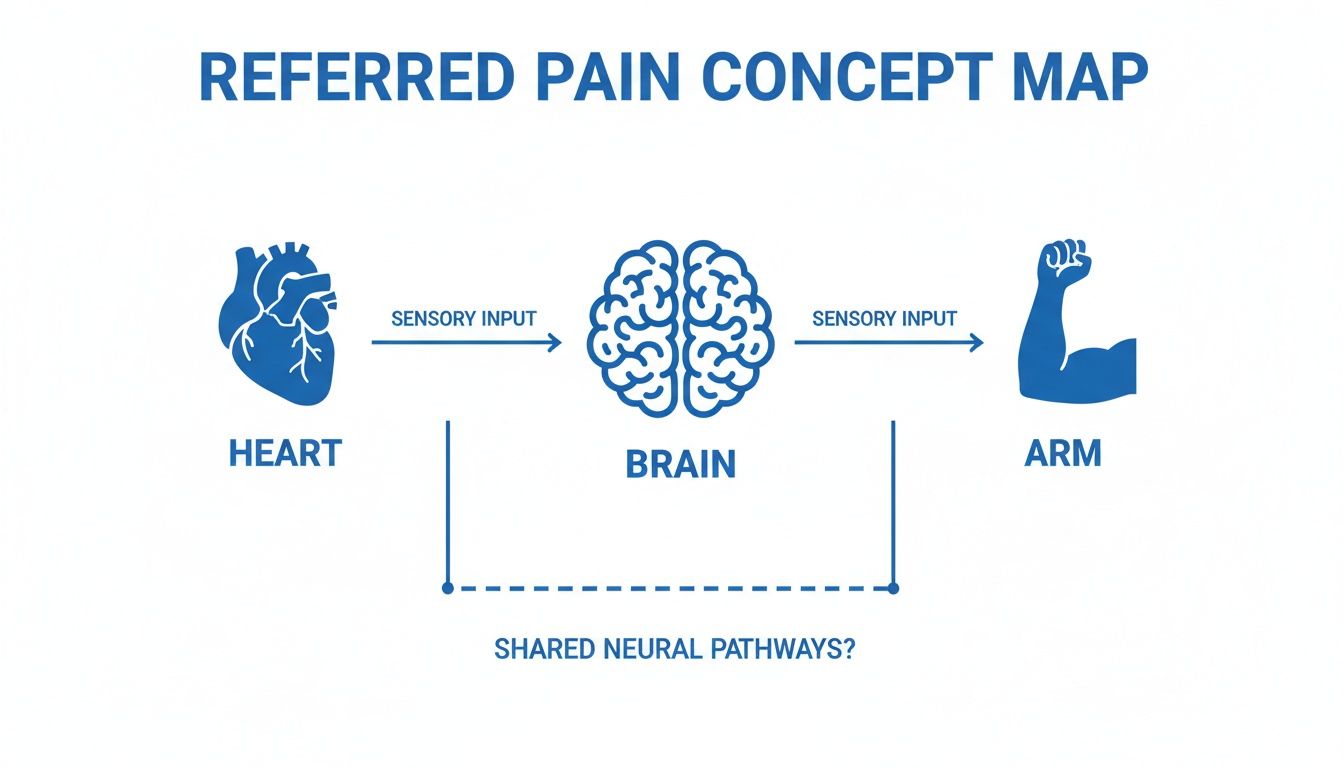
You can see how a pain signal that starts in the heart travels up to the brain but is felt as if it's coming from the arm. This is the core concept of referred pain in action.
Why Is the Left Arm More Common?
The left arm might be the textbook example of referred cardiac pain, but it's certainly not the only possibility. This whole phenomenon occurs because of something called somatic-visceral convergence, which is just a technical way of saying signals from internal organs (visceral) and the body's surface (somatic) get mixed up. This isn't a new discovery; descriptions of heart attack symptoms from as early as 1912 noted pain radiating to the left arm in over half of the cases.
That said, it's critically important to recognize that atypical presentations happen all the time. Pain can just as easily show up in:
- The right arm only
- Both arms at the same time
- The jaw, neck, or back
These variations pop up simply because everyone's internal nerve anatomy is a little different. For some people, the nerve pathways from the right side of the heart might have a stronger connection or overlap more with nerves from the right arm.
Recognizing this is crucial on the front lines, as atypical symptoms are far more common in women, older adults, and patients with diabetes.
Understanding the 'why' behind referred pain moves a clinician from simply recognizing a symptom to truly grasping its physiological origin. This deeper knowledge sharpens diagnostic instincts, especially when faced with atypical patient presentations. It reinforces the rule to consider any new, unexplained arm, jaw, or upper back pain as potentially cardiac until proven otherwise.
Recognizing Typical and Atypical Presentations
We know that arm pain can signal a heart attack, but in the real world, cardiac events don't always follow the script. Moving from the textbook theory of referred pain to actual patient assessment means you have to understand the difference between a "classic" presentation and an atypical one. Getting this right is everything—a missed or delayed diagnosis can be catastrophic.
Most people picture the "Hollywood" heart attack: sudden, crushing chest pain that shoots down the left arm. The truth is, a huge number of patients never experience this at all. Their symptoms can be much more subtle and are easily brushed off as something minor.
Typical Versus Atypical Symptoms
Thinking every heart attack involves dramatic chest-clutching is a dangerous mistake. Atypical symptoms aren’t rare; they're just different. For any healthcare provider, being able to spot them is an essential skill.
Typical Signs (The "Classic" Heart Attack):
- Crushing chest pressure or pain: Many describe it as feeling like an elephant is sitting on their chest.
- Pain radiating to the left arm: This is the hallmark signal of referred pain from the heart.
- Shortness of breath (dyspnea): A feeling like you just can't catch your breath, even when you're resting.
- Cold sweats: Suddenly breaking out in a clammy sweat for no clear reason.
- Profound fatigue: This isn't just feeling tired. It's a bone-deep exhaustion that sleep doesn't fix.
- Nausea or vomiting: It's often mistaken for a stomach bug or a simple case of indigestion.
- Jaw, neck, or back pain: A dull ache or pressure, especially concentrated between the shoulder blades.
- Pain in the right arm or even both arms: While less common than left arm pain, it's just as serious.

Who Is at Risk for Atypical Presentations?
It's critical to know which patients are more likely to show up with these subtle, confusing signs. If you assume everyone will have classic chest pain, you're going to miss diagnoses. You should always have a high index of suspicion for a cardiac event with these groups:
- Women: They are far more likely than men to report overwhelming fatigue, nausea, and pain in their back or jaw.
- Older Adults (over 75): Their main symptom might be something that seems unrelated, like sudden confusion, weakness, or dizziness.
- Individuals with Diabetes: Diabetic neuropathy can actually blunt the body's pain signals. This can lead to "silent" heart attacks with very little—or even zero—pain.
Think about a real-world case. Sarah, a 68-year-old with diabetes, came in with none of the classic signs. No chest pain, no left arm pain. Her only complaints were two days of feeling so exhausted she couldn't do her chores and a dull ache between her shoulder blades that she blamed on sleeping wrong. Her heart attack was only caught because her daughter insisted she go to the ER. Sarah’s story is a powerful reminder: atypical presentations are common, and you have to take them seriously.
Exploring the Differential Diagnosis for Arm Pain
While the connection between an arm pain heart attack is something every provider must recognize, it's just as crucial to know that not all arm pain signals a cardiac event. A solid differential diagnosis is your best friend when faced with this uncertainty. It's a systematic way to consider—and rule out—other potential culprits, making sure you don't miss what's right in front of you.
Think of yourself as a detective. The initial report is "arm pain," but that’s just the first clue. You need to dig deeper to solve the case. Is the pain sharp and stabbing, or is it a dull, heavy ache? Does it get worse with movement? Are there any other symptoms tagging along? Asking these questions helps you build a case for or against a heart attack.
Common Non-Cardiac Causes of Arm Pain
To build an effective differential diagnosis, it helps to group the usual suspects. Most non-cardiac arm pain falls into one of three buckets: musculoskeletal, neurological, or vascular. Each one has its own tell-tale signs.
.png)
Musculoskeletal Issues
These are easily the most common causes of arm pain, stemming from problems with muscles, bones, tendons, or ligaments.
- Rotator Cuff Injury: This involves damage to the muscles and tendons that cup the shoulder joint. Patients often describe a dull ache deep in the shoulder that flares up when they lift their arm or try to sleep on that side.
- Tendonitis: Simply put, this is an inflamed tendon, usually from overuse. The pain is often very localized to a specific spot and gets worse with any activity that stresses that tendon.
- Arthritis: Inflammation in the joints can bring on a stiff, aching pain in the shoulder, elbow, or wrist. It frequently feels most intense in the morning.
The big clue here is that the pain is mechanical. Musculoskeletal pain is almost always reproducible—you can make it worse with a specific movement and find relief with rest.
Neurological Problems
This type of pain comes from a nerve that's been compressed or irritated. It's like a pinched cable sending out a faulty, painful signal.
- Cervical Radiculopathy: Better known as a pinched nerve in the neck. The pain is often described as sharp, shooting, or burning and can travel right down the arm. A critical sign is that it might change with neck movement—turning the head might either ease the pain or make it spike.
- Carpal Tunnel Syndrome: This happens when the median nerve gets squeezed at the wrist. It typically causes numbness, tingling, and pain in the thumb, index, and middle fingers, not the whole arm.
Neurological pain often has a distinct "electric" or "pins-and-needles" quality that really sets it apart from the heavy, crushing pressure of cardiac pain.
Vascular Conditions
While less common, you can't forget about issues related to the arm's blood vessels.
- Thoracic Outlet Syndrome: This occurs when nerves or blood vessels get compressed between the collarbone and the first rib. It can lead to pain, numbness, and even discoloration in the arm and hand, often triggered by raising the arm overhead.
When a patient presents with arm pain, quickly running through these potential diagnoses is a fundamental skill. This table can serve as a mental checklist to help differentiate between the most common causes.
Arm Pain Differential Diagnosis Quick Guide

Remember, this is a quick guide, not a substitute for a full clinical workup. The goal is to rapidly form a primary hypothesis while keeping other possibilities in mind.
Building a strong differential diagnosis is a process of elimination. You always start by considering the most immediate threat to life—the heart attack—and then systematically gather evidence to either confirm it or confidently rule it out. A deep, constant ache that gets worse with exertion screams cardiac, while a sharp pain that changes when the patient turns their head points toward a nerve issue. This structured approach is the bedrock of safe, confident, and efficient clinical evaluation.
How ACLS and BLS Skills Save Lives in Cardiac Emergencies
When you're faced with a potential heart attack, especially one with the classic sign of arm pain, your training is what stands between that patient and a catastrophic outcome. Certifications in Basic Life Support (BLS) and Advanced Cardiac Life Support (ACLS) aren't just pieces of paper; they're the mental playbook that helps you act quickly and correctly.
In the United States, the statistics are staggering. Heart disease is still the number one killer, and a heart attack happens roughly every 40 seconds. That referred left arm pain heart attack sufferers often feel is a well-known but frequently misunderstood symptom, a result of shared nerve pathways. With early action guided by BLS and ACLS, we can drastically change those outcomes for the better. Staying certified means you're always prepared. For more on this, the CDC's comprehensive fact sheet on heart disease is an excellent resource.
The Role of ACLS and BLS Training
Your training gives you a clear, evidence-based plan of action. When you suspect Acute Coronary Syndrome (ACS)—the umbrella term that includes heart attacks—the first few moments are absolutely critical. Your BLS skills are the foundation: recognize the emergency, call for help, and start CPR if the person becomes unresponsive.
ACLS builds on that foundation, providing a systematic approach for healthcare providers. It’s a step-by-step game plan:
- Initial Assessment: This is your rapid check of the patient's airway, breathing, and circulation (the ABCs).
- Vital Signs and Oxygen: Get a quick read on their vitals and give them oxygen if their O2 saturation drops below 90%.
- Immediate Medications: Administer aspirin (162-325 mg) for the patient to chew. This is a simple but powerful step to help stop a clot from getting worse.
- Obtain a 12-Lead ECG: This is your most important diagnostic tool. It helps you see what's happening with the heart's electrical activity, identify the type of heart attack, and decide on the next steps, like reperfusion therapy.
Running through these steps smoothly and efficiently is the core of the adult cardiac arrest algorithm, a protocol designed to give patients the best possible shot at survival during these high-pressure events.
Modern Education for Modern Professionals
Let's be clear: the outdated belief that only in-person classes from a few legacy organizations are valid is no longer accurate. The healthcare industry is evolving, and the evidence supports this shift.
Numerous peer-reviewed studies and industry reports have confirmed that high-quality online learning is just as effective as traditional formats. When it comes to retaining knowledge, improving patient care outcomes, and providing much-needed flexibility, online CE is often equal or even superior. That's why accredited online certifications are gaining widespread acceptance among hospitals, clinics, and healthcare professionals.
For anyone in the medical field, finding efficient ways to keep up with protocols is essential. Modern study aids like using voice notes for medical students can be a great way to reinforce complex topics while on the move.
ProMed is at the forefront of this evolution. Our courses are built on the latest guidelines but are designed for how professionals actually live and work today. At the end of the day, what really matters is the quality of the education and how it translates to better patient care. A flexible, accredited online certification delivers on both convenience and credibility.
Common Questions About Arm Pain and Heart Attacks
When you're dealing with symptoms that could point to a heart attack, a lot of questions—and a lot of fear—can surface. That's completely understandable. Getting clear, straight answers is the best way to build confidence and know exactly when you need to act.
Here, we're going to tackle some of the most urgent and practical questions that both clinicians and patients ask about the connection between arm pain and heart attacks.
Can a Heart Attack Cause Pain Only in the Right Arm?
Yes, it absolutely can. While we’ve all been taught to look for the classic left arm pain, a heart attack can easily cause pain only in the right arm, or even in both arms at the same time.
This is what we call an "atypical" presentation, but it’s a critical possibility to keep in mind, especially for women, older adults, and people with diabetes. The way referred pain works is the same, but everyone's nerve pathways are a little different.
The bottom line is this: any new, unexplained arm pain that won't go away, gets worse with activity, or shows up with other red flags—like shortness of breath, nausea, or sweating—needs an immediate medical workup. It doesn't matter which arm hurts. Treat it as cardiac until proven otherwise.
How Long Does Cardiac Arm Pain Last?
Arm pain from a heart attack is persistent. It typically lasts for more than 15 to 20 minutes and doesn't get better with rest.
This is a key difference from a simple muscle strain, which usually eases up if you stop moving or change positions. Cardiac pain is relentless. It might come and go in waves, feeling like a dull ache one minute and intense pressure the next, but it won't just disappear on its own.
If you or a patient describes a deep, aching arm pain that has been going on for several minutes without any relief, you have to treat it as a cardiac emergency.
Are Online ACLS or BLS Certifications Truly Valid?
This is a huge—and important—question we hear all the time. The answer is an unequivocal yes. The world of healthcare education has changed, and high-quality online certifications are now widely accepted by hospitals and healthcare systems across the country.
The old-school belief that only in-person courses from legacy groups like the AHA or American Red Cross are valid just isn't true anymore.
What matters is the quality of the curriculum and whether you can demonstrate competency. Accredited online providers build their courses on the exact same evidence-based, ILCOR-compliant guidelines. The consensus is clear: online learning delivers the same life-saving knowledge but with the flexibility, cost savings, and time efficiency that modern healthcare professionals desperately need to stay current.
What Are the Immediate Steps for a Suspected Heart Attack?
If you think someone is having a heart attack, you need to move fast. Time is muscle. The faster you act, the better their chances of a good outcome.
- Call 911 Immediately: This is the single most important thing you can do. Don't try to drive the person to the hospital yourself. Paramedics can start life-saving treatment the second they arrive.
- Sit and Rest: Have the person sit down and stay as calm as possible. This minimizes the strain on their heart.
- Chew Aspirin: If they aren't allergic and don't have a bleeding disorder, have them slowly chew one regular-strength (325 mg) aspirin.
- Administer Nitroglycerin (If Prescribed): If the person has a known heart condition and has been prescribed nitroglycerin, help them take it exactly as their doctor directed.
- Be Prepared for CPR: If you are BLS or ACLS certified, stay with the person. If they become unconscious and you can't find a pulse, be ready to start CPR and use an AED if one is nearby.
At ProMed Certifications, we are committed to providing high-quality, accredited online certifications that prepare you for these critical moments. Our courses are designed for the realities of modern healthcare, giving you the flexibility you need and the life-saving knowledge you can trust. Explore our ACLS, PALS, and BLS courses to get certified or recertified today.
.avif)
Stay compliant with ProMed+
Certifications included: ACLS, BLS, PALS, CPR & Neonatal Resuscitation
Unlimited continuing education: over 200 hours of accredited CME
All-inclusive: One price. No surprises.
Get certified today

The Advanced Cardiac Life Support (ACLS) is an accredited online medical certification course that teaches medical professionals to respond to nearly all cardiopulmonary emergencies.

The Pediatric Advanced Life Support (PALS) Recertification instructs medical professionals on performing pediatric cardiopulmonary resuscitation in emergencies.

The Basic Life Support (BLS) Recertification is intended to teach healthcare professionals the basic steps of CPR and rescue breathing for adults, children, and infants.

Our online medical certification course for CPR, Automated External Defibrillator (AED), and First Aid is designed to teach adult, child, and infant CPR and AED use.

The Neonatal Resuscitation Certification trains medical professionals in performing resuscitation procedures and life-saving techniques for newborns at the time of delivery.

.png)
.png)
.png)