


1500 mcg to mg: The Complete Clinical Conversion Guide
.png)
You’re probably here because you saw 1500 mcg on a label, order, or practice question and need the answer fast.
The direct conversion is simple: 1500 mcg = 1.5 mg.
In healthcare, though, that small shift in units isn’t just math. It affects how you interpret medication labels, verify orders, document doses, and catch errors before they reach a patient. A clinician who can move confidently between micrograms and milligrams is doing more than solving a conversion problem. They’re practicing safe care.
Why This Simple Conversion Is a Critical Skill
A common clinical moment goes like this. You’re reviewing a medication label, the order is written in one unit, and the vial or tablet is labeled in another. You don’t have time to hesitate, but you also can’t afford to guess.
That’s where 1500 mcg to mg becomes more than a classroom exercise. It becomes a safety check.
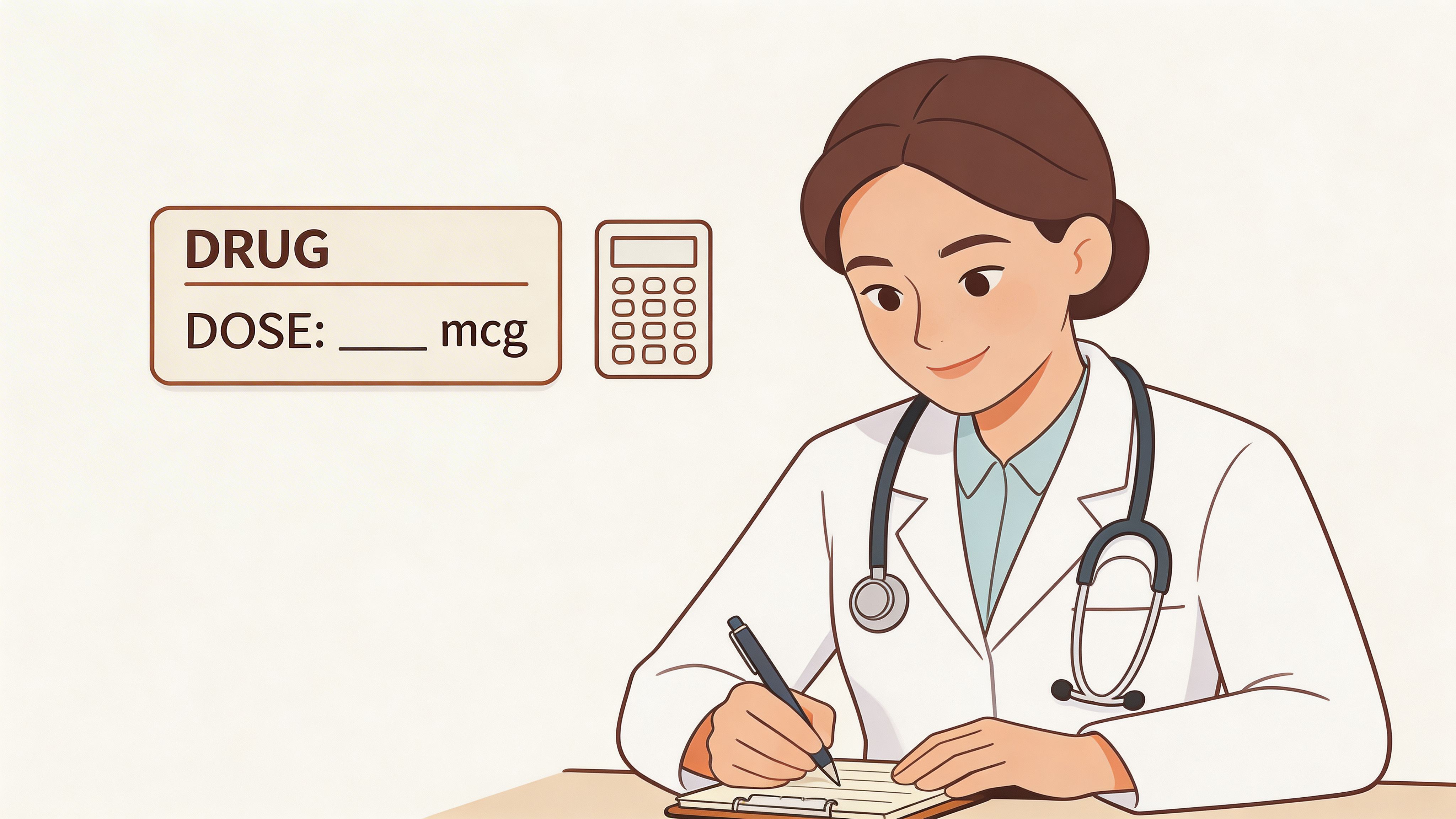
If a supplement, injection, or medication lists 1500 mcg, the equivalent is 1.5 mg. That answer should come quickly, but it should also come with understanding. When you know why the conversion works, you’re much less likely to miss a decimal, misread a label, or carry an error into the next step of care.
Where this shows up in real practice
You might see this conversion during:
- Medication reconciliation: A patient reports a home dose in mcg, but the chart uses mg.
- Order verification: A provider enters one unit, while the dispensing package uses another.
- Certification prep: ACLS, BLS, PALS, pharmacology CE, and nursing refreshers often test this exact skill.
- Daily communication: Nurses, physicians, pharmacists, and techs all need a shared unit language.
Clinical mindset: Fast math matters, but accurate math matters more.
This is also why continuing education still matters long after school. Core medication math skills fade if you don’t use them often. Many clinicians sharpen them through online CE and certification platforms because those formats let you revisit calculations, repeat practice questions, and learn at your own pace without sacrificing quality.
The old idea that only in-person learning counts is outdated. For cognitive skills like unit conversion, strong online training can be every bit as effective because what matters is mastery, repetition, and clinical application.
The Core Conversion Formula Explained
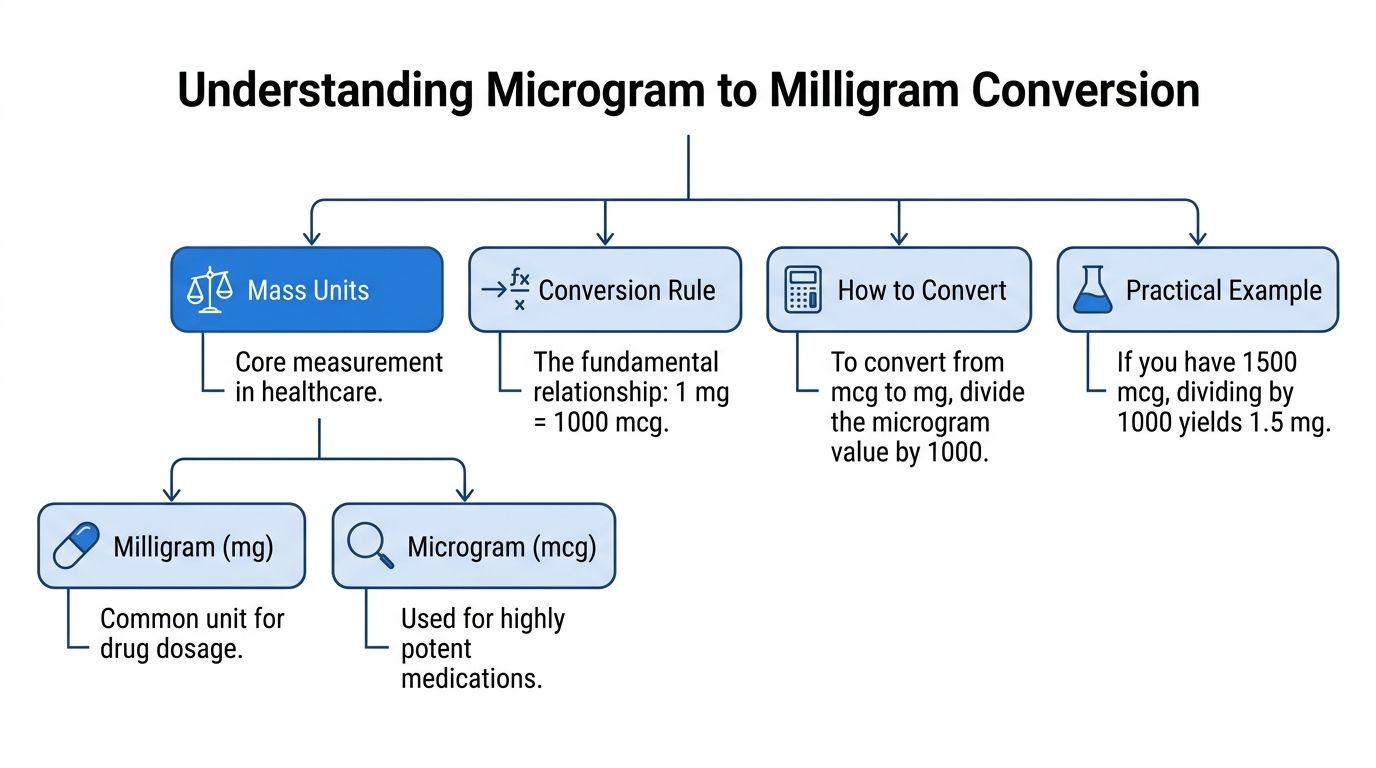
The relationship between these units is fixed:
- 1 milligram (mg) = 1000 micrograms (mcg)
That means micrograms are the smaller unit. When you convert mcg to mg, you’re moving from a smaller unit to a larger one, so the number gets smaller.
A simple way to think about it
It's similar to changing millimeters to meters. You don’t keep the same number because the unit got bigger. The quantity is the same, but the way you write it changes.
The same idea applies here:
- mcg is the smaller unit
- mg is the larger unit
- so you divide by 1000
Step by step math
Use this formula:
mg = mcg ÷ 1000
Now plug in the value:
1500 ÷ 1000 = 1.5
So:
1500 mcg = 1.5 mg
You can also set it up with dimensional analysis:
1500 mcg × (1 mg / 1000 mcg) = 1.5 mg
That setup helps because the mcg cancels out, leaving you with mg.
A quick reference table

If you want to strengthen your comfort with dosage math more broadly, it can help to review other forms of unit conversion too. The pattern is often the same. Start with the unit relationship, then convert one step at a time.
When a conversion feels confusing, write the units on paper. Most errors happen when clinicians try to do everything in their head.
Practical Examples in Clinical Settings
This calculation becomes more meaningful when you attach it to real medications. Some drugs and supplements are measured in micrograms because they’re potent enough that tiny amounts matter.
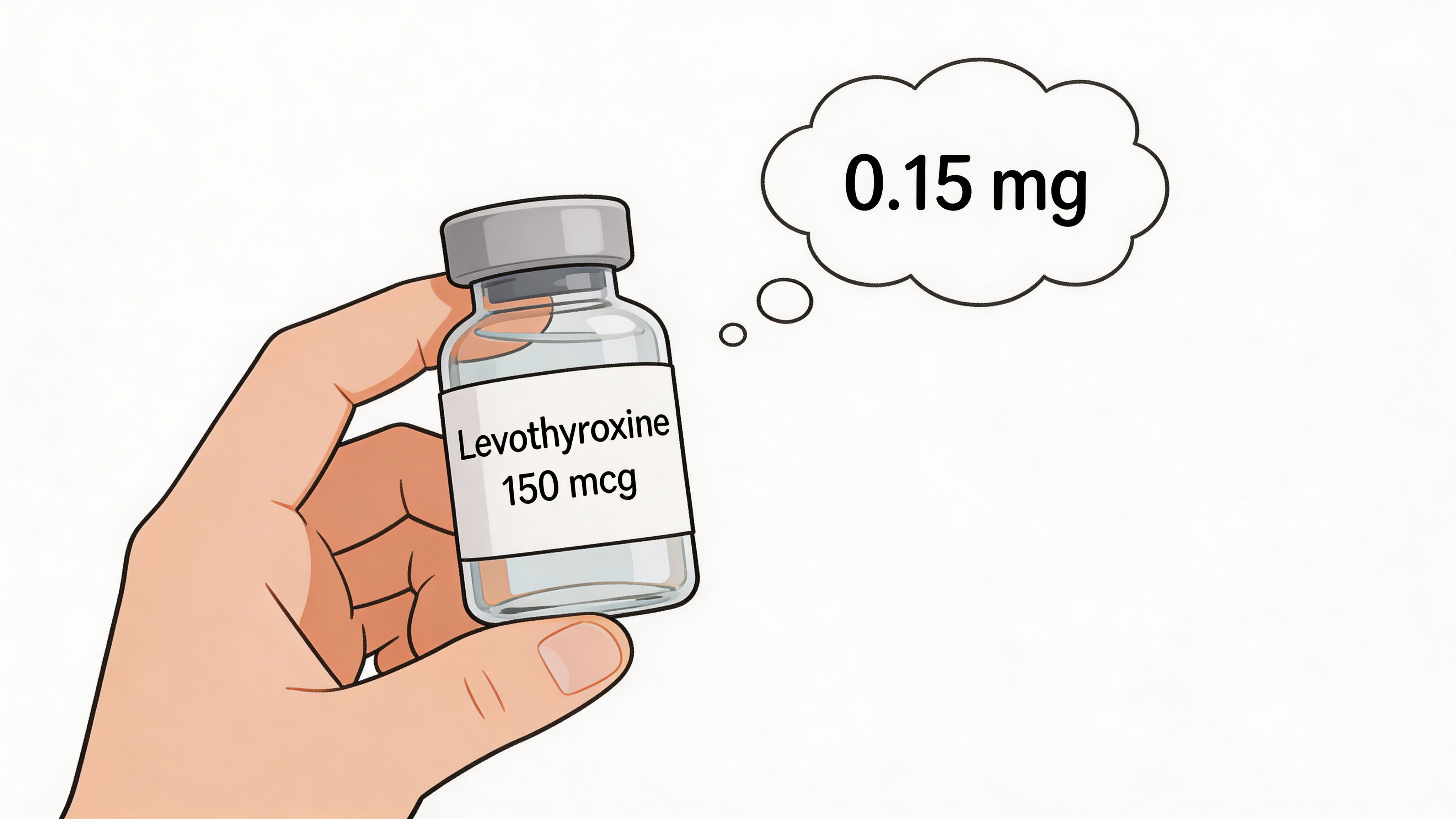
In clinical pharmacology, converting 1500 mcg to 1.5 mg is critical for high-potency medications like vitamin B12 or levothyroxine. Administering 1500 mcg (1.5 mg) of levothyroxine exceeds the typical adult maintenance dose of 100 to 200 mcg/day, which can contribute to thyrotoxicosis, and mcg to mg miscalculations account for 12% of pediatric overdoses, with a 75% reduction reported when standardized conversion tables are used.
Levothyroxine
Levothyroxine is a strong example because the routine doses are often written in micrograms.
A clinician may be very comfortable seeing:
- 100 mcg
- 150 mcg
- 200 mcg
But if someone reads 1500 mcg without mentally converting it, the scale of the dose may not register right away. Converting it to 1.5 mg helps you see immediately that it’s far above a standard maintenance amount.
Vitamin B12 and supplement labeling
Vitamin B12 products often appear in micrograms, and 1500 mcg is a common strength on labels. In that context, converting to 1.5 mg helps with:
- comparing formulations
- documenting accurately in charts
- discussing oral versus injectable forms
- avoiding confusion when one system uses mg and another uses mcg
This is also where clinicians benefit from regular medication review and emergency pharmacology refreshers. If you want a focused example of how dosing language appears in resuscitation education, this guide on https://promedcert.com/blog/acls-medications-and-doses is a useful companion read.
Why small unit errors become big clinical problems
A dose can be numerically correct and still be clinically wrong if the unit is misread.
Here’s what that looks like in practice:
- A label is read too quickly: The clinician sees 1500 and anchors on the number without checking mcg versus mg.
- A charting system displays a different unit: The medication list shows mg, but the original bottle shows mcg.
- A handoff skips the conversion: One person says the number, another person assumes the unit.
That’s why strong clinicians don’t just memorize the answer. They build a habit of checking whether the written unit matches the clinical expectation.
Avoiding Common Dosing Errors and Safety Tips
The dangerous part of 1500 mcg to mg usually isn’t the division itself. It’s what happens before or after the math.
Many clinicians can correctly say that 1500 mcg = 1.5 mg. Trouble starts when that answer gets used inside a longer workflow with label reading, order entry, compounding, dispensing, or documentation layered on top.
The double conversion trap
One of the easiest ways to make a serious error is to convert the same dose twice, or convert it once and then misread the new unit.
A significant risk is the double conversion trap in multi-step pharmacology. Standard guides often miss the danger of misreading labels such as 1.5 mg as 1500 mg, and a 2024 ASHP study reported 10x errors in 22% of pharmacy tech trainees when trailing zeros or scientific notation were involved.
That matters in routine care and emergency care alike. Medications often move through multiple hands before administration, which is why a strong crash-cart medication review process is so important.
The mistakes clinicians make most often
Some errors are predictable. That’s good news, because predictable errors are easier to prevent.
- Unit blindness: You see the number first and assume the unit.
- Decimal drift: You know the conversion but place the decimal in the wrong spot.
- Label carryover: You copy the package wording into the chart without checking whether the chart expects a different unit.
- Multi-step confusion: You convert for one purpose, then convert again during preparation or documentation.
Practical rule: Every time the unit changes, pause and ask, “Did the dose change, or only the way I wrote it?”
A safety checklist you can use
Try this brief process during med prep, chart review, or exam practice:
- Read the full unit
Don’t stop at the number. Read mcg or mg out loud if needed. - Write the formula
For mcg to mg, divide by 1000. - Estimate before finalizing
If you move from a smaller unit to a larger one, the number should get smaller. - Compare with clinical context
Ask whether the converted dose makes sense for the medication. - Document in one unit consistently
Don’t switch back and forth unless there’s a clear reason. - Use a second check on high-alert calculations
Another set of eyes can catch what fatigue misses.
A calculator helps. A standardized table helps. But neither replaces disciplined thinking.
Understanding Unit Notation and Precision
A lot of medication mistakes start with handwriting, abbreviations, or formatting. That’s why notation matters almost as much as the calculation itself.
mcg and μg mean the same thing
mcg and μg both mean microgram.
In practice, many clinicians prefer mcg in typed and written communication because the Greek letter μ can be misread. If the symbol is faint, handwritten poorly, or displayed badly in a digital system, it can create unnecessary risk.
The safest approach is simple. Use the clearest notation your setting accepts, and stay consistent.
Write doses so they can’t be misread
Precision in notation protects patients. A few habits make a big difference:
- Use a leading zero for amounts less than one. Write 0.5 mg, not .5 mg.
- Avoid extra trailing zeros when they don’t add meaning. Write 1.5 mg, not 1.50 mg.
- Match the unit to the source document carefully before rewriting it in another format.
- Keep scientific notation out of routine communication unless it’s required and clearly understood by everyone involved.
A quick notation example

Clear notation is part of dose accuracy. If someone can misread what you wrote, the calculation isn’t finished yet.
For learners, this is one reason repeated practice matters. A person may understand the math but still lose points, or create real-world risk, through sloppy notation. Strong training should teach both.
The Modern Way to Master Medical Math and Certifications
Medication math is a cognitive skill. You learn it through explanation, repetition, correction, and practice under realistic scenarios. That makes it especially well suited to online education.
A good online course lets you pause, retry, review missed questions, and revisit difficult concepts without the pressure of keeping pace with a room full of people. For busy nurses, physicians, and allied health professionals, that flexibility often leads to better consistency.
Why online learning fits this topic so well
With dosage conversion, the key questions are:
- Did you understand the unit relationship?
- Can you apply it correctly?
- Can you recognize when the answer doesn’t fit the clinical situation?
Those goals don’t require a folding chair in a classroom. They require solid content, clinical relevance, and enough repetition to build confidence.
That’s why the old belief that only AHA or American Red Cross in-person classes are valid doesn’t hold up as a blanket rule. Healthcare organizations increasingly recognize high-quality accredited online CE and certification options, especially for knowledge-based competencies and renewal needs. What matters is whether the education is credible, current, and accepted by the employer or licensing body.
What to look for in a strong online learning experience
Not every course is built equally. Look for programs that include:
- Case-based practice: Real medication examples, not abstract math alone
- Immediate feedback: So you can catch a reasoning mistake right away
- Self-paced review: Especially helpful if dosage math isn’t part of your daily role
- Accredited continuing education: Important for CE, CME, and certification confidence
- Clear pharmacology support: For learners who want more than a memorized formula
If you like using external tools as a quick double-check while studying, a simple MCG to MG conversion calculator can help reinforce the pattern after you work the problem yourself.
Online learning works well when it gives you repeated chances to think, calculate, correct, and apply.
That is the standard, not whether the seat was in a classroom.
Conclusion and Your Next Steps
The key answer is straightforward: 1500 mcg to mg = 1.5 mg.
What matters is knowing it with enough confidence to use it safely. In real practice, unit conversions affect dose verification, charting, handoffs, and medication judgment. That’s why a simple calculation belongs in every clinician’s active skill set, not buried in old notes from school.
If you want to stay sharp, modern online education is a smart way to do it. It’s flexible, practical, and well aligned with how healthcare professionals maintain competence today.
If you’re ready to strengthen medication math, refresh critical care knowledge, or complete accepted online CE and certification training, explore ProMed Certifications. Their fully online courses for ACLS, BLS, PALS, CPR, Neonatal Resuscitation, CE, and CME are designed for busy healthcare professionals who want high-quality education on a flexible schedule.
.avif)
Stay compliant with ProMed+
Certifications included: ACLS, BLS, PALS, CPR & Neonatal Resuscitation
Unlimited continuing education: over 200 hours of accredited CME
All-inclusive: One price. No surprises.
Get certified today

The Advanced Cardiac Life Support (ACLS) is an accredited online medical certification course that teaches medical professionals to respond to nearly all cardiopulmonary emergencies.

The Pediatric Advanced Life Support (PALS) Recertification instructs medical professionals on performing pediatric cardiopulmonary resuscitation in emergencies.

The Basic Life Support (BLS) Recertification is intended to teach healthcare professionals the basic steps of CPR and rescue breathing for adults, children, and infants.

Our online medical certification course for CPR, Automated External Defibrillator (AED), and First Aid is designed to teach adult, child, and infant CPR and AED use.

The Neonatal Resuscitation Certification trains medical professionals in performing resuscitation procedures and life-saving techniques for newborns at the time of delivery.

.png)
.png)
.png)