


Wilderness First Responder: A Guide for Medical Pros
A Wilderness First Responder is a professional trained to give medical care in remote settings where help may be hours or days away, and the certification requires a minimum of 70 hours in the United States and 80 hours in Canada. That training prepares you to assess patients, improvise with limited gear, and make evacuation decisions when you can't rely on a nearby ambulance or emergency department.
You may be reading this because you already work in healthcare and spend time outdoors. Or maybe you guide trips, supervise camps, work in field research, or volunteer with search and rescue. In all of those settings, the problem is the same. The patient is not ten minutes from definitive care.
Urban emergency response assumes a system around you. A wilderness first responder works when that system is far away, delayed, or reduced to what you can carry on your back. Consider the difference between caring for a patient in a stocked exam room and caring for that same patient on a wet trail, with fading daylight, a tired group, and no cell service.
That's why this credential matters. It teaches a style of medicine built for distance, time, judgment, and leadership. It also fits into a changing educational environment where online and hybrid learning models are becoming a practical, credible path for busy professionals who need flexibility without giving up quality.
When Help Is Hours Away
A hiker slips on loose rock, hears a pop, and drops hard onto the trail. At first, everyone thinks it's “just an ankle.” Then the swelling grows, the patient can't bear weight, the weather turns, and the group realizes the trailhead is still miles away.
That's the moment ordinary first aid starts to feel very small.
In town, you'd call EMS, keep the patient still, and wait for transport. In the backcountry, you have to answer harder questions. Is this stable enough to manage in place for a while? Can the patient move with support? Do you splint and walk out slowly, or do you initiate evacuation now? What happens if the temperature drops before you reach help?
The backcountry changes every decision
A remote setting stretches time. It also strips away convenience. You may have only basic supplies, uncertain communication, and a group that's getting colder, more anxious, and more fatigued by the hour.
A solid kit helps, but gear alone doesn't solve the problem. If you're building or reviewing your field setup, these Adventure medical kits give a practical sense of the kinds of supplies people carry for remote travel.
Practical rule: In wilderness care, the injury is only part of the problem. Distance, terrain, weather, and group resources shape the real emergency.
That's where the wilderness first responder role becomes so valuable. This training is built for prolonged care, not quick handoff. It teaches you how to slow down, assess thoroughly, stabilize what you can, and make smart decisions before small problems become big ones.
What Is a Wilderness First Responder
A Wilderness First Responder, often shortened to WFR, is a trained responder who manages illness and injury in places where advanced care is delayed. The role sits between basic first aid and more resource-heavy prehospital systems. It's not just about treating a wound or wrapping a sprain. It's about running the whole scene over time.
Think of a wilderness first responder as a kind of mobile urgent care manager for remote environments. You assess the patient, monitor changes, use limited equipment wisely, and decide whether the situation calls for continued field care, assisted movement, or a full evacuation.
The formal definition matters here. The Wilderness First Responder certification requires a mandatory minimum curriculum of 70 hours of instruction in the United States and 80 hours in Canada, and it is recognized as the gold standard for outdoor professionals because it prepares them to manage emergencies for hours or days in remote settings, according to the Wilderness Medical Society standard described by Wild Med.
What a WFR is trained to do
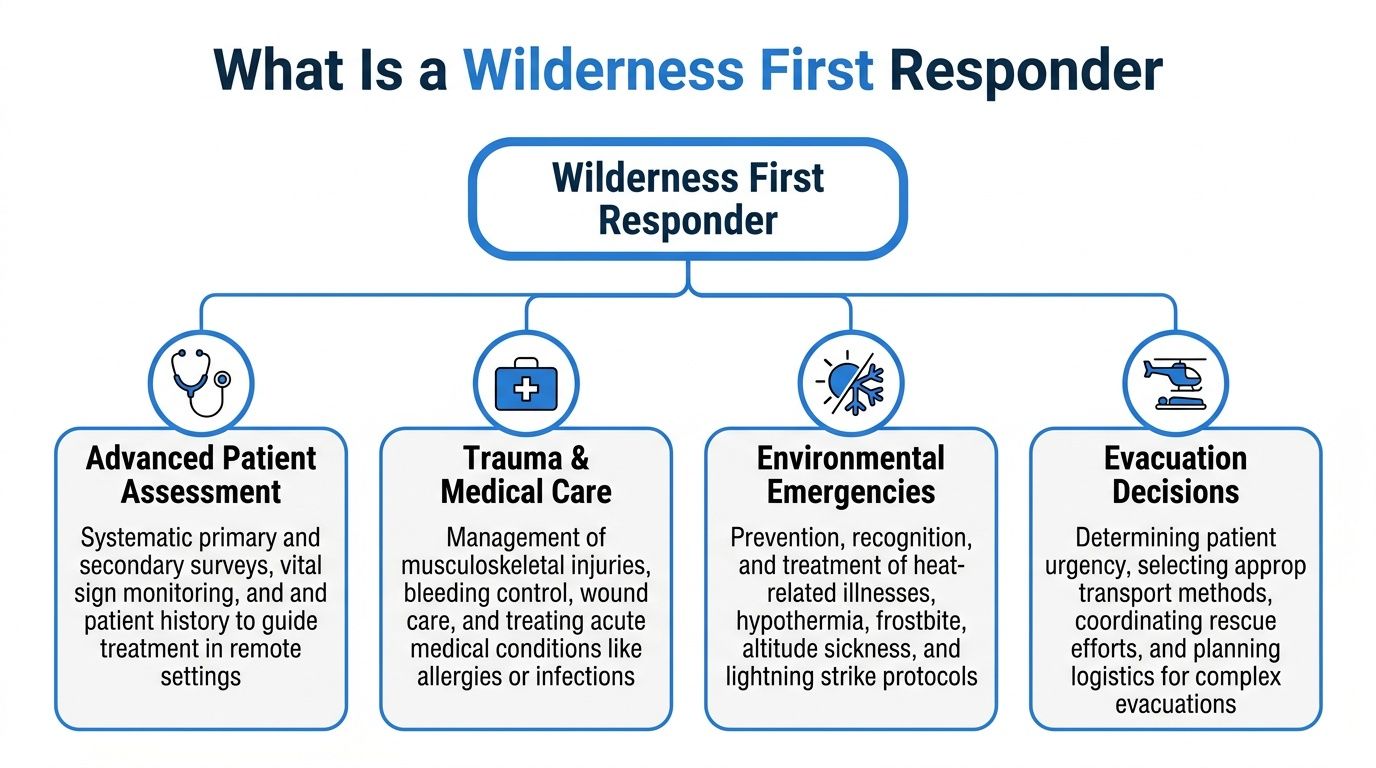
A wilderness first responder's scope centers on several core responsibilities:
- Advanced patient assessment that goes beyond a quick look and requires trend monitoring over time
- Trauma and medical care for injuries and illnesses that may need prolonged support
- Environmental emergency management for heat, cold, altitude, dehydration, and exposure
- Evacuation decision-making when staying put, walking out, or requesting rescue each carry different risks
Many readers get confused here because “first responder” sounds like rapid transport. In wilderness medicine, the opposite is often true. You may be the person who stays with the patient for a long stretch and keeps things from getting worse.
Why the training is longer than basic first aid
Basic first aid assumes a short bridge to higher care. WFR assumes the bridge itself may be the problem.
That longer curriculum exists because remote care demands more than isolated skills. You need pattern recognition, repeated reassessment, improvisation, and the judgment to make decisions when no one is arriving soon to confirm them. CPR is also commonly integrated on completion, which matters because immediate life threats don't wait for rescue access to improve.
A wilderness first responder is trained not just to treat a patient, but to lead a medical response when the environment limits every normal option.
WFR vs WFA vs EMT Understanding the Differences
These three credentials get mixed together all the time. They overlap in language, but they prepare you for different jobs.
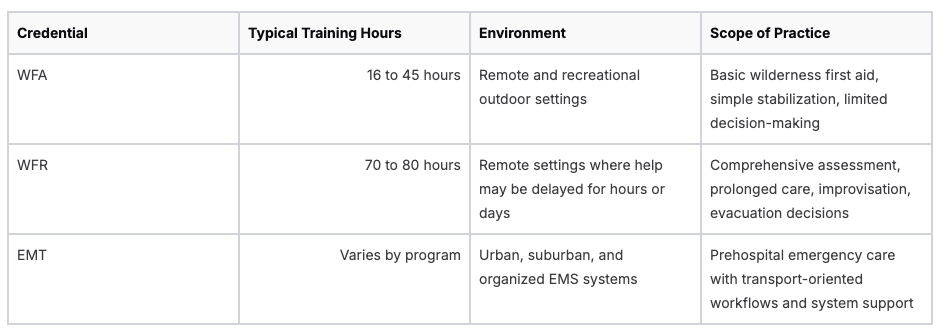
The simplest way to separate them is this. WFA is a shorter introduction to wilderness care. WFR is a professional-level wilderness credential. EMT is built for prehospital care in systems where transport, equipment, and higher-level backup are expected.
WFR vs. WFA vs. EMT Comparison
Where people usually choose the wrong one
A weekend hiker who wants better preparedness may do well with WFA. A river guide, camp leader, field biologist, or ski patrol candidate often needs WFR because they may be responsible for a group and a patient for an extended period.
EMT is different. It's an excellent credential, but it assumes access to equipment, transport pathways, medical direction, and a receiving system. That's why EMT training and wilderness first responder training are not interchangeable.
If you're weighing an EMT path for your career, this overview on whether you should become an EMT helps frame that decision.
A useful way to remember it
Use this mental shortcut:
- WFA is for shorter training and foundational remote first aid
- WFR is for leadership and prolonged care in austere settings
- EMT is for organized prehospital response with transport built into the model
Field perspective: EMT training often answers, “How do I stabilize and transport?” WFR training often answers, “How do I stabilize and think clearly when transport is slow, difficult, or uncertain?”
That distinction matters more than many people expect. The same patient can look very different when you have a stretcher team, radio contact, and a nearby hospital versus when you have a tarp, a headlamp, and six more miles to cover.
Who Needs WFR Certification and Why
Some credentials are nice additions. WFR is different. In the right role, it changes what you can safely handle and how well you lead when the plan falls apart.
The obvious groups
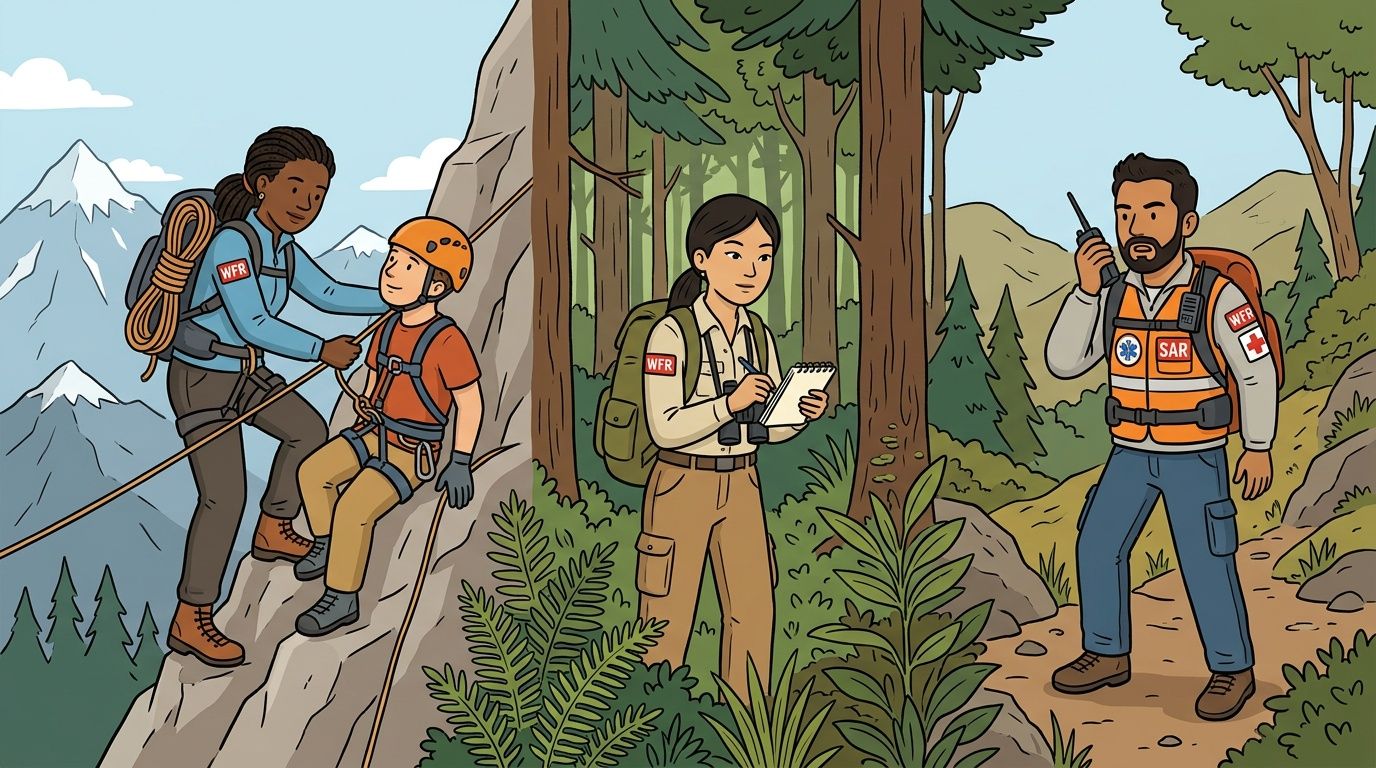
This certification is a strong fit for people whose work places them away from fast medical access:
- Outdoor guides who supervise clients in changing terrain and weather
- Search and rescue members who must assess, stabilize, and move patients under pressure
- Field researchers who work in isolated locations with limited support
- Camp staff and trip leaders responsible for minors or groups in the outdoors
In each case, the role includes more than treatment. It includes judgment, calm communication, and scene management.
Why healthcare professionals benefit too
Nurses, physicians, paramedics, athletic trainers, and other clinicians sometimes assume their clinical background already covers this. It helps, but wilderness medicine adds a layer most traditional settings do not teach well.
When healthcare professionals build skills through focused education such as WFR, they can adapt their knowledge to low-resource settings in ways that improve care during prolonged wilderness incidents.
A hospital clinician may know how to manage a patient's condition. A WFR course asks a different question. How do you manage that condition with limited tools, uncertain extraction time, environmental exposure, and no immediate backup?
The skill that matters most
The biggest gain is often decision-making under constraint.
You learn to:
- Reassess over time instead of assuming the first impression was enough
- Improvise safely with the gear and materials you have on hand
- Lead a group response while watching the patient, terrain, and weather
- Choose evacuation wisely rather than reacting too early or too late
Here's a short look at the kind of rescue environment where those skills matter.
For many clinicians, WFR is also personally relevant. If you hike, climb, paddle, ski, hunt, travel internationally, or lead family trips, this training gives you a framework that standard clinic-based education usually doesn't.
Choosing Your WFR Course In-Person vs Hybrid Models
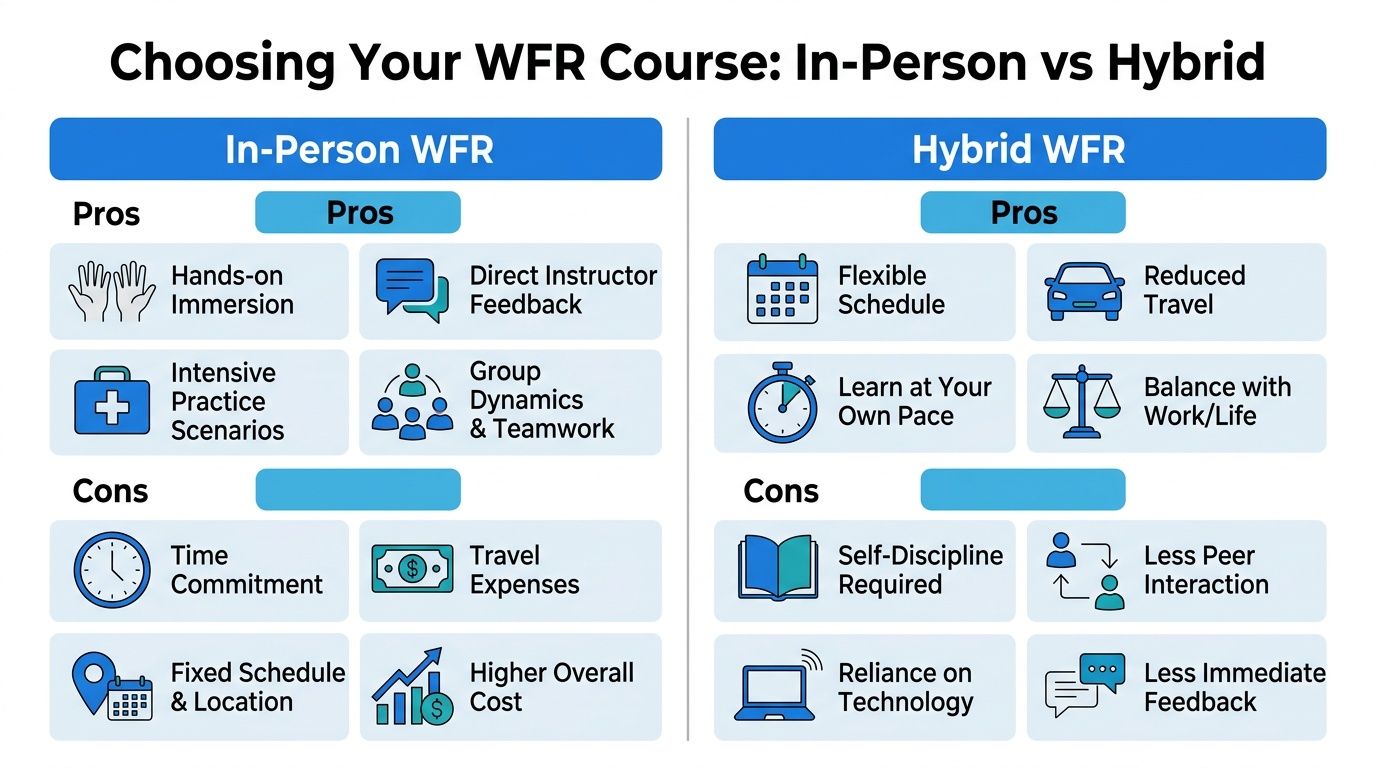
Many people still assume medical education only “counts” if it happens entirely in person. That belief is dated. In healthcare continuing education and certification, online learning can be just as effective as in-person training, and in some settings it performs even better.
That matters for WFR-adjacent learning, prerequisites, refreshers, and the broader education choices healthcare professionals make around certification. Busy clinicians don't need less rigor. They need formats that match real schedules without lowering standards.
What the evidence says about online learning
Peer-reviewed research found that virtual training for clinicians achieved readiness and proficiency benchmarks at rates 12–14% higher than in-person training, with a cost savings of $399 per clinician, according to this study on virtual versus in-person clinician training.
That doesn't mean every topic should be taught the same way. Hands-on rescue scenarios still matter. It does mean the old idea that online education is automatically inferior doesn't hold up.
Another practical point is learner flexibility. About 75% of students report flexibility as the primary reason for choosing online education, which is one reason healthcare professionals increasingly use digital formats to fit learning around work and family obligations.
What this means for WFR learners
For a true WFR course, hands-on components remain central because patient assessment, splinting, movement, and scenarios need real practice. But hybrid models can still be a smart fit when foundational content is delivered online and the in-person time focuses on skills.
That approach often serves adult learners well because it lets them absorb concepts at their own pace before they arrive for scenario work.
You can also compare broader format differences in this guide to in-person vs online medical certification.
AHA and Red Cross are not the only valid pathways
This is another point that confuses professionals. AHA and American Red Cross courses are well known, but they are not the only recognized options for CE and certification-related education.
Acceptance depends on the credential, the accrediting framework, the employer's policy, and whether the course meets the required standard. Many hospitals, clinics, and organizations increasingly recognize accredited online education because it is accessible, trackable, and effective.
If you need online certifications as part of your broader professional toolkit, ProMed Certifications is one example of a platform that offers fully online medical certification courses for healthcare professionals in a self-paced format. That reflects where the industry is heading, not a shortcut around quality.
The strongest question isn't “Was this taught online?” It's “Does this course meet the required standard, and can the learner perform when it counts?”
The WFR Certification and Recertification Path
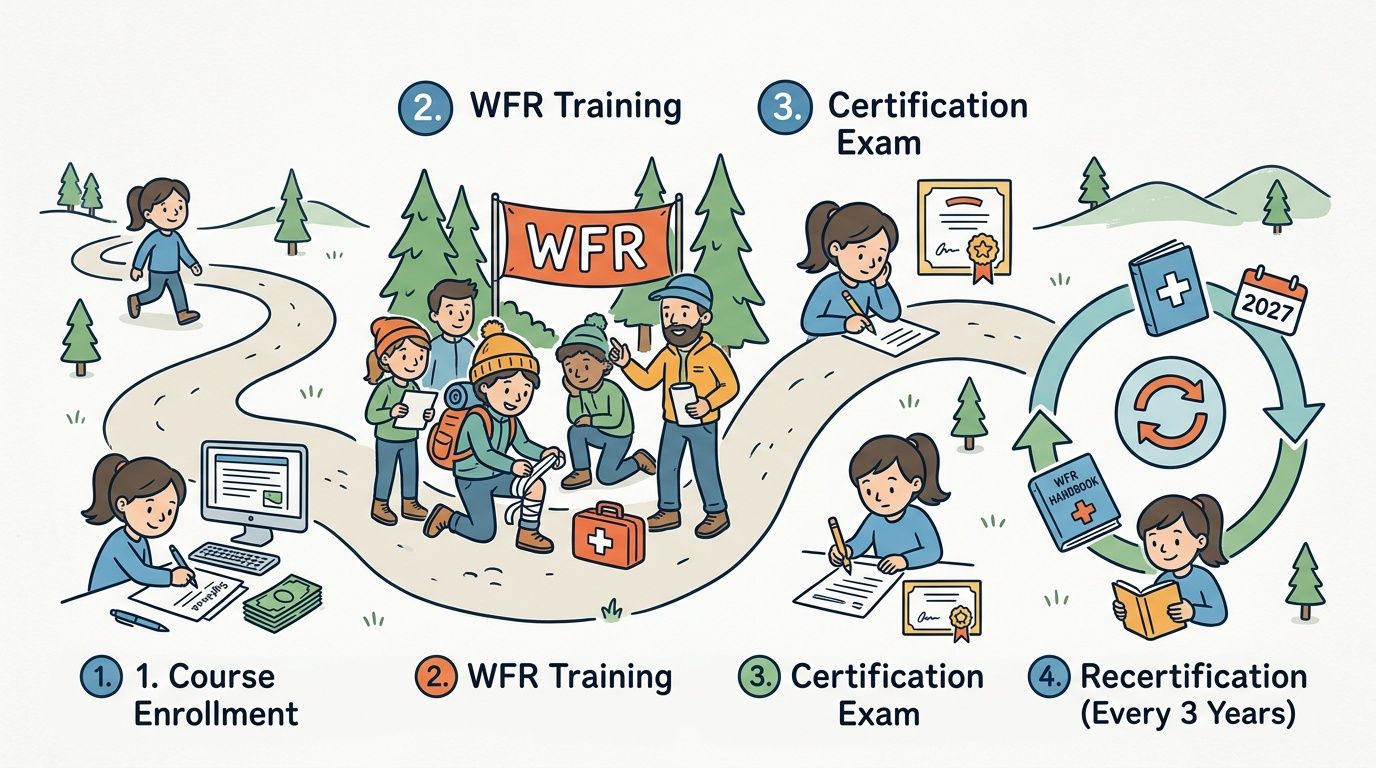
Getting a wilderness first responder certification feels more manageable when you view it as a sequence instead of one giant leap. You need the right foundation, the full course, and a plan to keep the credential current.
Step one starts with baseline life support
Many WFR providers include or require CPR as part of the overall training path. For some learners, that means making sure their basic life support knowledge is current before the course begins.
If you need that prerequisite or want a flexible refresher, BLS Certification is available as a 100% Online BLS Certification option. The course can be taken anywhere, on your schedule, and the card can be received in as quick as one hour or less after you complete the course and exam.
What you learn during the course
A typical WFR curriculum builds practical competence in several areas:
- Patient assessment: scene size-up, history, vital signs, head-to-toe exam, and trending changes
- Trauma care: wound management, musculoskeletal injuries, splinting, and spinal considerations
- Medical problems: respiratory issues, allergic reactions, infections, and other non-traumatic complaints
- Environmental problems: heat illness, hypothermia, altitude issues, and exposure-related risk
- Evacuation planning: deciding when to monitor, assist, delay movement, or trigger rescue
The point of this training isn't memorizing isolated steps. It's learning how to connect information under pressure.
How long the certification lasts
The 70–80 hour curriculum prepares responders to manage emergencies for days until professional help arrives, and major providers commonly validate that preparation with a standard 3-year certification period, as noted earlier in the established WFR standard.
That validity window is why recertification matters. Skills like assessment sequencing, field judgment, and patient monitoring fade if you don't use them often.
For readers comparing certification timelines across programs, this explanation of how long a ProMedCert certification will be valid is a useful example of how validity periods are communicated clearly in online education.
Keep in mind: recertification isn't just paperwork. It's a skills check on how you think, not only what you remember.
Take the Next Step in Your Medical Journey
A wilderness first responder fills a very specific gap. It prepares you to care for patients when distance, weather, terrain, and time remove the safety net most clinicians are used to.
Just as important, the way professionals pursue education is changing. Online learning is no longer a second-tier option for healthcare CE and certification. In one comparison of occupational health and safety training formats, online learners achieved knowledge scores statistically equivalent to in-person learners. That fits what many healthcare professionals already know from experience. Flexible learning can be rigorous, practical, and easier to sustain over a busy career.
If WFR is on your horizon, start by tightening up the skills that support it. For many readers, that means current CPR, AED, and first aid knowledge. CPR AED & First Aid Certification is a 100% Online Certification for CPR, AED & First Aid option that can be completed on your own schedule, with a card available in as quick as one hour or less after you finish the course and exam.
The outdoors won't become more predictable. Your training can become more adaptable.
If you're building your next certification plan, ProMed Certifications offers online courses designed for healthcare professionals who need credible, flexible education that fits real work schedules.
.avif)
Stay compliant with ProMed+
Certifications included: ACLS, BLS, PALS, CPR & Neonatal Resuscitation
Unlimited continuing education: over 200 hours of accredited CME
All-inclusive: One price. No surprises.
Get certified today

The Advanced Cardiac Life Support (ACLS) is an accredited online medical certification course that teaches medical professionals to respond to nearly all cardiopulmonary emergencies.

The Pediatric Advanced Life Support (PALS) Recertification instructs medical professionals on performing pediatric cardiopulmonary resuscitation in emergencies.

The Basic Life Support (BLS) Recertification is intended to teach healthcare professionals the basic steps of CPR and rescue breathing for adults, children, and infants.

Our online medical certification course for CPR, Automated External Defibrillator (AED), and First Aid is designed to teach adult, child, and infant CPR and AED use.

The Neonatal Resuscitation Certification trains medical professionals in performing resuscitation procedures and life-saving techniques for newborns at the time of delivery.

.png)
.png)
.png)