


Trauma Informed Care Training
.png)
A patient arrives late, avoids eye contact, snaps at the front desk, and refuses part of the exam. In a busy clinic, that can look like resistance or noncompliance. In many cases, it may be a stress response.
That shift in interpretation is the starting point for trauma informed care training. It helps healthcare professionals pause before labeling behavior, ask better questions, and reduce the chance of making an already difficult encounter feel threatening. For many clinicians, nurses, medical assistants, therapists, and support staff, that shift changes daily practice more than any single script or checklist.
It also changes how teams think about difficult interactions. A patient who seems guarded may be protecting themselves. A parent who appears angry may be frightened. A coworker who seems detached may be carrying secondary stress from repeated exposure to trauma. If you work with people, this framework matters.
Modern training has made this easier to learn and easier to implement. You no longer need to wait for a one-day seminar to build these skills. Flexible online education fits the reality of healthcare schedules, and that matters when staff need training they can complete. If your work often includes tense patient encounters, this practical resource on dealing with difficult patients in healthcare pairs well with trauma informed care principles because it helps translate compassion into communication.
Your Guide to a More Compassionate Practice
Trauma informed care is not about assuming every patient has the same history. It's about recognizing that many people have experienced events that affect how they perceive safety, authority, touch, noise, waiting, pain, and loss of control. Healthcare settings can trigger those responses without anyone intending harm.
For that reason, trauma informed care training is best understood as a practice skill, not just a sensitivity topic. It teaches professionals to notice patterns, adjust communication, and build safer interactions. Those changes can be small. Knock before entering. Explain each step before touching a patient. Offer choices when possible. Use neutral, respectful language.
Why the shift matters in daily care
The old model often starts with, “Why is this patient acting this way?” The trauma informed model starts with, “What might this person be responding to right now?” That question doesn't remove accountability or clinical standards. It improves the odds that your care plan will work.
In practical terms, trauma informed care training helps you:
- Reduce escalation: Patients who feel safer are often more able to listen, consent, and participate.
- Build trust faster: Clear explanations and predictable routines lower uncertainty.
- Protect staff well-being: Teams learn how to stay grounded during emotionally charged encounters.
- Improve consistency: Staff across roles use shared language and expectations.
Trauma informed care doesn't lower standards. It changes how we reach them.
A good training program gives you a way to apply these ideas across intake, triage, exams, bedside care, discharge planning, documentation, and follow-up. That's why the field has moved beyond awareness alone. The goal is not just to know trauma exists. The goal is to deliver care differently because of that knowledge.
What Trauma-Informed Care Really Means
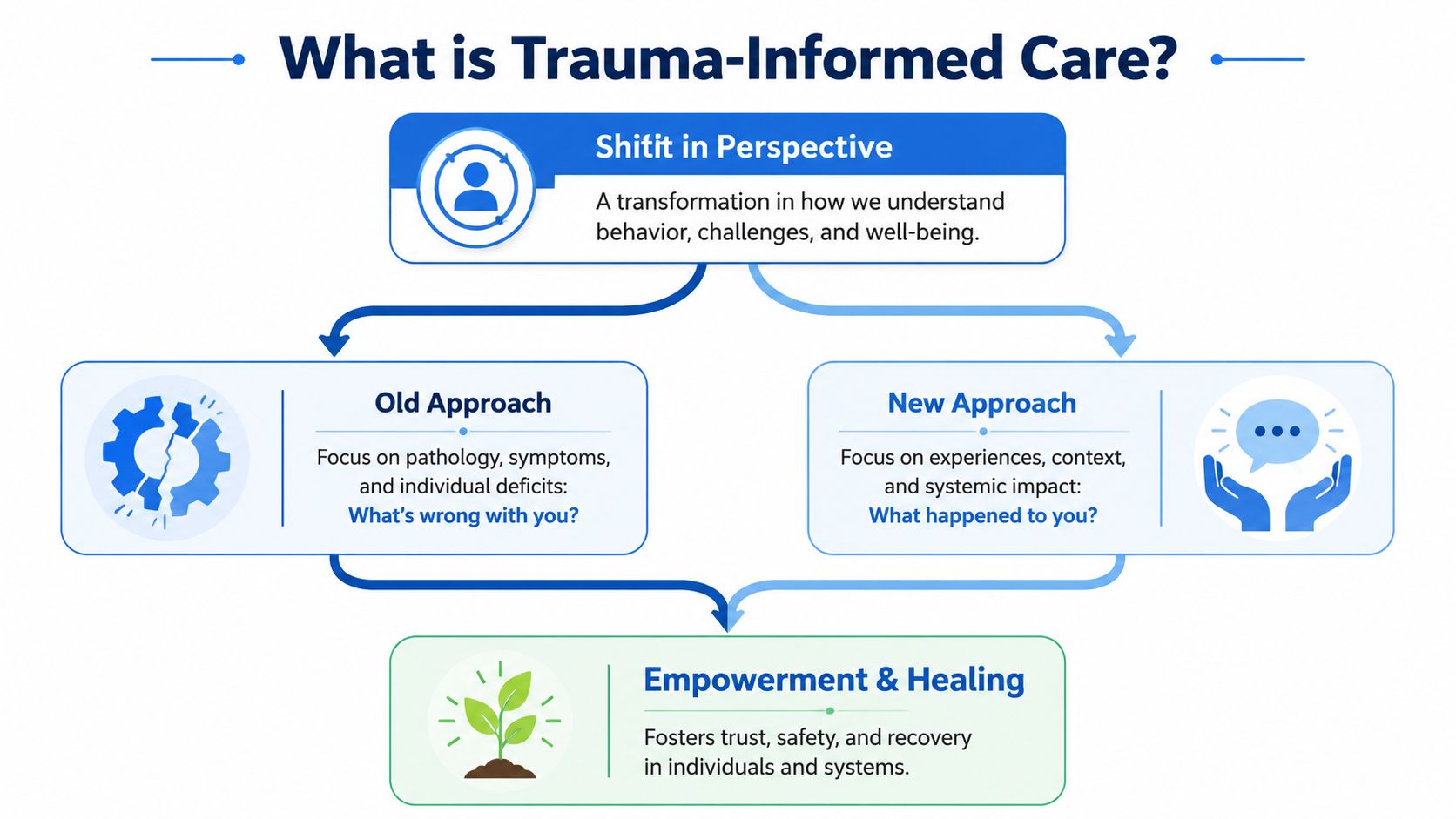
Trauma-informed care is an approach that asks providers to look beyond symptoms alone. Instead of viewing behavior as defiance, manipulation, or lack of motivation, it considers the role that past experiences may play in present reactions.
That doesn't turn every healthcare worker into a trauma therapist. It means you deliver care in a way that promotes safety, trust, and dignity.
The 4 R's in plain language
A widely used framework in trauma informed care training is SAMHSA's 4 R's. Clinicians are taught to Realize the prevalence and impact of trauma, Recognize signs and symptoms, Respond by integrating trauma knowledge into policy and procedure, and Resist re-traumatization.
Like infection control, you don't wait for proof of contamination before using good precautions. You use practices that lower risk across the board.
Here's what the 4 R's look like in real life:
- Realize: Trauma is common, and it can shape how patients react to touch, authority, delays, pain, or unexpected changes.
- Recognize: Signs may show up as anxiety, shutdown, irritability, missed appointments, hypervigilance, or difficulty trusting staff.
- Respond: Staff adapt workflows, scripts, room setup, and policies so care feels more predictable and collaborative.
- Resist re-traumatization: Teams avoid unnecessary power struggles, surprise exposure, dismissive language, and preventable loss of control.
From philosophy to workflow
Readers often get confused. Trauma informed care is not just “be nice” training. It's operational.
A front-desk employee can offer privacy when discussing sensitive information. A nurse can explain why a question is being asked before asking it. A clinician can offer a choice between two acceptable next steps. A manager can review whether current policies create avoidable distress.
Some patients will also need trauma-specific treatment, which is different from trauma informed care itself. If you want a patient-friendly explanation of therapeutic options.
The same move toward accessible education appears across healthcare training. For example, ACLS Certification can now be completed online through a format designed for busy professionals, with coursework available anywhere and completion possible in as quick as one hour or less. That same flexibility matters for trauma informed learning, especially when staff need practical education without stepping away from patient care for long blocks of time.
The Urgent Need for Trauma-Informed Skills
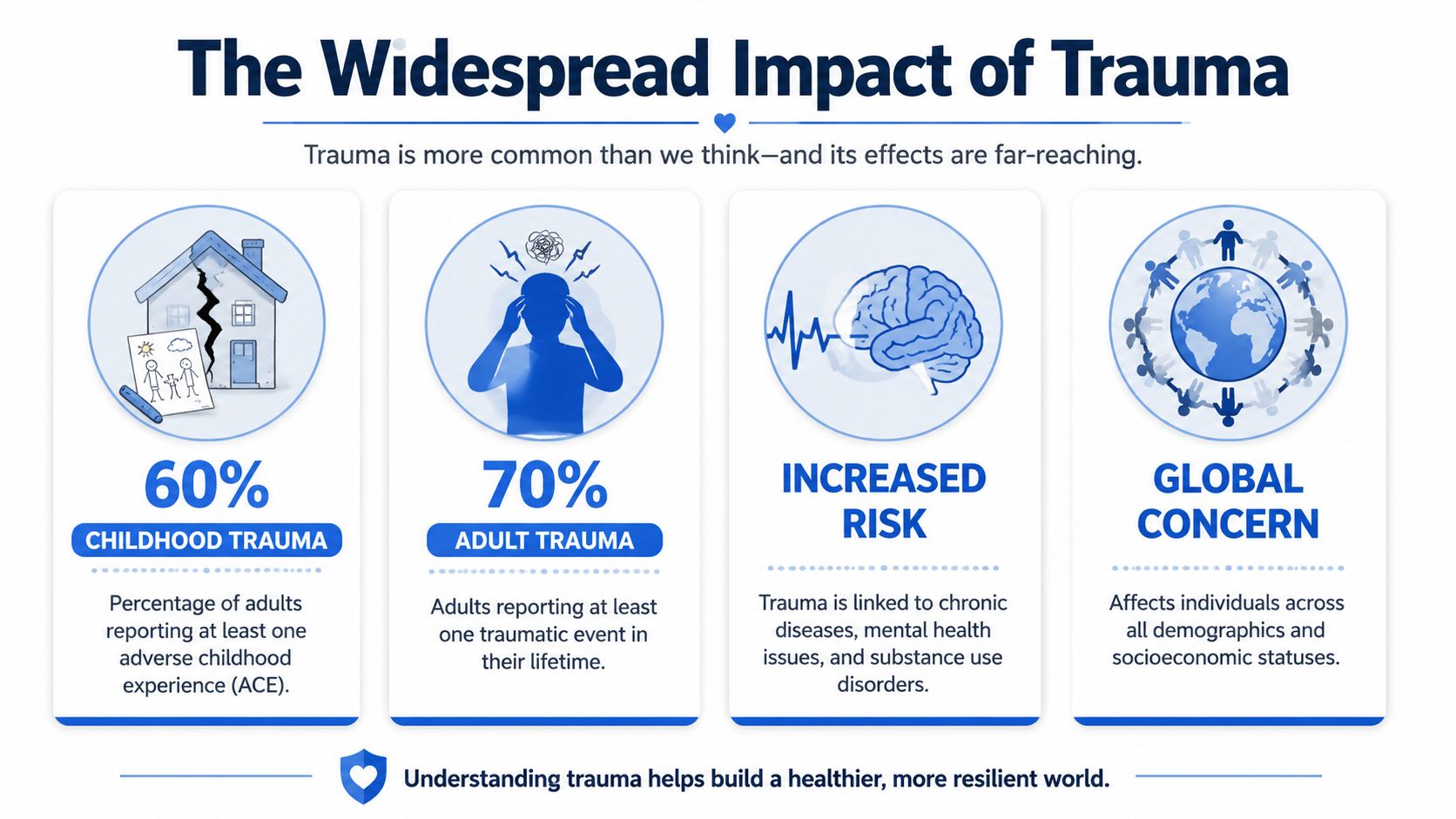
Trauma informed care training is not gaining attention because of a passing trend. It's gaining attention because trauma exposure is widespread, and healthcare workers encounter its effects every day.
A 2024 systematic review reported that the World Health Organization found 70.4% of respondents across 24 countries had experienced lifetime trauma, with an average of 3.2 traumas per person. The same review emphasized ongoing education for administrative staff, clinical practitioners, and support staff as essential for integrating trauma informed care across an organization, as described in this systematic review on trauma-informed care implementation.
Why this matters beyond behavioral health
Many clinicians still associate trauma informed care with mental health, addiction treatment, or social work. That's too narrow.
Trauma affects how patients tolerate procedures, receive bad news, respond to pain, manage chronic illness, and interact with systems. It also affects whether they return for follow-up. That means primary care, emergency medicine, pediatrics, obstetrics, surgery, rehabilitation, dentistry, and community health all have a stake in this.
A useful comparison comes from education. A Child Trends analysis found that the number of states with policies encouraging or requiring professional development on trauma-informed care in schools rose from 9 states in September 2017 to 30 states by September 2019, a 233% increase, or a tripling over two years, according to Child Trends' report on state trauma-informed school policies. Schools often formalize workforce training early, so that change is a strong signal of broader institutional adoption.
The workforce implication
This isn't only about patients. Staff are affected too. Repeated exposure to crisis, grief, violence, and emotionally charged care takes a toll. Teams that ignore trauma dynamics often mistake stress responses for attitude problems, both in patients and in coworkers.
A trauma-informed workplace pays attention to what staff carry, not just what patients bring in.
Healthcare leaders should also connect trauma informed care with clinician sustainability. Burnout, compassion strain, and emotional overload can undercut even the best training if organizations treat TIC as a one-time course rather than part of daily operations.
The Core Curriculum of Effective TIC Training
Not all trauma informed care training is equally useful. Some courses stay at the awareness level. They define trauma, review principles, and stop there. Better training gives professionals tools they can use during the next shift.
A strong curriculum usually blends clinical understanding, communication skills, and workforce protection. It should help staff know what trauma can look like, what to say in high-stress moments, and how to avoid carrying every difficult encounter home with them.
What high-quality training should include
Look for coursework that covers several layers of practice:
- Foundations of trauma: This includes how trauma can affect the brain, body, attention, memory, sleep, trust, and threat perception.
- Recognition across settings: Signs of trauma may look different in children, older adults, survivors of violence, patients with substance use disorders, or people with chronic pain.
- Communication techniques: Staff need scripts for consent, explanation, redirection, and de-escalation that preserve dignity.
- Environmental awareness: Noise, lighting, privacy, positioning, waiting, and physical touch all influence perceived safety.
- Professional boundaries and self-regulation: Clinicians need ways to stay present without becoming emotionally flooded.
A frequent blind spot is secondary traumatic stress. Staff can absorb the emotional weight of repeated exposure to others' suffering. The CHCS workforce resource describes trauma-informed work as including prevention of secondary traumatic stress and notes promising evidence of reduced violence and greater awareness of personal trauma reactions when staff receive training. It also points to brief, credentialable online formats, including a two-hour online curriculum with CME/MOC credit.
What practical training sounds like
Good training is concrete. It teaches language such as:
- Before an exam: “I'm going to explain each step before I do it.”
- When a patient hesitates: “We can pause. You still have choices.”
- During escalation: “You're safe here. I want to understand what feels hard right now.”
- After distress: “Would you like water, a quieter room, or a moment before we continue?”
Practical rule: If a workflow removes choice, privacy, or predictability, it may need a trauma-informed revision.
Trauma informed care training also works best when it links bedside behavior to larger systems. Intake forms, security practices, documentation habits, supervision, and staff debriefing all affect whether TIC feels real or performative.
For clinicians who need broader on-demand education alongside trauma-informed learning, ProMed+ Physician CME offers a streaming library with over 200 AMA PRA Category 1 Credits™ and access designed to fulfill state licensure mandates. That kind of format reflects what many professionals need now: education that is credible, current, and accessible when the schedule allows.
Why Online Training Is a Powerful Choice
Many healthcare professionals still hear some version of the same message: real training happens in a classroom, and online education is somehow second tier. That view is outdated.
For trauma informed care training, online formats make particular sense. This content is heavily cognitive, communication-based, and reflective. Learners benefit from being able to pause, replay, take notes, and return to modules after a difficult shift. Those are advantages, not compromises.

What the evidence supports
One study of healthcare providers found that a brief, regularly scheduled TIC training produced a measurable increase in knowledge about trauma and PTSD, and that gain persisted through 6 months after training. The study also found improved comfort working with trauma-exposed patients, as reported in this TIC training study for healthcare providers. That matters because it shows that accessible, lower-dose training can still produce lasting educational benefit.
The key lesson is not that every online course is automatically strong. It's that delivery format alone does not determine quality. A well-designed online course can teach concepts, language, reflection, and implementation just as effectively as a live session.
Why busy professionals choose online formats
Healthcare schedules are fragmented. Staff work nights, split shifts, overtime, weekends, and rotating assignments. That reality makes fixed-seat training hard to scale.
This matters for acceptance too. Many institutions now recognize accredited online CE and certification pathways because they fit workforce needs without lowering educational standards. The old belief that only a few legacy in-person providers are valid doesn't hold up across modern healthcare education. For cognitive training, especially, organizations increasingly care about accreditation, content quality, and outcomes, not whether a learner sat in a hotel conference room.
Online trauma informed care training is often the format staff will finish. In education, completion matters. So does retention. So does the ability to revisit material before applying it in practice.
Choosing the Right Training and Implementing It
Once you decide trauma informed care training belongs in your practice, the next step is selecting a course and building an implementation plan that goes beyond completion certificates.
Many organizations often stall. They train staff, check the box, and assume culture change will follow. It usually doesn't. Training works best when the course is credible and the rollout is intentional.
What individuals should look for
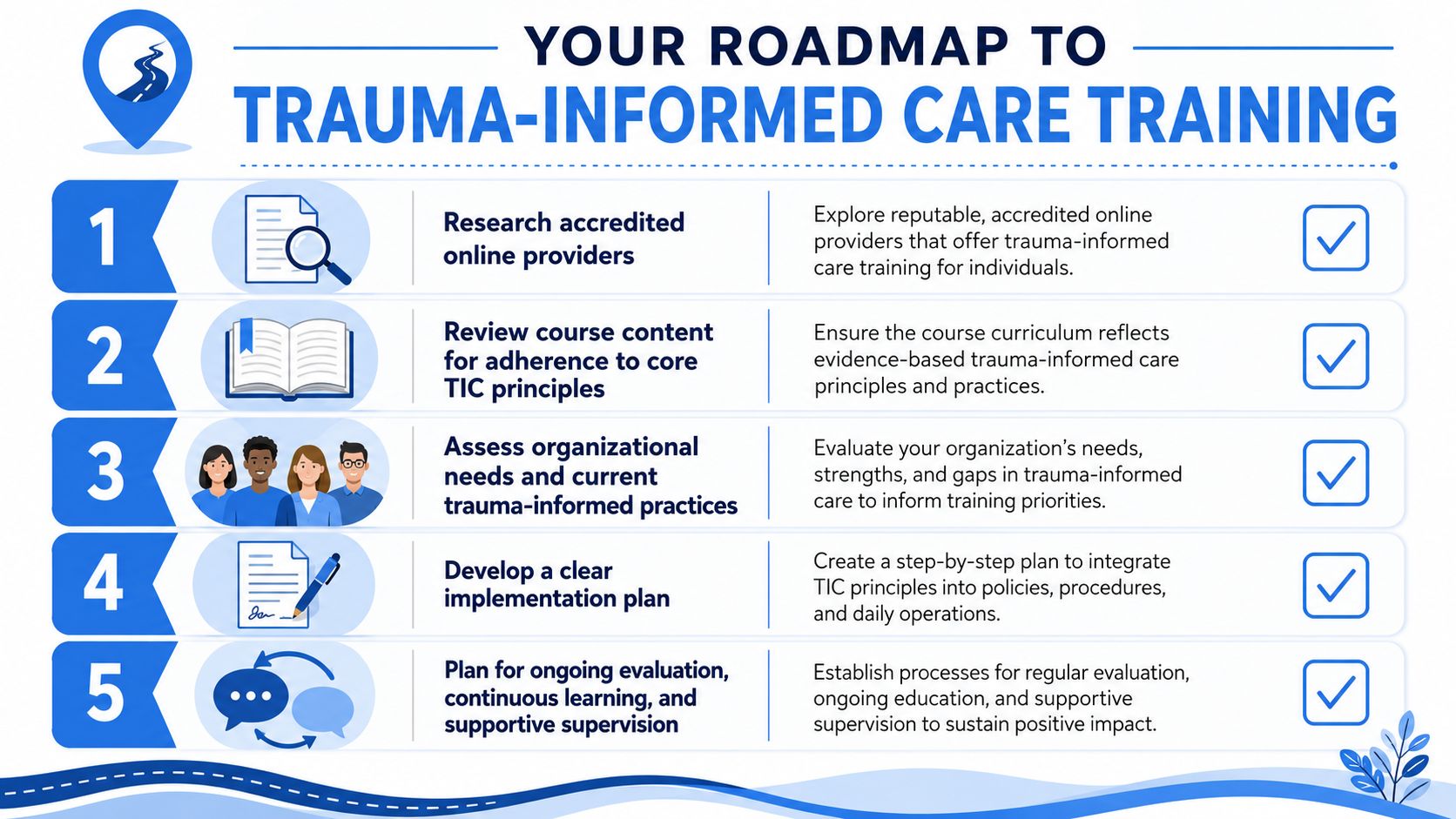
If you're choosing a course for yourself, use a short screen:
- Accreditation first: Confirm the education is recognized for your professional needs when CE or CME is relevant.
- Curriculum depth: The course should cover more than definitions. Look for patient communication, workflow application, and staff well-being.
- Evidence orientation: Training should connect principles to real practice, not just values language.
- Usability: Busy professionals need a format they can complete and revisit without friction.
A simple question helps separate strong options from weak ones: Can you name three things you would do differently with a patient tomorrow after taking this course?
What organizations should measure
For leaders, implementation should include policy review, staff support, and follow-up. A 2024 scoping review in trauma and emergency medicine found that only two curricula in the literature showed a reproducible positive impact on clinician use of trauma-informed practices and patient outcomes, according to this scoping review of TIC training in emergency medicine. That finding is important because it warns against assuming any training will produce meaningful change.
Use a practical rollout model:
- Start with pressure points: Intake, triage, restraint policies, invasive exams, discharge instructions, and complaint patterns are common places to begin.
- Train across roles: Front-desk teams, security staff, clinicians, and managers all affect the patient experience.
- Revise procedures: If the course teaches choice and transparency, your policies should allow staff to offer both.
- Build supervision in: Managers should reinforce the language and behaviors taught in training.
- Review impact: Look at patient feedback, staff feedback, incident patterns, and whether daily practice has changed.
The best trauma informed care training changes routines, not just opinions.
Implementation also needs staff recovery practices. If you ask people to show up calmly for distressed patients, you need systems that help them regulate after difficult encounters. This resource on mindfulness exercises healthcare workers can use to cope with stress is helpful for that reason. It supports the same goal from the workforce side.
Frequently Asked Questions About TIC Training
Is trauma informed care training only for therapists or behavioral health staff
No. It's useful for front-desk staff, nurses, physicians, medical assistants, care coordinators, technicians, case managers, and leaders. Anyone who shapes a patient's sense of safety can benefit.
Is a certificate of completion the same as a certification
Not always. A certificate of completion usually means you finished an educational activity. A certification usually refers to a more formal credentialing process. Providers should state clearly what the learner receives at the end.
How long does online trauma informed care training take
It varies by provider and depth. Some programs are intentionally brief and focused. Others are broader and include CE or CME components. The right length depends on your role, your setting, and whether you need introductory or implementation-focused training.
Can online training really prepare me for real patient interactions
Yes, if the course is well designed. Trauma informed care is largely about recognition, communication, workflow, and reflection. Those are all skills that can be taught effectively in online formats, especially when learners can revisit modules and apply them in practice over time.
What should I ask before enrolling
Use these questions:
- Is the content evidence-based? Look for clear grounding in established trauma-informed principles.
- Does it include practical application? Scripts, case examples, and workflow changes matter.
- Is it relevant to my role? A hospital nurse, outpatient therapist, and front-desk coordinator may need different emphasis.
- Will it count for CE or CME if I need that? Verify before you buy.
- Can I access it on my schedule? Completion is easier when the format fits real life.
How do I know whether training worked
For individuals, ask whether your communication, pacing, and patient interactions changed. For organizations, look for adoption in actual practice. Training should show up in how staff explain procedures, respond to distress, and review policies after challenging events.
If you're ready to build these skills in a format that fits healthcare work as it happens, ProMed Certifications offers online medical education designed for busy professionals who need flexible, credible training options they can complete on their own schedule.
.avif)
Stay compliant with ProMed+
Certifications included: ACLS, BLS, PALS, CPR & Neonatal Resuscitation
Unlimited continuing education: over 200 hours of accredited CME
All-inclusive: One price. No surprises.
Get certified today

The Advanced Cardiac Life Support (ACLS) is an accredited online medical certification course that teaches medical professionals to respond to nearly all cardiopulmonary emergencies.

The Pediatric Advanced Life Support (PALS) Recertification instructs medical professionals on performing pediatric cardiopulmonary resuscitation in emergencies.

The Basic Life Support (BLS) Recertification is intended to teach healthcare professionals the basic steps of CPR and rescue breathing for adults, children, and infants.

Our online medical certification course for CPR, Automated External Defibrillator (AED), and First Aid is designed to teach adult, child, and infant CPR and AED use.

The Neonatal Resuscitation Certification trains medical professionals in performing resuscitation procedures and life-saving techniques for newborns at the time of delivery.

.png)
.png)
.png)