


RN vs CNA: Choosing Your Path in Nursing
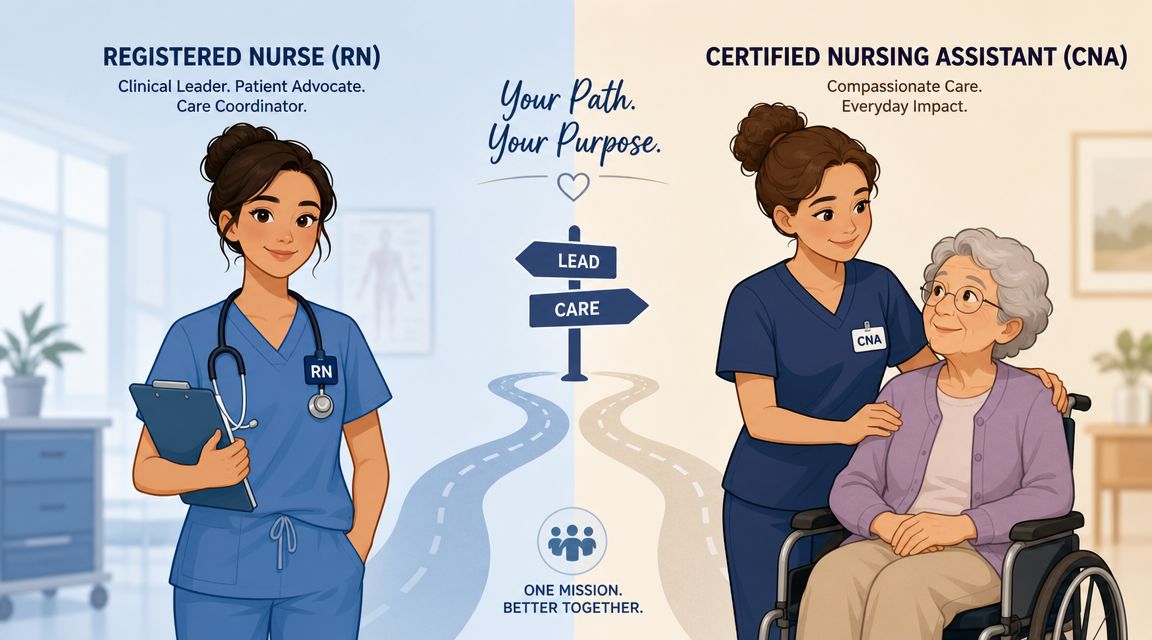
If you're looking at nursing careers right now, you're probably balancing a few very real questions at once. You want meaningful work. You may want a stable paycheck. You may also need a path that fits your current life, whether that means getting into healthcare quickly or investing more time now for a broader role later.
That's where many people get stuck on RN vs CNA.
On paper, both roles work closely with patients. Both are essential in hospitals, long-term care, rehab, and home care. Both can put you at the bedside, helping people through some of the hardest days of their lives. But they are not the same job, and choosing between them isn't just about picking a title. It's about choosing the kind of workday, responsibility level, training path, and future you want.
I've guided many students through this decision, and the biggest mistake I see is treating it like a simple ranking question. It isn't. A Certified Nursing Assistant (CNA) can be the right fit for someone who wants a faster entry into patient care. A Registered Nurse (RN) can be the right fit for someone who wants a wider clinical scope, more autonomy, and more long-term specialization options.
Your Future in Nursing Starts Here
A lot of prospective students come into nursing with the same assumption. They think they need to decide which role sounds more impressive. That's usually the wrong starting point.
The better question is this: What kind of role fits your life right now, and what kind of healthcare professional do you want to become over time?
Some people need a shorter runway. They want to start working with patients sooner, earn income sooner, and learn whether bedside care suits them. For them, the CNA route often makes sense. Others already know they want to assess patients, manage care plans, administer medications, and carry a broader level of clinical responsibility. For them, the RN path may be worth the longer educational commitment.
It's similar to entering healthcare through two different doors.
One door gets you onto the floor faster. You learn direct care, patient comfort, observation, and teamwork up close. The other door takes longer to open, but it leads to a broader practice scope and more decision-making authority.
Neither door is the “wrong” one.
Practical rule: Choose based on your next five years, not just your next five months.
You also don't need to assume your first choice locks in your whole career. Many people begin in one role and later continue their education. Nursing careers often grow in layers.
What matters most is clarity. You should know what each role does, what training it requires, what the work feels like day to day, and what tradeoffs come with each path. Once you understand those pieces, the decision becomes much less confusing and much more personal.
RN vs CNA A High-Level Overview
The easiest way to understand RN vs CNA is to separate direct support from clinical management of care.
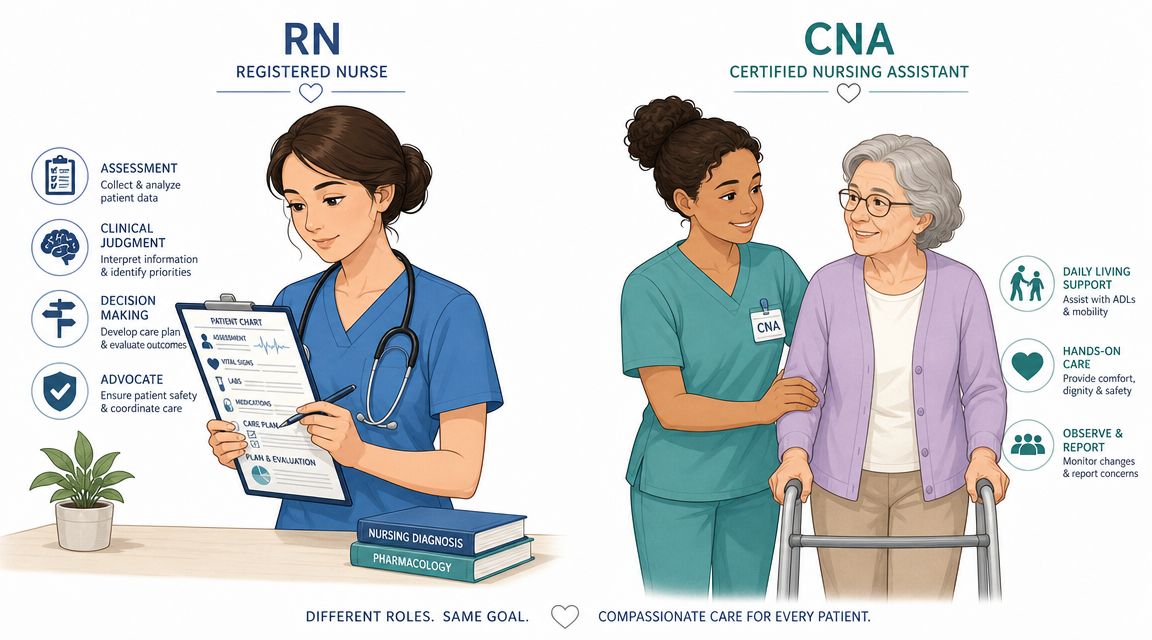
A CNA is extensively involved in hands-on daily support. An RN carries a broader clinical role that includes assessment, planning, coordination, and skilled nursing tasks. Both matter. They serve patients in different ways.

That distinction becomes clearer when you look at workforce scale. In the United States, Data USA reported 1,312,843 nursing assistants in 2024, with an average annual wage of $34,186, and the U.S. BLS reported about 211,800 openings per year on average from 2024 to 2034 for nursing assistants and orderlies because replacement demand is high, despite only 2% projected growth.
The simplest way to think about the difference
Here's the analogy I give students.
A CNA is often the team member closest to the patient's day-to-day needs. They help with comfort, movement, hygiene, feeding, and noticing changes. An RN takes that bedside information, combines it with assessment and clinical judgment, and turns it into a plan of care.
It's a bit like this:
- CNA role helps carry out essential daily care and notices what's changing.
- RN role decides what those changes may mean clinically and what should happen next.
That doesn't make one role “better.” It makes them interdependent.
Why this matters in real care settings
This difference shows up most clearly in places where patients need a lot of ongoing support, such as long-term care, rehab, and home care.
Strong care teams don't happen because one title outranks another. They happen because each person knows their role and communicates well.
In other words, RN vs CNA isn't a battle. It's a partnership with different lanes.
Education and Certification Paths Compared
A student standing at this fork in the road usually is not asking only, “Which title sounds better?” The core question is closer to, “What kind of training can I handle right now, and what kind of work life do I want on the other side of it?”
That is why this section matters. Education shapes your timeline, your budget, your weekly routine, and how quickly you can start caring for patients.
The CNA route
The CNA path is often the shorter runway into healthcare.
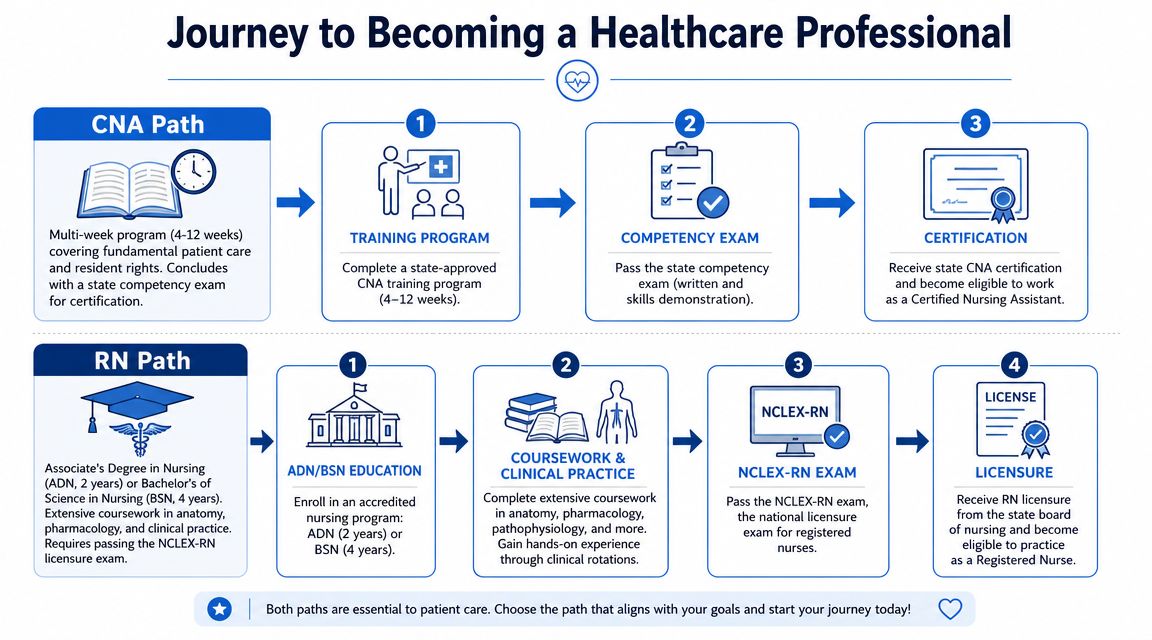
Training usually focuses on direct care skills: infection control, safety, communication, basic observations, mobility support, hygiene, and daily living assistance. After that, you meet your state's certification requirements and test for placement on the state registry.
For many students, CNA training works like getting onto the clinical floor through the side door first. You begin close to patients, learn how care feels hour by hour, and build comfort in a healthcare setting before deciding whether to keep climbing.
This path often fits students who want to:
- Start working sooner and gain patient-care experience quickly
- Test their fit for nursing before committing to a longer degree program
- Build bedside confidence through hands-on care
The RN route
The RN path asks for more time and a deeper academic commitment.
To become an RN, you usually complete an ADN or BSN and then pass the NCLEX-RN. That longer preparation exists for a reason. RNs need a wider base in science, assessment, clinical judgment, pharmacology, and care planning because their decisions carry broader responsibility.
If the CNA role introduces you to patient care, the RN route trains you to interpret what is happening, decide what needs attention, and coordinate the next step. One role centers on doing and observing. The other adds analysis, prioritization, and licensed accountability.
Side-by-side training mindset

Where online learning fits now
Many prospective students still hear outdated advice that online certifications somehow count less than in-person ones. That confusion can lead people to rule out practical options too early.
The better question is whether the course meets employer expectations, state rules, and accreditation standards. Format matters less than quality and acceptance. For busy adults, parents, military spouses, and shift workers, online learning often makes the difference between delaying a goal and starting.
That is especially true for early credentials such as BLS and for continuing education later on. A factual example is ProMed Certifications, which offers online healthcare certifications such as BLS, ACLS, PALS, CPR, and Neonatal Resuscitation. If you are planning beyond one course and into a full nursing application strategy, these best practices when submitting nursing school applications can help you prepare in a more organized way.
One more practical reality matters here. Training choices affect daily life, not just your resume. If you are balancing classes, clinicals, commuting, and long shifts on your feet, even small decisions around comfort and endurance start to matter.
A simple way to decide is this. If you want a faster start, early patient contact, and a lower barrier to entry, the CNA route may fit your life right now. If you are ready for a longer educational climb in exchange for broader responsibility and more career options later, the RN route may be the better match.
Daily Roles and Responsibilities on the Floor
Titles become clearer when you picture the work itself.
A student often asks me, “But what would my day look like?” That's the right question. Most career decisions become easier once you stop comparing labels and start comparing routines.
What an RN is usually doing
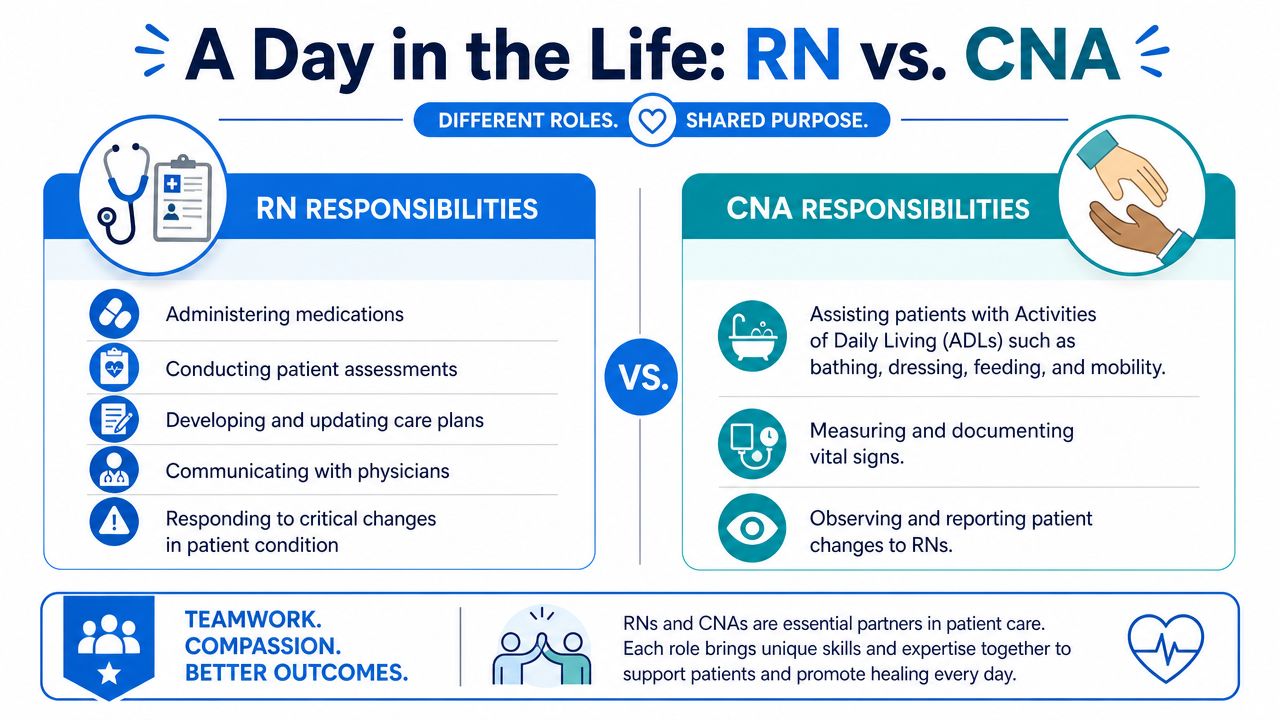
From a scope-of-practice standpoint, the RN role is broader. RNs assess, plan, coordinate, and deliver skilled nursing, including medication administration, monitoring for reactions or side effects, and creating and implementing care plans, while CNAs primarily provide basic direct care such as activities of daily living, mobility assistance, and vital-sign checks under RN or LPN supervision (Rasmussen University overview of CNA versus RN scope).
On a typical shift, an RN may be:
- Assessing patients at the start of the shift and throughout the day
- Reviewing symptoms and changes to decide what needs attention
- Giving medications and watching for side effects or adverse reactions
- Updating care plans as patient needs change
- Communicating with physicians and the care team about next steps
- Teaching patients and families what to expect, what to monitor, and how to continue care safely
The RN role involves constant judgment. Not just doing tasks, but deciding what matters most and what should happen next.
What a CNA is usually doing
A CNA's work is more physically hands-on and often more continuous at the bedside.
A CNA may spend much of a shift:
- Helping with bathing, dressing, grooming, and toileting
- Assisting with meals and hydration
- Repositioning or transferring patients safely
- Taking vital signs
- Observing patient comfort, mood, mobility, and behavior
- Reporting changes quickly to the supervising nurse
If an RN often asks, “What does this change mean clinically?”, a CNA is often the first to notice that a change happened at all.
A skilled CNA is often the first set of eyes on a subtle change in comfort, appetite, mobility, or behavior.
Why students often misunderstand this
People sometimes assume the RN does “medical work” and the CNA does “basic work.” That framing misses the point.
Basic care is not small care. Helping a patient eat, move safely, stay clean, avoid skin breakdown, and feel human matters tremendously. Those tasks protect dignity and can reveal early signs that something is wrong.
The relationship is collaborative. The CNA gathers important bedside observations. The RN interprets that information within the larger care picture.
And there's a practical side students don't think about until clinicals start. Both roles spend long hours on their feet.
If you're thinking beyond bedside basics and want to see where the RN path can branch out, these career options for registered nurses show how varied the profession can become over time.
Salary Potential and Job Outlook for 2026 and Beyond
Two students can stand in the same hospital hallway and see two very different futures. One wants to start earning as soon as possible. The other is willing to spend more time in school for a wider range of options later. Salary and job outlook matter because they shape what each path can realistically support in your life.
The U.S. Bureau of Labor Statistics reported a median annual wage of $86,070 for registered nurses in May 2023, compared with $38,200 for nursing assistants. The same agency projected 6% employment growth for RNs from 2022 to 2032 and 4% for nursing assistants over that period.
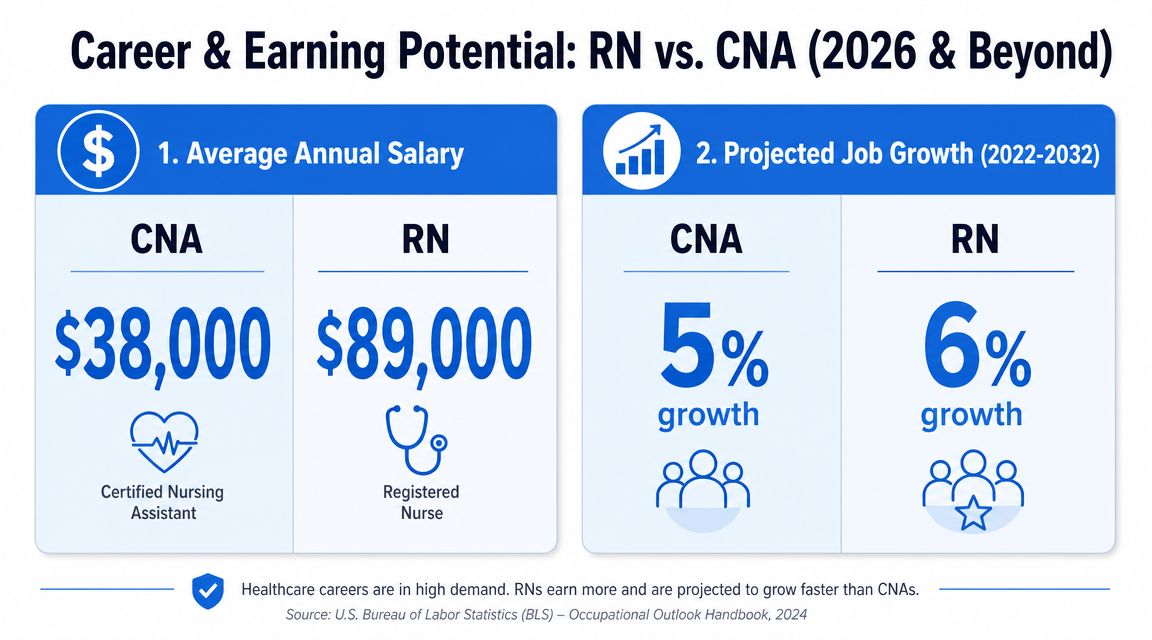
What those numbers mean in real life
A higher RN salary is tied to a longer runway. You spend more time in school, meet stricter licensing requirements, and carry broader responsibility once you are on the floor. In return, you are usually paid for clinical judgment, coordination, medication administration, patient education, and the ability to make decisions that affect the whole plan of care.
CNA pay sits lower, but the entry point is faster. For some students, that is not a drawback. It is the deciding factor. If you need income soon, want to test whether bedside care fits you, or need a shorter training path that can work with family or work obligations, the CNA route can make practical sense.
That is the part many articles skip. The better-paying job is not always the better first move for your life.
Growth percentages do not tell the whole story
Students often compare 6% versus 4% and stop there. That misses how healthcare hiring works.
RN demand is tied to the need for licensed clinicians who can assess patients, coordinate care, and handle more complex medical responsibilities. CNA demand comes from something more constant. Patients still need help eating, bathing, repositioning, walking safely, and reporting changes in comfort or behavior. Facilities need people in those roles every day, even if the growth rate is a little lower on paper.
A useful way to frame it is this. RN is usually the longer investment with a broader payoff. CNA is usually the faster entry with steadier access to frontline work.
A better money question
Do not ask only which role pays more. Ask which path fits the timing and shape of your life.
Use these questions:
- How quickly do I need a paycheck?
- Can I realistically commit to a longer education path right now?
- Do I want broader responsibility and a higher income ceiling later?
- Am I looking for a first step into nursing, or the role I want to hold long term?
If you are drawn to nursing but need a shorter on-ramp, online training can be a valid starting point if it matches your state requirements and includes the steps needed for certification. For students weighing that bridge approach, this guide on advancing from CNA to RN over time can help you map the financial side of the decision with more clarity.
The goal is not to chase the biggest number on a chart. The goal is to choose a path you can start, sustain, and build on.
Career Progression and Specialization Pathways
One of the best things about nursing is that your first role doesn't have to be your last role.
A CNA position can be a long-term career for people who love direct patient support. It can also be a launch point. Working as a CNA teaches you how care feels at the bedside, how patients communicate distress, and how teams function under pressure. Those lessons carry forward.
If you start as a CNA
Starting as a CNA can help you answer an important question early. Do you enjoy the daily realities of patient care enough to build more education on top of it?
For many people, that answer becomes clear only after time on the floor.
A CNA role can help you build:
- Comfort with patient interaction
- Confidence in clinical environments
- Observation skills that matter to nurses
- Team habits such as reporting, handoff, and accountability
If you're thinking about using that route as a bridge, this guide on how to advance your career from CNA to RN maps out the transition in a practical way.
If you choose the RN path
The RN license opens a much wider map.
RNs can move into specialties, leadership, education, care coordination, and advanced practice over time. The exact route depends on your interests and your state requirements, but the larger point is simple. RN training gives you access to more branches later.
Common directions include:
- Specialty practice areas such as critical care, pediatrics, oncology, or labor and delivery
- Education roles where nurses teach students, staff, or patients
- Leadership roles involving unit management or operational oversight
- Advanced clinical growth through additional formal education and certification
The most valuable long-term nursing skill isn't memorizing everything once. It's learning how to keep learning.
That's where continuing education matters. Online CE has become a practical part of career growth because nurses need learning that fits rotating shifts and real life. The old assumption that worthwhile professional education must happen in a classroom is fading. For certifications and CE, online options are widely used because they give working clinicians access without unnecessary schedule disruption.
The teamwork lesson most people overlook
A frequently missed part of the RN vs CNA discussion is work design. CNAs typically operate under RN or LPN supervision, and research on RN and nursing assistant relationships has found that patient safety depends heavily on trust, two-way communication, and accountability rather than job title alone (Indeed discussion of CNA work with underserved populations and RN-CNA teamwork).
That matters for career growth.
A CNA who learns to communicate clearly, escalate concerns well, and work reliably with nurses is building habits that matter in every future healthcare role. An RN who respects CNA observations and leads with clarity becomes safer and more effective. Career advancement isn't only about climbing. It's also about learning how to function well with others in the care environment.
Making Your Choice and Taking the Next Step
If you're still weighing RN vs CNA, come back to three things.
First, how quickly do you need to enter the workforce? Second, how much responsibility do you want in your future role? Third, how much time and energy can you realistically invest in education right now?
If you want a faster start and direct bedside experience, CNA may fit your life well. If you already know you want the broader licensed nursing role, the RN path may be worth the longer climb.
There isn't one correct answer. There's the answer that fits your current season and your long-term direction.
When you're ready to apply, small practical details matter too. Reviewing strong RankResume's nurse examples can help you understand how nursing candidates present clinical skills, training, and patient care experience clearly.
The next step doesn't need to be dramatic. It just needs to be real. Research your state requirements, compare program formats, and make sure your foundational certifications are in place. For many students, that starts with BLS and other core credentials that support either path.
If you're ready to move toward a nursing role, ProMed Certifications offers online healthcare certification courses that can help you complete required training on your schedule. That flexibility is especially useful if you're balancing school applications, work, family responsibilities, or a career change while preparing for the next step.
.avif)
Stay compliant with ProMed+
Certifications included: ACLS, BLS, PALS, CPR & Neonatal Resuscitation
Unlimited continuing education: over 200 hours of accredited CME
All-inclusive: One price. No surprises.
Get certified today

The Advanced Cardiac Life Support (ACLS) is an accredited online medical certification course that teaches medical professionals to respond to nearly all cardiopulmonary emergencies.

The Pediatric Advanced Life Support (PALS) Recertification instructs medical professionals on performing pediatric cardiopulmonary resuscitation in emergencies.

The Basic Life Support (BLS) Recertification is intended to teach healthcare professionals the basic steps of CPR and rescue breathing for adults, children, and infants.

Our online medical certification course for CPR, Automated External Defibrillator (AED), and First Aid is designed to teach adult, child, and infant CPR and AED use.

The Neonatal Resuscitation Certification trains medical professionals in performing resuscitation procedures and life-saving techniques for newborns at the time of delivery.

.png)
.png)
.png)