


A Guide to Using Pediatric AED Pads Correctly
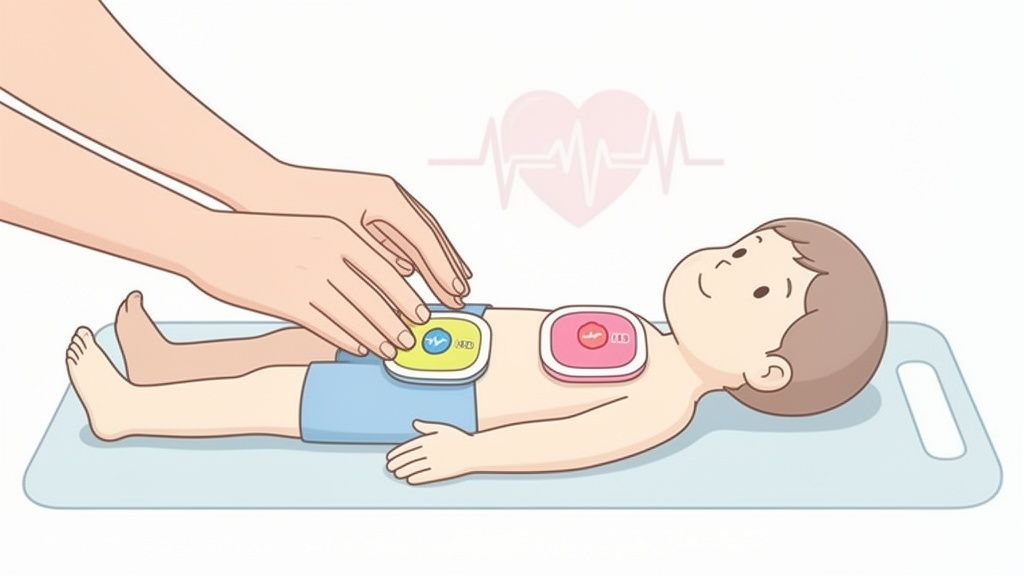
When a child goes into sudden cardiac arrest, every single second counts. Using the right equipment isn't just a suggestion—it’s absolutely critical. Pediatric AED pads are specifically made to deliver a weaker, reduced-energy shock that’s right for a child's smaller body, a vital difference from the standard pads used on adults. This guide will help you understand the why, when, and how of using them, giving you the confidence to act decisively in an emergency.
The Critical Role of Pediatric AED Pads
Sudden cardiac arrest doesn’t just happen to adults. When it strikes a child, your response has to be just as fast, but much more precise. This is exactly why pediatric AED pads are a non-negotiable piece of equipment. A child’s body is fundamentally different from an adult’s, and that requires specialized tools to have any hope of a good outcome.
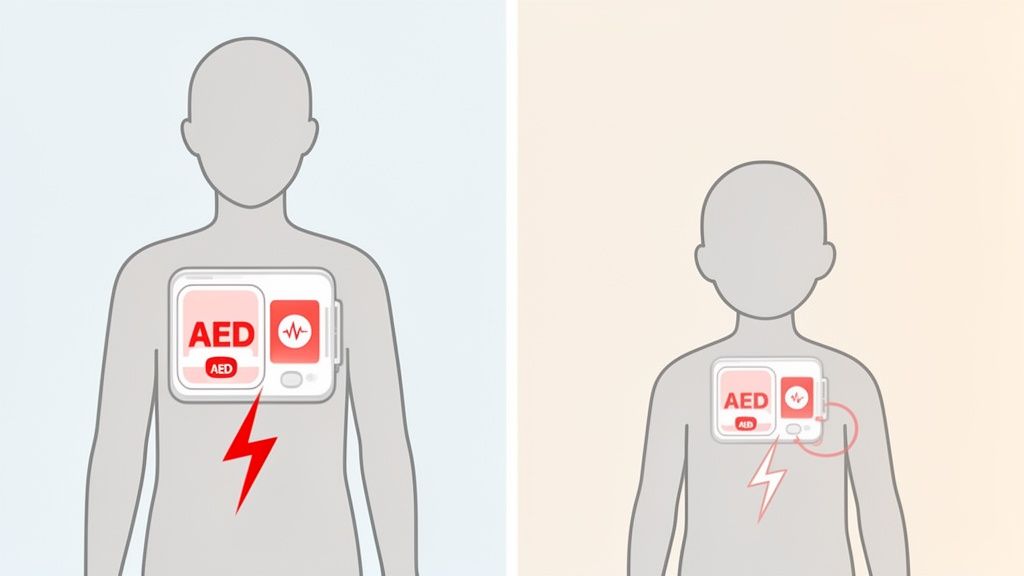
Think of it like this: an adult AED delivers a powerful jolt of electricity, like a blast from a firehose. While that's what's needed for a grown-up, that same force can be far too damaging for a child’s smaller, more fragile heart. Pediatric pads are more like a precision sprinkler—they deliver the life-saving energy, but at a lower, safer dose for a child.
Why Specialization Matters in Pediatric Care
Grasping this difference is a core skill for any healthcare professional, especially those with PALS or BLS certifications. It’s not just about grabbing smaller pads; it’s about applying the right medical principles to give your patient the best possible chance. This kind of specific knowledge is what high-quality nurse-led pediatric care is built on, highlighting why having child-specific emergency gear is so important.
Proper training drills these details into you, preparing you to act with confidence when the pressure is on. Knowing how to respond correctly can completely change the outcome and is a key link in the pediatric chain of survival.
To put these differences in perspective, here’s a quick breakdown of what sets pediatric and adult AED pads apart.
Pediatric vs Adult AED Pads at a Glance
This table offers a quick comparison, highlighting the fundamental differences between pediatric and adult AED pads for emergency response.

Ultimately, having the right tool for the job is what matters. Using adult pads on a small child can deliver a dangerously high shock, while using pediatric pads on an adult won't deliver enough energy to be effective.
It's worth noting that top-tier online certifications are now widely seen as just as valid and effective as in-person classes. Multiple peer-reviewed studies have confirmed that online learning can lead to equal or even superior knowledge retention and patient care outcomes, all while offering unparalleled flexibility.
This industry shift is changing professional development for the better. The outdated belief that only in-person classes from providers like the AHA or American Red Cross are valid is simply not true. Modern healthcare is evolving, and organizations are increasingly recognizing accredited online certifications. A high-quality online PALS or BLS course will absolutely equip you with these life-saving skills, giving you the competence you need to handle a pediatric emergency.
When you first look at pediatric AED pads, the most obvious difference from the adult version is their size. But the real magic isn't what you see on the surface; it's the technology working inside to protect a child’s smaller, more fragile heart.
The core function that sets these pads apart is energy attenuation. This is just a clinical term for reducing the electrical shock's power.
Think of an AED as a high-voltage wall outlet. Adult pads are like a standard plug, letting the full current flow through. Pediatric pads, on the other hand, are like a smart adapter that steps down the voltage, making sure the energy delivered is just right for a child's heart.
This isn't a small tweak—it's a critical safety feature. The pads have a built-in resistor that automatically dials down the AED's electrical output (measured in joules). This ensures the powerful shock meant for a 200-pound adult doesn't cause more damage to a 40-pound child.
Built for a Child's Unique Physiology
Beyond just lowering the energy, these pads are engineered specifically for a child’s body. The adhesive is strong enough to get a solid connection but formulated to be gentle on a child's sensitive skin, preventing unnecessary irritation.
The conductive gel is also different. It's designed to spread the lower-energy shock evenly across the smaller pad, making sure the electrical current takes the correct path right through the heart. As a provider, knowing these details helps you make confident, split-second decisions when the pressure is on.
Knowing the 'why' behind using pediatric pads is a key competency reinforced in high-quality PALS and BLS training. It's the difference between simply following steps and truly understanding the life-saving science you are applying.
This is exactly the kind of deeper knowledge that modern online certification programs are built to provide. The old-school belief that only courses from specific providers like the AHA or American Red Cross are valid is quickly becoming outdated. The healthcare industry now recognizes that accredited online training can offer equivalent, and sometimes even superior, results in both knowledge retention and patient care outcomes.
The Science of Safe Energy Delivery
The AHA guidelines are clear: use pediatric AED pads for any child up to 8 years old or weighing less than 55 pounds (25 kg). This is to stop the AED from delivering too much energy.
For instance, a paramedic with a manual defibrillator might start a shock at 2 joules per kilogram and increase it from there. An AED with pediatric pads takes the guesswork out of it, automatically adjusting the dose to a safer, fixed level. This is crucial since young children have a lower chance of having a shockable rhythm in the first place.
Leading manufacturers also have specific guidelines. ZOLL Medical, for example, specifies an anterior-posterior placement for kids—one pad on the chest, one on the back. This ensures the current travels directly through the heart in a smaller torso.
For any professional renewing their PALS or BLS certification, this kind of specific, evidence-based knowledge is non-negotiable. It's a standard of care that's taught and reinforced effectively through accredited online education. Platforms like ProMed Certifications are at the forefront of this change, delivering convenience and credibility by offering courses that carry the same weight as traditional classes but with the flexibility busy professionals need. You can stay current on best practices without completely upending your schedule.
Grabbing the right pediatric AED pads is a huge first step, but it’s only half the battle. Where you place those pads is just as critical. Proper placement is all about making sure that life-saving electrical current takes a direct path through the heart muscle—that’s the entire point of defibrillation, after all.
For infants and small children, we don't use the same pad placement as we do for adults. The go-to method is anterior-posterior placement, which is just a technical way of saying front-and-back. This technique is perfect for a small torso because it guarantees the pads are far enough apart, with the heart sitting squarely in the middle of the electrical path.
Step-by-Step Anterior-Posterior Placement
Trying to apply AED pads in the middle of a high-stress emergency can feel overwhelming, but the process itself is actually very simple. Your best guides will always be the pictures on the pad packaging and the AED’s own voice prompts.
Here’s a breakdown of how to get it right:
- Prepare the Child’s Torso: First things first, get all clothing off the child’s chest and back. If the skin is wet from sweat or water, give it a quick wipe-down. The pads need solid, dry contact to work.
- Place the Front (Anterior) Pad: Take one pad and place it right in the center of the child’s chest, directly over the breastbone (sternum).
- Place the Back (Posterior) Pad: The second pad goes on the child’s back, positioned right between the shoulder blades.
- Connect and Analyze: With both pads stuck on firmly, plug the connector into the AED. Now, just listen and follow its instructions. Critically, make sure no one is touching the child while the machine analyzes their heart rhythm.
This front-and-back setup is essential. It prevents the pads from getting too close and touching, which would cause the electrical current to arc across the surface of the skin instead of passing through the heart where it’s needed.
The image below gives you a great visual of how pediatric pads step down the AED’s energy to a level that’s safe for a child.
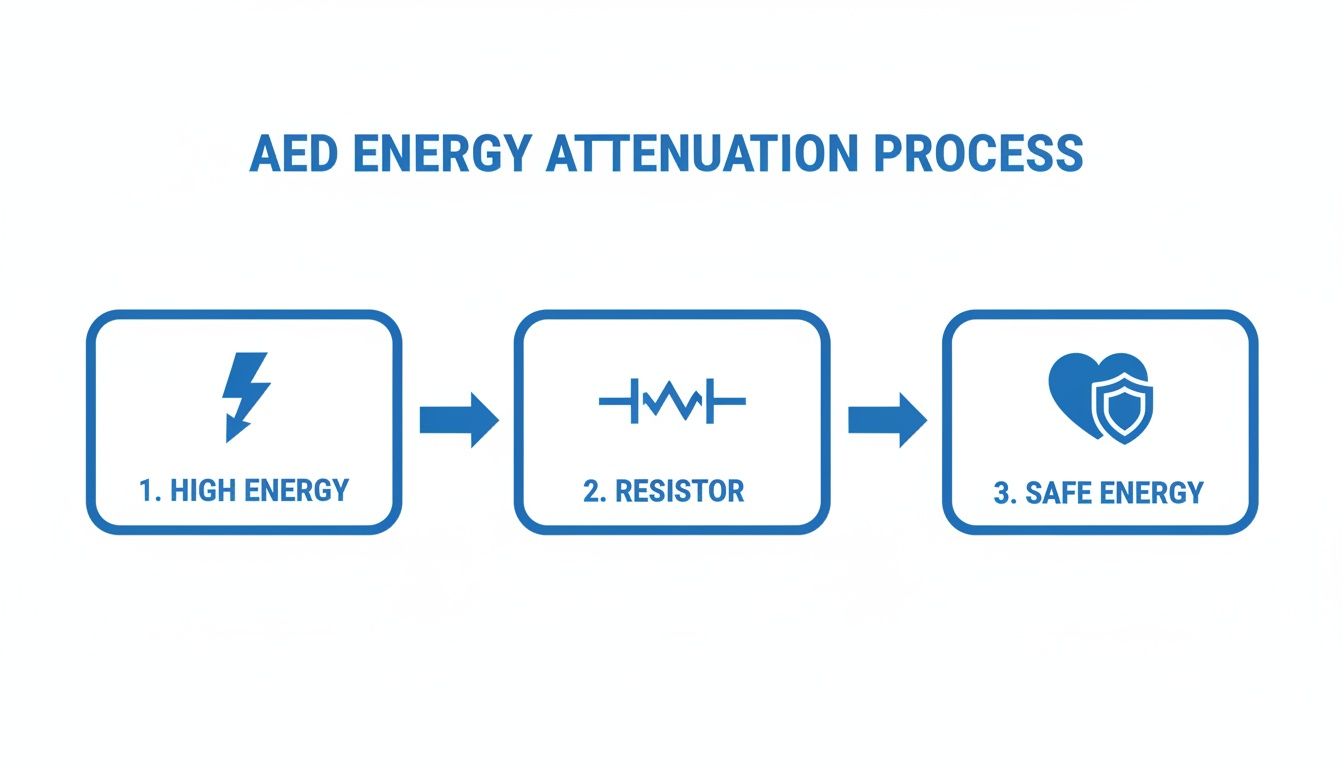
As you can see, the device's high energy is passed through a special resistor built into the pediatric pads. This delivers a shock that is both safe and effective for a child’s smaller heart.
Navigating Real-World Scenarios
So, what happens when you have a larger child who’s right on the edge of the 8-year or 55-pound cutoff? If you place the pads on the front of the chest and there's any chance they might touch, don't risk it. Your default move should always be the anterior-posterior (front-and-back) placement. It’s the safest and most effective bet, no matter if you're using adult or pediatric pads on a child in that gray area.
This is the kind of on-the-fly critical thinking that top-tier PALS and BLS courses are designed to build. You can see how these judgment calls fit into the bigger picture by reviewing the official pediatric BLS algorithm for a single rescuer.
The idea that only traditional, in-person training is valid is an outdated view. The general consensus in the healthcare industry is shifting, with hospitals and clinics increasingly recognizing that high-quality, accredited online certifications produce equally competent providers.
In fact, peer-reviewed studies have shown that online learning often leads to equal or even superior knowledge retention compared to a conventional classroom. These programs are built to prepare you for exactly these kinds of real-world situations, like making a judgment call on pad placement. It’s powerful proof that modern, accredited online training gives you the confidence and skill you need to act decisively and save a life.
Navigating Pediatric AED Age and Weight Guidelines
When a child goes into cardiac arrest, one of the most stressful questions you can face is deciding whether to use adult or pediatric AED pads. It’s a high-stakes moment, but thankfully, the answer isn’t a judgment call.
The American Heart Association (AHA) and AED manufacturers have set a clear, evidence-based rule: use pediatric AED pads for any child under 8 years of age or weighing less than 55 pounds (25 kg).
This isn’t just an arbitrary number. It’s all about physics and physiology. An adult AED delivers a powerful jolt of electricity designed for a full-grown heart. That same dose can be too much for a child’s smaller, more delicate heart muscle, potentially causing serious damage. Pediatric pads are specifically engineered to dial down that energy to a safer, effective level for a child.
The Dilemma: What if Pediatric Pads Are Unavailable?
In a perfect world, you’d always have the right size pads. But emergencies are rarely perfect. So, what happens when you’re faced with a child in cardiac arrest, you have an AED, but only adult pads are available?
This is a scenario every good BLS or PALS certification course will drill into you. The answer is unequivocal: use the adult pads instead of delaying defibrillation.
A delayed shock is a denied chance at survival. Any shock is far better than no shock at all. The key is to place the adult pads in an anterior-posterior (front-and-back) position. This ensures the pads don’t touch each other, which would prevent the AED from working correctly.
This kind of critical thinking is a hallmark of high-quality medical training, and it highlights just how far online education has come.
The belief that only in-person training from organizations like the AHA or Red Cross is valid is simply outdated. Today’s healthcare world is moving fast, and hospitals, clinics, and other organizations are widely recognizing accredited online certifications. Peer-reviewed studies support this shift, showing that online learning achieves equal or superior outcomes in knowledge retention and skill mastery.
Critical Don'ts: Using Pediatric AED Pads
While you can use adult pads on a child in a pinch, the reverse is never, ever an option. You must never use pediatric AED pads on an adult or any patient who tips the scales over the 55-pound limit.
The reason is stark and simple: it won’t work. The reduced energy dose from pediatric pads is just too weak to restart an adult-sized heart. The rescue attempt would be completely ineffective.
This is more than just a piece of trivia; it’s a vital detail for any rescuer. Research reveals some pretty significant gaps in how often AEDs are used on children, often because rescuers hesitate. For out-of-hospital cardiac arrests, children between 1 and 8 years old only get an AED shock 16.3% of the time. That’s much lower than the rate for adults, even though many of these kids have shockable rhythms.
These numbers show just how critical proper training and confidence are. Closing this life-threatening gap starts with knowing exactly what to do and having the confidence to do it.
This is precisely the kind of practical, real-world training that modern online certification platforms like ProMed Certifications are built for. Our courses are future-focused and aligned with industry shifts, designed for busy healthcare professionals who need credible, comprehensive education that fits their schedule. By enrolling, you’re arming yourself with the knowledge to make life-saving decisions under pressure, all while meeting the highest standards of modern patient care.
Maintaining Your AED Pad Inventory and Readiness
An automated external defibrillator is only as good as its weakest link. More often than not, that weak link is an old, expired set of electrode pads. Keeping a ready-to-go inventory of pediatric AED pads is a non-negotiable for any clinic, school, or first response team. This isn't just a box-ticking exercise; it’s about making sure your equipment will actually work when a child’s life depends on it.
The simple fact is that AED pads expire. They typically have a shelf life of around two to three years. Over time, the conductive gel that creates a solid connection with the skin dries out, and the adhesive loses its stick. Using expired pads can mean a failed shock or even skin burns, turning a rescue attempt into a disaster.
.png)
Best Practices for Pad Storage and Management
Managing your supply of pediatric AED pads is a straightforward process, but it’s one that makes all the difference in an emergency. Think of it as a critical piece of your entire readiness plan.
Here are a few tips to keep your gear in top shape:
- Check Expiration Dates Routinely: Make it a monthly habit. Visually inspect the expiration dates on every single pad package you have—both the primary set in the AED and your backups.
- Keep Pads Sealed: Don't break that seal until the moment you need them. The packaging is designed to keep the pads clean and prevent that essential gel from drying out.
- Store in Ideal Conditions: Keep your AED and its pads in a climate-controlled spot. Extreme heat or cold will quickly degrade the gel and adhesive, rendering them useless.
- Ensure Compatibility: Always double-check that the pediatric AED pads you buy are compatible with your specific AED model. They aren't one-size-fits-all.
The need for these specialized supplies is growing fast. The global market for pediatric defibrillator pads, which includes pediatric AED pads, was estimated at a huge $300 million in 2024. This is a direct result of more public-access AEDs and a better understanding of pediatric sudden cardiac arrest. Hospitals are the biggest buyers, accounting for about 70% of sales, which makes sense given the volume of emergencies they handle and how often pads need replacing.
The Role of Training in Preparedness
This whole idea of being prepared is a cornerstone of any good certification course. It’s not just about knowing how to do CPR or where to place the pads; it’s about understanding the entire system, from checking expiration dates to acting with confidence.
The belief that only in-person training is valid is an outdated perspective. The healthcare industry is increasingly recognizing that high-quality, accredited online certifications deliver equivalent—and often superior—knowledge retention and flexibility for busy professionals.
Modern online courses give you the practical, detailed training you need to manage everything from your inventory to a real-life pediatric emergency. They provide a convenient and credible way to make sure you're truly prepared, matching the real-world demands of professional responsibility and patient care.
Why Training Is Your Most Important Tool
Having the right gear, like **pediatric AED pads**, is an important piece of the puzzle. But the equipment doesn't save lives on its own—a prepared and confident rescuer does.
When you're facing the immense pressure of a pediatric cardiac arrest, your most valuable tool isn't the AED. It’s the high-quality training that guides your hands and decisions, turning panic into purposeful action.
This is the training that teaches you the critical details: when to reach for pediatric versus adult pads, how to nail the anterior-posterior placement, and what to do if you don't have the perfect equipment on hand. These aren't just facts to memorize; they're life-saving skills that need to happen without a second thought.
The Rise of Modern, Flexible Education
For a long time, there was a belief in the healthcare world that the only "real" training came from in-person classes run by a few specific organizations. That old-school thinking is quickly being replaced by a much more modern and practical approach.
As the healthcare industry evolves, so does the understanding that accredited online education isn't just a convenient backup—it is equally effective.
Numerous peer-reviewed studies and industry articles have shown that online learning can lead to the same, or even better, knowledge retention and skill mastery as traditional classroom settings. It's why hospitals, clinics, and entire healthcare systems are now widely accepting certifications from accredited online providers like ProMed.
The consensus is shifting. High-quality online education is now seen for what it is: a credible and powerful way to prepare medical professionals for real-world emergencies. This change helps dedicated professionals get top-tier training that aligns with industry shifts without disrupting their work schedules or personal lives.
Why Online Training Is the Future
Modern online certification platforms, like ProMed Certifications, are at the heart of this movement. Our programs are future-focused, built for busy professionals who need both credibility and convenience. They cover every crucial detail of using pediatric AED pads with the same depth and adherence to AHA guidelines as any in-person course.
Here’s why this approach just works better for so many people:
- Flexibility & Time Efficiency: You can learn at your own pace, fitting lessons into your schedule whenever it makes sense, without having to take time off work.
- Accessibility: All the material is right there for you 24/7 on any device. Need a quick refresher on pad placement or age guidelines? Just log in.
- Cost Savings: Online courses often cut out the extra costs of travel, hotels, and the high tuition fees that can come with traditional training.
Ultimately, being ready for a pediatric emergency comes down to the confidence you build through solid, repeatable training. Whether you're a nurse, paramedic, or first responder, knowing the full scope of your responsibilities is what truly matters.
Choosing an accredited online certification from ProMed is a smart, modern move to ensure you're fully prepared to act decisively and save a young life.
Frequently Asked Questions About Pediatric AED Pads
Even after the best training, it's natural to have a few "what if" questions lingering in the back of your mind about pediatric AED pads. Getting those sorted out before an emergency is what allows you to act with clarity and confidence when it counts. Let's walk through some of the most common questions we hear from responders and healthcare pros.
Can I Cut Adult AED Pads to Fit a Child?
Absolutely not. You must never cut or alter adult AED pads for any reason. This is one of the most critical rules to remember.
Think of it this way: the pad's surface is engineered to deliver a precise electrical current evenly. The moment you cut it, you destroy that design. This can lead to an unpredictable energy delivery, causing skin burns and, even worse, a completely ineffective shock that has no chance of restarting the heart.
So what do you do if you only have adult pads? Your training should kick in. Use the adult pads, but place them in an anterior-posterior (front-and-back) position. The most important thing is to make sure the pads don't touch each other. An attenuated shock from adult pads is always better than no shock at all.
What Happens if I Use Pediatric Pads on an Adult?
This is a scenario that would unfortunately lead to a failed rescue attempt. Pediatric AED pads have a built-in attenuator, which is specifically designed to reduce the AED's energy output to a level that is safe for a child.
That reduced dose is simply not powerful enough to defibrillate an adult's heart. Using them on an adult is a critical mistake that wastes precious seconds and makes the entire effort futile. Always use adult pads for any patient over 8 years old or weighing more than 55 pounds (25 kg).
Do All AEDs Accept Pediatric Pads?
Most modern AEDs are built to work with pediatric AED pads, but you have to know how your specific model handles the switch. They don't all work the same way.
- Automatic Detection: Some of the newer AEDs are smart enough to automatically recognize when pediatric pads are plugged in and will adjust the shock energy on their own.
- Key or Switch: Other common models require you to take an extra step. You might need to insert a special "pediatric key" or flip a manual switch to tell the machine it's treating a child and needs to lower the energy dose.
This is exactly why knowing your specific equipment is so vital. It’s a core skill taught in any legitimate BLS or PALS course, reinforcing the value of high-quality online certifications. These programs are now widely accepted by healthcare institutions, proving just as effective as old-school in-person classes for mastering these life-or-death details.
The outdated idea that only AHA and Red Cross training is valid just doesn't hold up anymore. The industry has evolved, and professionals are wisely turning to flexible, top-tier online courses to stay sharp and prepared.
At ProMed Certifications, we're at the forefront of this change, delivering convenience and credibility. We are dedicated to providing accredited, convenient, and truly comprehensive online training that gets you ready for real-world emergencies. Our courses are built on the latest guidelines and are accepted across North America, giving you the credible skills you need to save a life. Enroll today and get certified with confidence at promedcert.com.
.avif)
Stay compliant with ProMed+
Certifications included: ACLS, BLS, PALS, CPR & Neonatal Resuscitation
Unlimited continuing education: over 200 hours of accredited CME
All-inclusive: One price. No surprises.
Get certified today

The Advanced Cardiac Life Support (ACLS) is an accredited online medical certification course that teaches medical professionals to respond to nearly all cardiopulmonary emergencies.

The Pediatric Advanced Life Support (PALS) Recertification instructs medical professionals on performing pediatric cardiopulmonary resuscitation in emergencies.

The Basic Life Support (BLS) Recertification is intended to teach healthcare professionals the basic steps of CPR and rescue breathing for adults, children, and infants.

Our online medical certification course for CPR, Automated External Defibrillator (AED), and First Aid is designed to teach adult, child, and infant CPR and AED use.

The Neonatal Resuscitation Certification trains medical professionals in performing resuscitation procedures and life-saving techniques for newborns at the time of delivery.

.png)
.png)
.png)