


Neonatal Resuscitation Certification: A Course Review
.png)
You've probably heard that neonatal resuscitation certification only “counts” if you sit through an in-person class. That belief is outdated. What matters in real practice is whether the review keeps you aligned with current guidance, sharp under pressure, and ready to act in the first minute of life, because that's where newborn outcomes are shaped.
A strong certification is not a checkbox. It's a clinical refresh that supports safer ventilation, faster decisions, and better team coordination. The evidence base backs that up, too, because structured neonatal resuscitation training has been associated with lower early neonatal mortality and fewer perinatal deaths in pooled analyses of low- and middle-resource settings (systematic review and meta-analysis).
For working clinicians, that changes the question. The core issue isn't whether a course is held in a classroom or online, it's whether the format is accredited, aligned with current guidance, and accepted by your employer. Online CE and certifications have gained substantial traction because they fit shift work, reduce scheduling friction, and let you review at the pace that matches clinical life.
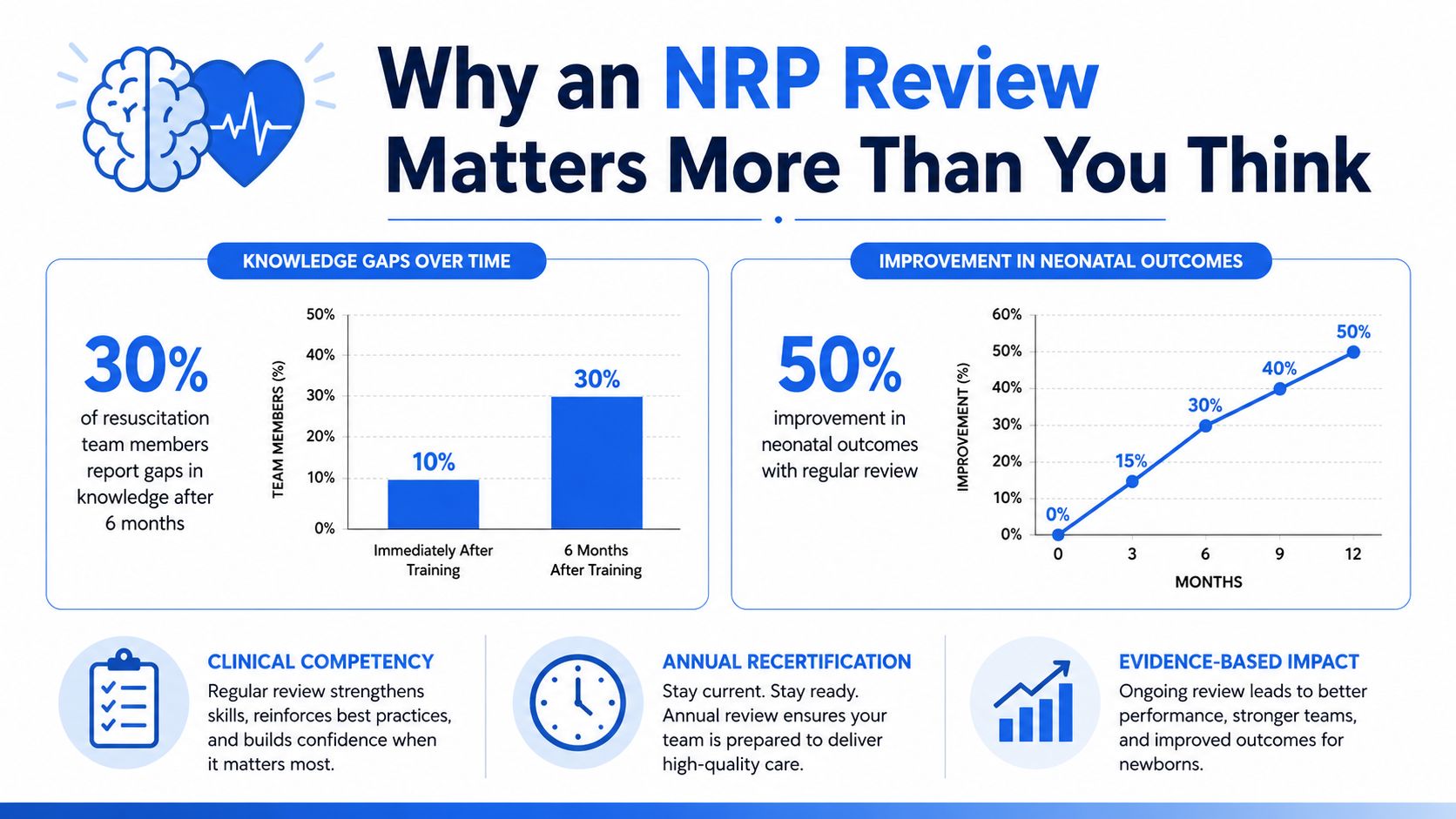
Why an NRP certification Matters More Than You Think
A lot of clinicians treat certification like administrative maintenance. That misses the point. Neonatal resuscitation certification is a competency check for one of the most time-sensitive moments in care, and structured training has been associated with better newborn outcomes in pooled analyses of low- and middle-resource settings.
Why the certification still matters after you already know the algorithm
The hard part is not learning the steps once. It is keeping the sequence clear when a baby is not breathing, the room is busy, and every second feels compressed. Certification matters because it keeps your mental model active and your team language consistent.
Practical rule: If your certification does not improve how quickly you recognize ventilation problems, it has not done enough.
The same evidence base also points to lower perinatal deaths and fewer stillbirths, although the stillbirth estimate was not statistically precise. That is the right frame for certification, as a mortality intervention with educational content attached, not the other way around.
The format matters too. A clinician does not need extra friction, they need a way to stay current that fits real practice. Accredited online training can meet that need without a missed shift or travel burden, and for working clinicians that is a legitimate professional choice, not a shortcut. For a closer look at what a current online certification should include, see ProMed Certifications' neonatal algorithms.
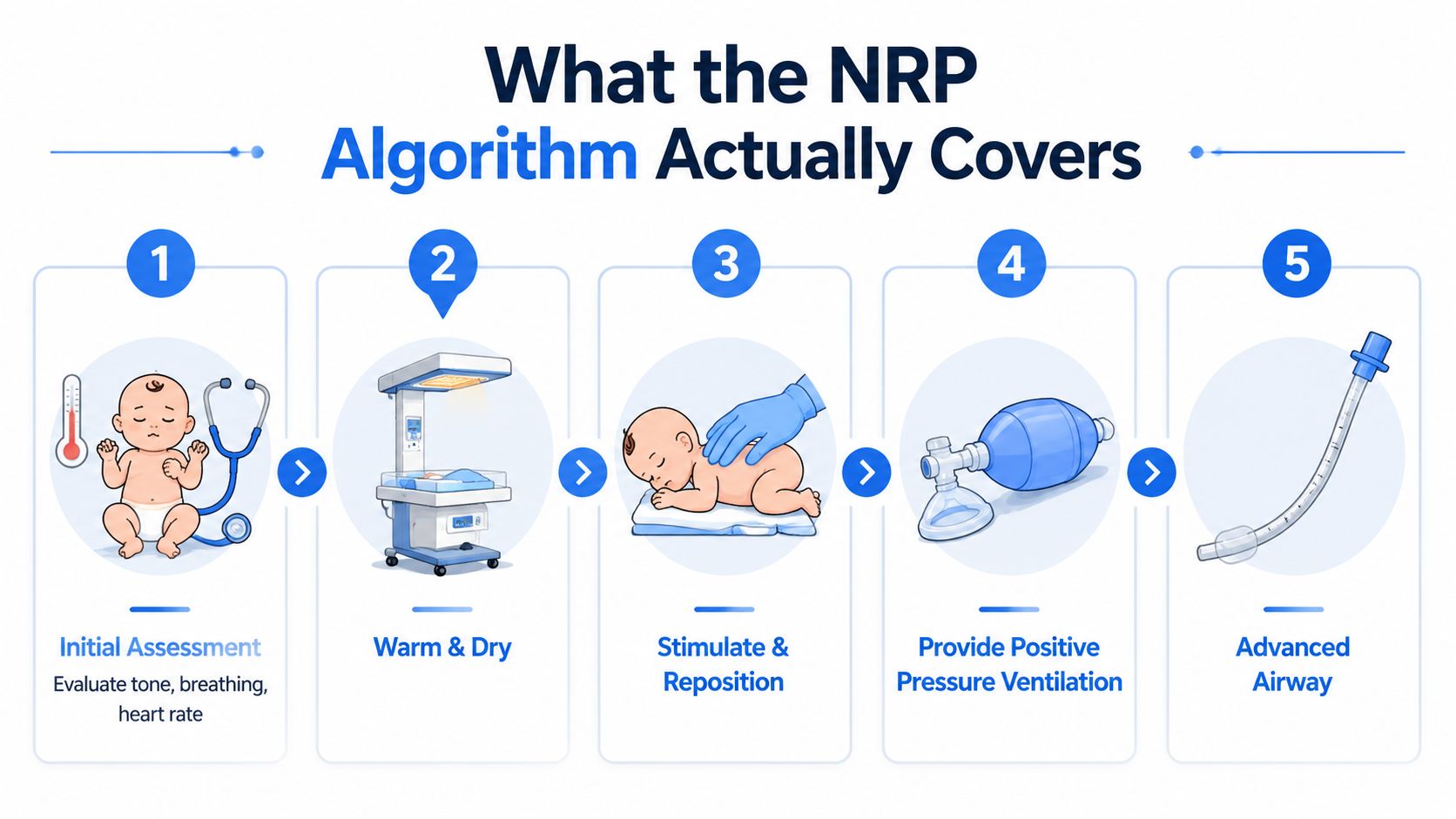
What the NRP Algorithm Covers
The NRP framework centers on the first minute after birth, when assessment and action have to happen together. Initial checks focus on breathing, heart rate, and color within 60 seconds of birth, while maintaining temperature in the 36.5 to 37.5°C range, drying, stimulation, airway positioning, and suction only when it is needed.
The order of actions matters more than memorizing a list
The algorithm works like a decision tree, not a script you recite from memory. If the newborn does not breathe in the first 60 seconds, or remains bradycardic with a heart rate below 100/min after initial actions, the next move is positive-pressure ventilation at 40 to 60 breaths per minute rather than moving straight to compressions (AHA and international consensus guidance).
Chest compressions are reserved for a heart rate below 60/min after 30 seconds of effective ventilation (AHA and international consensus guidance). That sequence is what people miss when they are rusty. In newborn resuscitation, ventilation comes first, because poor lung inflation is the common reversible problem behind bradycardia.
The oxygen plan is equally specific. For preterm infants under 35 weeks, the guidance recommends starting with 21% to 30% oxygen, while infants at 35 weeks or greater should start at 21% oxygen, with pulse oximetry guiding titration and a strong recommendation against starting with 100% oxygen (AHA and international consensus guidance).
A compact reference helps during recertification, especially when you are trying to connect the sequence to the bedside. The ProMed's neonatal algorithms page can sit beside your study plan as a quick reminder of the flow: first question the ventilation, then decide whether the heart rate is improving. If the heart rate drops after birth, the first question is usually not “Do we need compressions?” It is “Is the ventilation effective?”
Good NRP performance looks boring on paper and urgent in real life. The difference is usually chest rise, seal, and speed of correction.
The 2020 guidance also notes that failure to achieve return of spontaneous circulation after 10 to 20 minutes of intensive resuscitation is linked with a high risk of mortality and moderate-to-severe neurodevelopmental impairment (AHA and international consensus guidance). That is one reason recertification courses keep emphasizing timing. You are not just learning steps, you are learning how to recognize when the sequence is failing.
Online vs In-Person NRP Certification Compared
The debate is often framed as tradition versus convenience, but that misses what working clinicians need. Flexibility, cost, knowledge retention, and employer acceptance matter more than the format itself. Once you measure those points, online NRP certification becomes a practical route, not a lesser one.
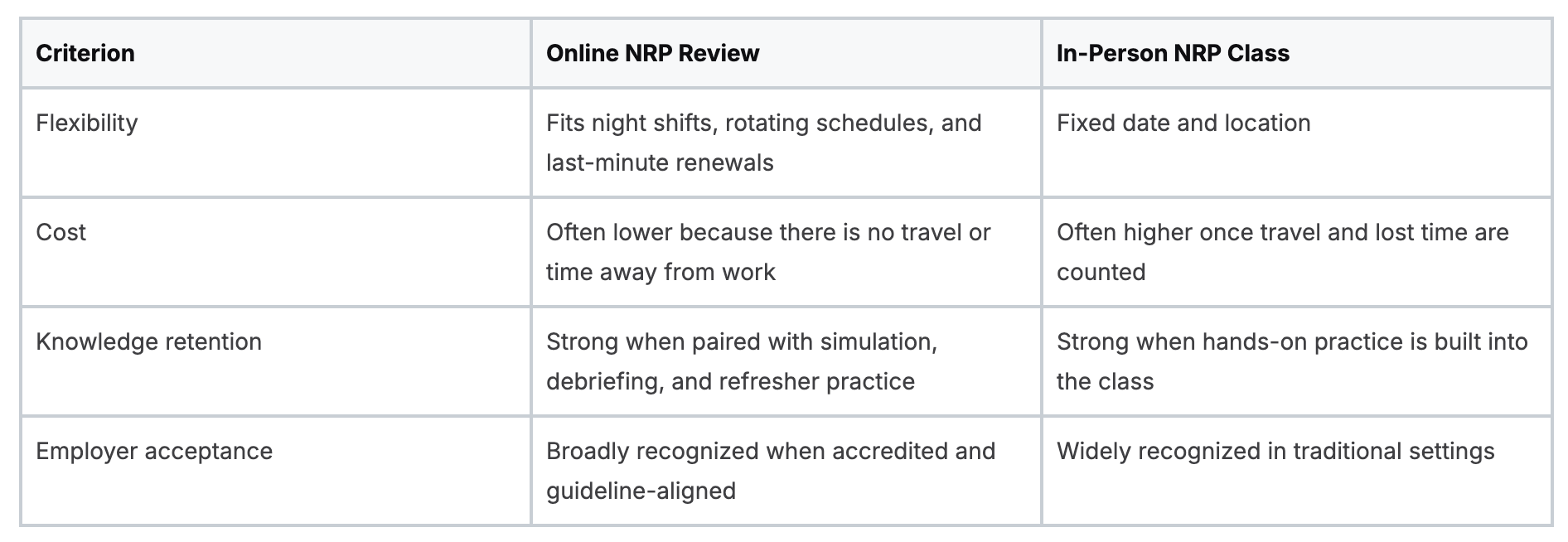
A 2022 systematic certification found that e-learning alone has insufficient evidence to prevent decay in neonatal resuscitation knowledge and performance among already-certified providers, which is an important caveat (AAP NeoPedialink). That finding does not dismiss online learning. It shows that online recertification works best as part of a blended competency plan, especially when a unit adds simulation or bedside refreshers.
That point fits the broader evidence base. Training programs and recertification formats can improve knowledge and skill retention, and the field has been moving toward formats that respect clinician schedules without lowering standards. For clinicians trying to stay current between shifts, the question is whether the course supports competency in practice, not whether it happens in a classroom.
If you already hold PALS Certification, the comparison is familiar. Different credentials often use different delivery formats, but the same standard applies. Does the course prepare you for the clinical setting where you work?
The assumption that only AHA or American Red Cross in-person classes count does not hold as a blanket rule. Employer policy still matters, but accreditation, content quality, and acceptance policy matter more than location. For a closer look at how format affects training logistics, this comparison of in-person and online medical certification lays out the practical differences without treating one format as automatically better.
Inside ProMed Certifications' NRP Offering
The Neonatal Resuscitation Certification option from ProMed is built around a straightforward workflow, self-paced recertification material, an online exam, instant digital certification, and unlimited retakes. That combination solves a real scheduling problem for clinicians who can't step away for a weekday classroom slot or who need to complete renewal quickly between shifts.

What that format actually means for busy clinicians
The biggest advantage is control. A night-shift nurse can work through certification modules during a quiet stretch, a travel clinician can finish the material before the next assignment starts, and a unit that loses staff to scheduling conflicts doesn't have to wait for a live class. For people who need a card quickly, that kind of access matters.
ProMed also states that the course is aligned with current AHA guidance and includes a guarantee of acceptance across North America, with a money-back guarantee if an employer doesn't accept the certification. Those are policy claims, not clinical claims, so the practical takeaway is narrower. If your employer accepts the credential, the course solves the logistics problem cleanly. If your unit requires hands-on practice, you still need to add simulation locally.
Clinical reality: online certification can cover the cognitive standard, but your team still needs live practice for bag-mask work, role clarity, and room choreography.
That's the honest way to use any online certification. The course delivers the review, assessment, and credentialing piece. It doesn't replace the muscle memory built during bedside drills or unit mock codes, and it shouldn't be treated as if it does.
The appeal is that the online model supports real-world compliance without making clinicians choose between education and coverage. ProMed's format matches how many teams work now, which is why online CE and certification continue to gain ground among health professionals who need credible options that don't consume an entire day.
How ProMed Stacks Up Against Other NRP Providers
ProMed, in-person AHA courses, and hospital-run classes each solve a different problem. The right choice depends on what your employer wants, how your schedule works, and how much hands-on support you need from the class itself.

The practical differences that matter
- ProMed Certifications: Works well for clinicians who need online, self-paced access and want certification without travel or classroom scheduling. It also fits people who value a simple renewal path and documented acceptance terms.
- AHA in-person courses: Useful when a learner wants built-in simulation time and direct instructor feedback in one session. The tradeoff is less flexibility.
- Hospital-run classes: Often convenient for local staff and can reflect unit-specific workflow, but they depend on the facility's calendar and staffing capacity.
A common misconception is that AHA or Red Cross in-person classes are the only recognized options. That isn't true in practice. Accredited online programs with guideline-aligned content and documented employer acceptance are now a normal part of the certification process, especially for clinicians who can't easily attend a live class.
ProMed's online model is one option in that broader mix. Its value is not that it replaces every kind of training, but that it removes unnecessary barriers for people who already know they need a valid credential and a fast, flexible path to get it.
A Practical Study Plan for Your NRP Certification
A useful certification plan stays simple, repeatable, and tied to the moments that are easiest to miss under stress. I would break it into three passes so the material builds in layers instead of all at once.
Pass one through three
- First pass, build the framework. Read the algorithm until you can explain it in plain language, from the initial assessment through ventilation and escalation.
- Second pass, lock in the high-yield details. Focus on the 3:1 compression-to-ventilation ratio, the 90 compressions and 30 ventilations per minute standard during coordinated resuscitation, the 40 to 60 breaths per minute PPV rate, and the 21% oxygen starting point for term infants.
- Third pass, test yourself under pressure. Use practice questions, scenario rehearsal, and a timer so you are not only recognizing the answer, you are deciding quickly.
Retention drops when skills sit untouched, so NRP review works best when online learning is paired with hands-on simulation and debriefing rather than treated as a one-time event. That is also why unit-based practice matters before high-risk coverage, especially if you have not managed a newborn scenario in a while.
A short question bank can make the second and third passes more efficient. ProMed's neonatal practice test fits that kind of workflow, because it lets you rehearse the sequence until it feels familiar without adding unnecessary friction. The point is not to cram, it is to make the algorithm feel automatic when the room gets busy.
Common Questions About NRP Certification Answered
Is an online NRP card accepted by hospitals and staffing agencies? Often yes, but employer policy still decides the final answer. Accredited online certification is increasingly recognized, especially when it's guideline-aligned and paired with unit simulation.
How often do you need to renew NRP? Renewal timing depends on the credentialing body and employer policy, but the reason refreshers matter is simple, performance decays if skills aren't revisited. That's why booster learning and simulation keep showing up in the conversation.
When should you use NRP versus PALS in mixed-unit practice? Many institutions use a location-based approach, NRP in NICU and PALS in PICU or CICU. Others use an age-based approach, where PALS may be used for infants with postmenstrual age greater than 44 weeks (NICU provider resuscitation review).
Is ProMed a legitimate option for nurses and physicians who need fast recertification? It's one online option in a growing category of accredited certification providers. If your employer accepts online certification and you still complete hands-on practice locally, the format can fit busy clinical schedules well.
The safest approach is to verify your employer's policy, keep your review aligned with current guidance, and choose the format that lets you stay current without creating avoidable barriers.
If you're ready to renew on a schedule that works for clinical life, review the current options at ProMed Certifications and choose the NRP path that fits your unit, your shift pattern, and your employer's requirements.
.avif)
Stay compliant with ProMed+
Certifications included: ACLS, BLS, PALS, CPR & Neonatal Resuscitation
Unlimited continuing education: over 200 hours of accredited CME
All-inclusive: One price. No surprises.
Get certified today

The Advanced Cardiac Life Support (ACLS) is an accredited online medical certification course that teaches medical professionals to respond to nearly all cardiopulmonary emergencies.

The Pediatric Advanced Life Support (PALS) Recertification instructs medical professionals on performing pediatric cardiopulmonary resuscitation in emergencies.

The Basic Life Support (BLS) Recertification is intended to teach healthcare professionals the basic steps of CPR and rescue breathing for adults, children, and infants.

Our online medical certification course for CPR, Automated External Defibrillator (AED), and First Aid is designed to teach adult, child, and infant CPR and AED use.

The Neonatal Resuscitation Certification trains medical professionals in performing resuscitation procedures and life-saving techniques for newborns at the time of delivery.

.png)
.png)
.png)