


Mastering CPR Certification for Healthcare Providers Online: A Practical Guide
So, you're wondering if a cpr certification for healthcare providers online is actually legitimate. The answer is a confident yes, and this guide will help you understand why.
For years, the belief was that only in-person classes from specific organizations like the AHA or American Red Cross were valid. To get certified, you had to block off a full day for a classroom session. But let's be honest, that model doesn't always fit the chaotic schedule of a modern healthcare professional. The good news is, that outdated way of thinking is changing.
The Modern Shift to Online CPR Certification
Things have changed, and for the better. The healthcare industry is finally catching up and embracing high-quality online education. This isn't just about convenience; it's about a more effective, flexible way of learning that respects your time and expertise.
Today's accredited online courses offer sophisticated learning modules and self-paced structures that meet—and often exceed—the old classroom standards. The industry is evolving, and so is the acceptance of online continuing education, with hospitals, clinics, and organizations increasingly recognizing accredited online certifications.
Evidence-Based and Effective Learning
This move toward online certification isn't just a trend. It's backed by a growing body of peer-reviewed studies confirming that online learning models are just as effective as in-person training. When it comes to retaining critical knowledge and improving patient outcomes, research consistently shows online formats are equal, if not superior, to their in-person counterparts.
Think of it like this: an online platform lets you rewind and review complex topics—like the exact steps for high-quality chest compressions or proper AED pad placement—as many times as you need. This self-directed approach helps you truly master the material before you move on, something you can't always do in a rushed, one-day class.
Why Online Training Clicks for Healthcare Providers
The real benefit of getting your CPR certification online goes way beyond just avoiding a commute. The whole format is designed with the realities of a medical career in mind.
- Unmatched Flexibility: Knock out your coursework during a quiet night shift, between patient appointments, or from your couch. No more sacrificing a precious day off.
- Cost and Time Savings: You can save a surprising amount of money by cutting out travel, gas, parking fees, and the need to take unpaid time off work.
- Consistent, High-Quality Content: Reputable providers like ProMed Certifications ensure their curricula are built around the latest AHA and ILCOR guidelines. You're getting the same evidence-based information, just delivered in a smarter, more accessible way.
The consensus is shifting. Hospitals, clinics, and major healthcare organizations are recognizing that accredited online certifications deliver the necessary skills and knowledge effectively. The focus is on the quality of the education, not the four walls it's learned in.
This growing acceptance means you can confidently choose a certification path that respects your time and supports your career. As you get started, just remember that top-tier medical education is no longer confined to a physical classroom.
How to Choose the Right Online CPR Course
Finding the right online CPR certification can feel overwhelming, but it doesn't have to be. Once you know what to look for, you can easily sift through the options and find a high-quality program that your employer will accept and that will prepare you for a real emergency.
Let's break down exactly what matters.
First, you need to know the difference between a standard CPR course and the more in-depth Basic Life Support (BLS) certification. While CPR is a crucial skill for anyone, BLS is the standard for healthcare professionals. BLS goes further, covering skills like two-rescuer team dynamics, using a bag-valve-mask, and handling airway obstructions for patients of all ages.
For any certification to be valid, its curriculum has to be based on solid science. That means it must follow the most current, evidence-based guidelines from the world's leading resuscitation authorities.
Key Factors for Selecting a Provider
When you're looking at a CPR certification for healthcare providers online, these are the non-negotiables. Getting these right ensures your training is credible, effective, and worth your time and money.
- Accreditation: The provider absolutely must be accredited by a reputable organization. This is your proof that their course materials have been independently verified for quality and accuracy.
- Curriculum Alignment: Look for an explicit statement that the course follows the latest guidelines from the American Heart Association (AHA) and the International Liaison Committee on Resuscitation (ILCOR). These two bodies set the global standard for resuscitation science.
- Provider Reputation: Go with a provider that has a solid, long-standing reputation. Dig into authentic reviews and testimonials. A provider who is confident in their program will offer a money-back guarantee. This is a huge green flag, giving you peace of mind that your certification will be accepted—or you get your money back.
A common myth is that only certifications issued directly by the AHA or the American Red Cross are valid. That's simply not true anymore. Many independent, accredited providers use the exact same scientific guidelines, offering certifications that are widely accepted across the entire healthcare industry.
The quality of the training materials themselves is another major tell. The best online programs offer way more than just a downloadable PDF.
What to Look for in Course Materials
Your digital classroom should be built for real learning. High-quality video demonstrations are a must for mastering techniques like proper hand placement and compression depth. Think of these videos as your virtual instructor, showing you precisely how to perform every single step.
A great course will also provide a detailed training manual you can download and reference anytime. This becomes an invaluable resource long after you've passed the exam. Lastly, make sure the provider offers responsive, helpful customer support to guide you if you hit any snags.
To dig even deeper into this, check out our guide on how to choose the best online BLS course, which has even more tips specifically for healthcare professionals.
By focusing on these key areas, you can confidently choose a trusted online provider like ProMed, knowing you're getting a top-tier education that aligns with industry standards and truly prepares you for an emergency.
Navigating The Online Learning And Skills Verification
So, what does completing a cpr certification for healthcare providers online actually look like these days? It's a fair question, especially if your last recertification was in a stuffy classroom. Modern online platforms are a world away from boring PDF downloads; they're interactive experiences built for real learning and skill retention.
The first part of your training is the cognitive, or "didactic," portion. This is where you'll dive into the core material through a series of modules you can tackle at your own pace. Forget just reading text on a screen. You can expect a mix of:
- High-quality video lectures that break down critical skills like high-performance chest compressions and correct AED pad placement.
- Interactive scenarios that put you in the hot seat, challenging you to apply what you've learned in simulated emergencies.
- Downloadable training manuals and quick-reference guides—perfect for a quick refresher down the road.
This self-paced format means you can learn when and where it works for you, hitting rewind on complex topics until you feel completely confident. To get a better sense of how digital education works, this guide on learning professional skills offers some great insights.
The Truth About Skills Verification
Let's be honest: the hands-on skills verification is the biggest hang-up for most healthcare professionals considering an online course. There's this outdated belief that you have to be in a physical classroom to prove you know what you're doing.
That's just not the case anymore. The industry has fully embraced blended and remote skills verification models that are just as effective—and are widely accepted.
Today's top-tier online CPR programs give you a few solid options for your hands-on assessment:
- Remote Skills Verification: This is a game-changer. Using a voice-assisted manikin (VAM), you perform your skills from your home or office while an instructor verifies your technique in real-time over video.
- Local Evaluator: You can arrange to have your skills checked off by a qualified local professional. This could be a certified instructor, a paramedic, or even a designated supervisor right at your own facility.
- Blended Learning: The classic hybrid model. You complete all the coursework online, then pop into a brief, in-person skills session at an affiliated training site.
The real takeaway here? The quality of your skills is what matters, not the location where you perform them. Peer-reviewed studies have shown that these blended learning outcomes are on par with, and sometimes even better than, traditional in-person-only classes, thanks to the focused, one-on-one evaluation.
This chart helps break down the decision-making process for choosing the right certification path based on your role.
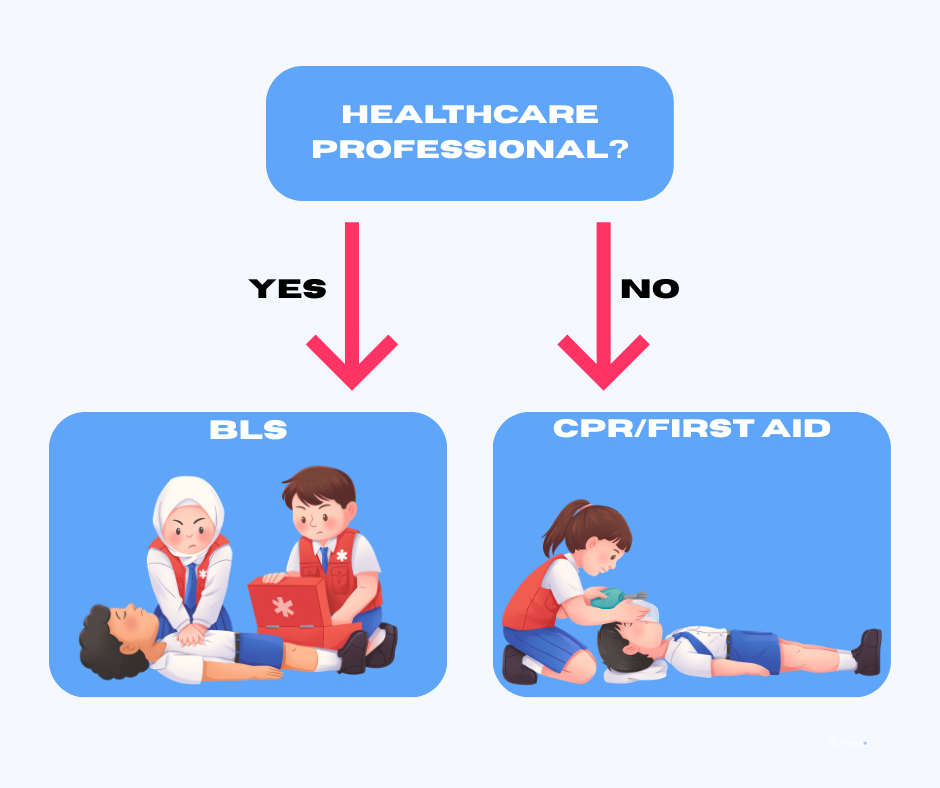
As you can see, the path for a healthcare professional requires a more advanced, BLS-level certification, whereas the general public can typically opt for a standard CPR/AED course.
Online vs In-Person CPR Training Comparison
Choosing between online and in-person training can be tough. Both are valid options, but online education highlights flexibility, cost savings, and equal quality in a way that aligns with the future of our industry.
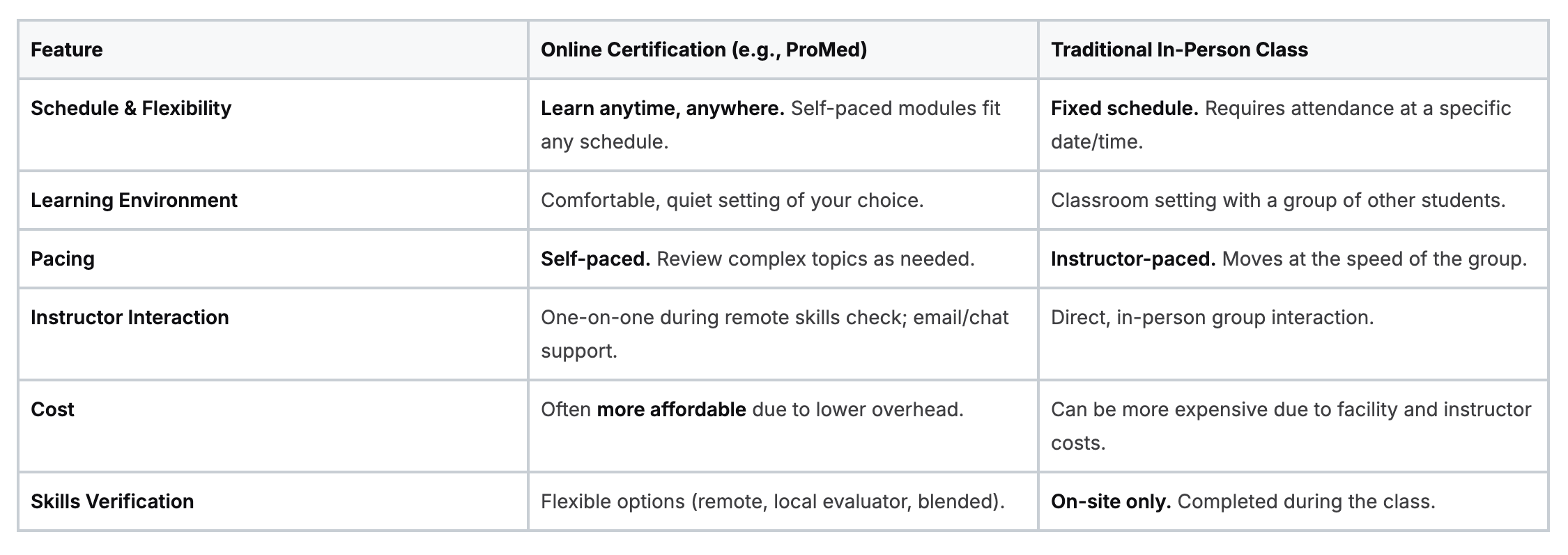
Ultimately, online platforms like ProMed offer a level of convenience and personalized pacing that's hard to beat, without sacrificing the quality of the hands-on skills validation that employers require.
Built For Real-World Confidence
The demand for high-quality, flexible training isn't just a trend; it's a fundamental shift in professional development. The global first aid and CPR training market hit USD 4,812.90 million in 2023 and is projected to soar to USD 7,694.95 million by 2032.
That's nearly 60% growth, underscoring just how critical certified professionals are in the healthcare field.
At the end of the day, a great online program is designed to build lasting confidence. By combining flexible online learning with a validated, hands-on skills check, you get an experience that truly prepares you to act decisively and correctly when it counts. The system is built on proven principles of adult learning theory, giving you the control and resources you need to master the material.
Ensuring Your Certification Is Accepted by Your Employer
Let's be honest: presenting an online certification to an employer can feel like a hurdle. But you can walk into that conversation with total confidence when you’re prepared.
The trick is to frame your choice not as a shortcut, but as a smart, well-researched, and completely credible educational decision.
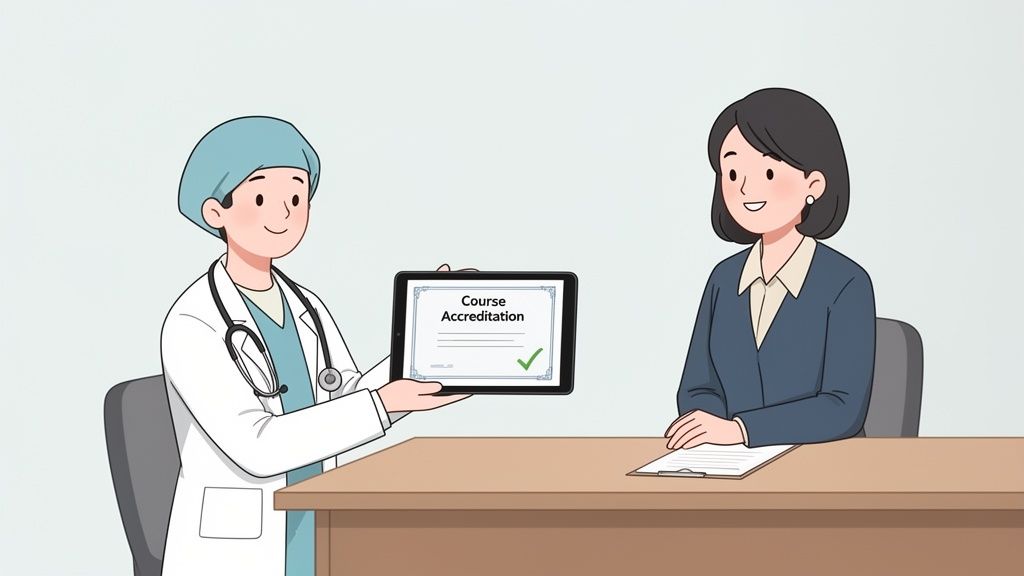
It all starts with proactively sharing the right information. Before you even sign up for a course, you should know how to make a certificate that employers actually value. That means choosing providers that are transparent about their accreditation and curriculum, showing a clear alignment with ILCOR and AHA standards from the get-go.
Busting the Myth of Exclusivity
One of the most stubborn, outdated beliefs out there is that only the American Heart Association or the American Red Cross can issue a valid certification. This simply isn't true anymore.
The industry has changed. Plenty of accredited online providers now follow the exact same evidence-based scientific guidelines.
Your employer’s main concern is—and should be—patient safety and compliance. When you can show them that your online course is built on the same rigorous foundation, you immediately address that concern. More and more healthcare institutions are realizing that it's the quality of the education that matters, not the logo on the card.
Preparing for the Conversation
Walking into your manager's office prepared can make all the difference. Don't just wait for them to ask questions; have the answers ready. This shows initiative and proves you’ve done your homework.
Here’s a quick checklist of what to have on hand:
- Provider Accreditation: Have a direct link or a printout of the provider’s accreditation page. This is your proof of legitimacy.
- Curriculum Syllabus: Show them the course outline. Point out how it aligns with the latest ILCOR and AHA guidelines.
- Money-Back Guarantee: This is a big one. Mention the provider's acceptance guarantee. A company like ProMed wouldn't offer a 100% money-back guarantee if their certifications weren't widely accepted.
- Skills Verification: Be ready to explain exactly how your hands-on skills were validated, whether it was through a remote session, a local evaluator, or a blended model.
By presenting this information clearly, you shift the conversation away from "online vs. in-person" and toward the quality and credibility of the education you actually received.
The goal is to demonstrate that your online certification meets every professional standard required. You chose an efficient, modern, and scientifically-backed method for maintaining your critical life-saving skills.
Highlighting the Growing Acceptance
The need for accessible CPR training is huge. Globally, training rates are all over the map, and in the United States, less than 20% of the population gets CPR training annually. This creates a massive gap, even among professionals.
This data just reinforces the value of flexible online options that help more providers stay current. When you're armed with the facts, accreditation details, and a confident approach, you can effectively show your employer the value and legitimacy of your online certification.
For a little more guidance, you can read about how to confirm if your employer will accept a ProMedCert provider card.
Squeezing More Value From Your Medical Certifications
Once you feel good about getting your CPR certification for healthcare providers online, it's time to zoom out and look at the bigger picture. Picking the right provider isn't just about knocking out one course; it's about finding a long-term partner for all your continuing education needs. Getting this right from the start saves you a ton of time, money, and administrative headaches down the road.
This is exactly where a platform like ProMed really makes a difference. When you think beyond a single certification, you can build a single, stress-free hub for your entire career development. It's about making your professional life simpler while making sure you get the highest quality training out there.
Bundle Your Certifications for Maximum Impact
For most of us in healthcare, BLS is just the beginning. Depending on your specialty, you probably need Advanced Cardiac Life Support (ACLS) and Pediatric Advanced Life Support (PALS), too. Trying to juggle separate courses and renewal dates for each one can be a logistical nightmare.
That's why bundling these critical certifications is such a smart play. Imagine completing your BLS, ACLS, and PALS renewals all in one place, whenever it fits your schedule. This approach has some serious perks:
- Real Cost Savings: Bundling courses is almost always cheaper than buying them one by one. You get more education for your money.
- Time Efficiency: You can power through all your required training in a concentrated block of time that works for you. No more staggered deadlines creeping up on you.
- Simplified Management: With one provider, all your certificates and renewal reminders are in a single spot. It instantly declutters your professional life.
At ProMed, we’re at the forefront of this change. We designed our course bundles to solve these exact problems, delivering both convenience and credibility. Our goal is to give you a single, reliable platform for the core certifications that keep you ready for any emergency, so you can focus on patient care, not paperwork.
By bundling, you’re doing more than just renewing a card—you're making a strategic investment in your own efficiency. It takes the hassle out of compliance and ensures you're always current across all the essential life-support skills.
Integrate All Your Professional Requirements
Your training needs don't stop with life-support certifications. As a licensed professional, you also have ongoing requirements for Continuing Education (CE) or Continuing Medical Education (CME) just to maintain your license. Managing these credits is often another separate, time-sucking task.
A truly great educational partner gets this. The best platforms roll all of your professional requirements into a single, seamless experience. Think of it as your personal career dashboard, where everything you need is right at your fingertips.
This integrated approach means you can manage your Nursing CE or Physician CME right alongside your life-support certifications. Instead of bouncing between multiple websites and manually tracking credits from different places, you have one central hub for all your educational accomplishments. It's a small change that makes a huge difference in staying organized and compliant.
Your All-in-One Educational Hub
When a platform combines your core certifications with CE/CME, it offers a complete solution for your career. This setup gives you a clear, comprehensive view of your professional standing at all times.
Here’s what that looks like in the real world:
- One Account, Total Access: Log in once to access your BLS, PALS, ACLS, and your full library of CE/CME courses.
- Automated Tracking: Your completed courses and earned credits are logged automatically, making it easy to see what you’ve done and what’s next.
- Effortless Reporting: For nurses, platforms like ProMed can offer automated reporting to CE Broker and state boards, which eliminates manual submissions and potential mistakes.
This kind of consolidation doesn't just add convenience; it gives you back your most valuable asset—your time. When you aren't chasing down certificates or manually logging CE credits, you have more mental energy to dedicate to what really matters: providing excellent care to your patients.
The ProMed Peace of Mind Guarantee
Choosing an educational partner is a big deal, and you deserve to feel completely confident in that choice. That’s why we stand behind our programs with a 100% money-back guarantee.
This isn't just a marketing line; it's our commitment to you. We are so sure of the quality of our accredited courses and their widespread acceptance that if, for any reason, your employer doesn't accept your ProMed certification, you'll get a full refund. No questions asked.
This guarantee removes all the risk from the equation. It lets you embrace the flexibility and quality of online learning with total assurance that your investment is protected. It’s our way of showing that we're dedicated to your success and are a partner you can trust for the long haul.
Your Top Questions About Online CPR, Answered
Let's cut through the noise and tackle the questions we hear all the time from healthcare professionals about getting CPR certified online. The bottom line is that these certifications are valid, accessible, and widely accepted—let’s dive into why.
Is an Online CPR Certification Legitimate for Healthcare Professionals?
Yes, without a doubt. A high-quality online CPR or BLS certification from an accredited provider is just as effective as an in-person one. The real test of legitimacy isn't the format; it's the curriculum.
The key is choosing a program built on the latest evidence-based guidelines from the American Heart Association (AHA) and the International Liaison Committee on Resuscitation (ILCOR). The old idea that only a card from the AHA or Red Cross will suffice is simply outdated. What matters to employers and licensing boards is the scientific accuracy of your training, not the logo on your certificate.
As long as the course content is current and the provider is nationally accredited, an online certification meets the professional standards you need.
Will My Hospital or Clinic Accept It?
This is the big one, isn't it? The answer is almost always yes, especially if you stick with a reputable provider. We're seeing a huge shift as more and more healthcare institutions recognize how effective and efficient online training can be.
Providers like ProMed Certifications are so confident their courses will be accepted that they offer a 100% money-back guarantee. This takes all the financial risk off your shoulders and shows just how trusted their certifications are by facilities nationwide.
A good tip? Before you enroll, have your provider's accreditation and curriculum details ready to share with your employer. It makes the approval process seamless.
How Can I Practice Hands-On Skills Online?
This is a perfectly valid concern. You can't learn the feel of proper chest compressions just by watching a video. That's exactly why credible online programs require a hands-on skills verification to complete your certification.
You’ve got a few really convenient options for this:
- Remote Skills Verification: Using a voice-assisted manikin (VAM), you can perform your skills from anywhere—even your living room. A certified instructor observes and guides you in real-time over video.
- Local Evaluator: You can complete your skills check with a qualified professional in your area. This could be a certified instructor, a paramedic, or even a designated training lead at your own workplace.
- Blended Learning: This hybrid approach is popular. You do all the coursework and exams online at your own pace, then pop into a brief, in-person skills session at a partner training center.
The point of skills verification is to prove you can perform the techniques correctly, not where you prove it. Peer-reviewed studies actually back up these blended and remote models, showing they produce outcomes equal to—or even better than—traditional training, thanks to the focused, one-on-one feedback.
Is Online CPR the Same as BLS?
No, and for anyone in a clinical role, this distinction is critical. While both teach life-saving skills, they're built for completely different audiences.
- CPR/AED: This course is for the general public—think teachers, coaches, or office staff. It covers the fundamentals of chest compressions, rescue breathing, and using an AED.
- Basic Life Support (BLS): This is the gold standard for healthcare professionals. BLS includes everything from a CPR course but dives much deeper. You'll cover things like two-rescuer team dynamics, advanced airway management with bag-valve-masks, and specific protocols for infants, children, and adults in a clinical setting.
If you work in healthcare, you almost certainly need a BLS certification. Always double-check your employer’s specific requirements, but it's a safe bet that BLS is what they're looking for. Getting it online just means you get the same professional-grade training in a format that actually fits your life.
This guide should lay the framework for understanding that online certification is a valid, effective, and future-focused choice for healthcare professionals. Ready to get your certification from a trusted, convenient, and fully accredited provider? ProMed Certifications is at the forefront of this industry shift, offering comprehensive online BLS, ACLS, and PALS courses designed for you.
Explore our certification options and see how easy it is to stay compliant and confident in your skills.
.avif)
Stay compliant with ProMed+
Certifications included: ACLS, BLS, PALS, CPR & Neonatal Resuscitation
Unlimited continuing education: over 200 hours of accredited CME
All-inclusive: One price. No surprises.
Get certified today

The Advanced Cardiac Life Support (ACLS) is an accredited online medical certification course that teaches medical professionals to respond to nearly all cardiopulmonary emergencies.

The Pediatric Advanced Life Support (PALS) Recertification instructs medical professionals on performing pediatric cardiopulmonary resuscitation in emergencies.

The Basic Life Support (BLS) Recertification is intended to teach healthcare professionals the basic steps of CPR and rescue breathing for adults, children, and infants.

Our online medical certification course for CPR, Automated External Defibrillator (AED), and First Aid is designed to teach adult, child, and infant CPR and AED use.

The Neonatal Resuscitation Certification trains medical professionals in performing resuscitation procedures and life-saving techniques for newborns at the time of delivery.

.png)
.png)
.png)