


Refresher Course for RN: A Quick Guide to Returning to Nursing
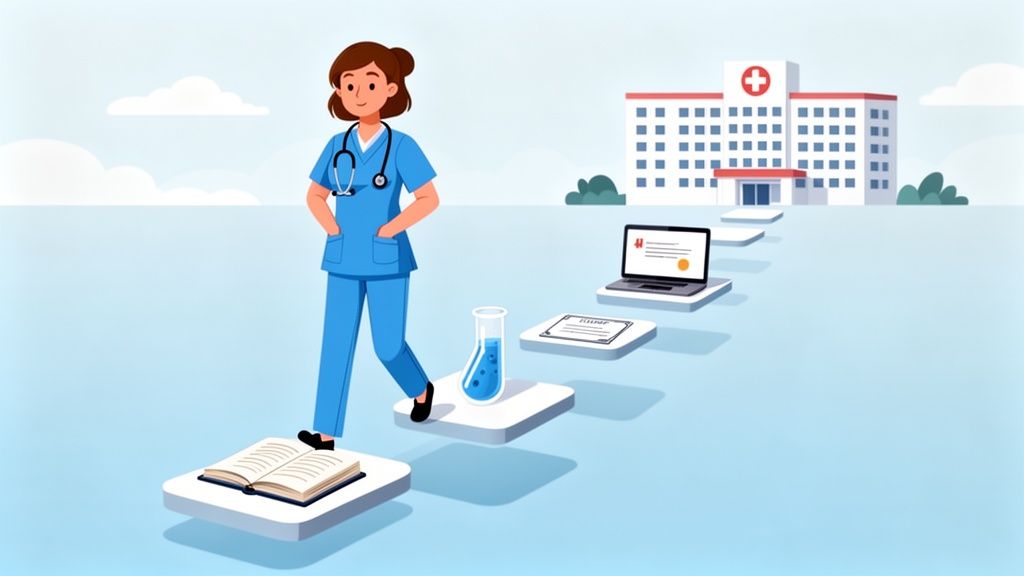
Think of an RN refresher course as a professional tune-up for your nursing career. It’s a structured program designed to get registered nurses who've been away from the bedside back up to speed with current clinical skills and knowledge.
Simply put, it's the bridge that reconnects you to safe, confident, and competent patient care. This guide will help you understand what these courses are, why they matter, and how to choose the right one for your journey back to the floor.
What Is an RN Refresher Course and Who Needs One?
A refresher course for an RN is much more than a simple review. It's a critical, confidence-boosting step for thousands of professionals looking to jump back into a field that changes at lightning speed.
Healthcare is constantly evolving—new technology, updated pharmacology, and shifting patient care standards are the norm. This structured learning path makes sure your skills are sharp, current, and perfectly aligned with today's best practices, better equipping you to provide excellent patient care.
.png)
This isn’t just about ticking a box on a form. It's about rebuilding the self-assurance that comes from knowing you’re fully prepared to handle the demands of modern nursing. Whether you've been out of the field for two years or ten, the right program makes all the difference.
Common Reasons for Enrollment
Nurses step away from direct patient care for all sorts of valid reasons. A refresher course is the perfect on-ramp for those looking to return.
You'll likely need a course if you are:
- Reactivating a Lapsed or Inactive License: Many state boards of nursing require proof of recent competency if a license has been inactive for a specific period, often two to five years.
- Returning After a Career Break: Life happens. Taking time off for family, exploring another career path, or focusing on your health are common reasons for a hiatus. A refresher course easily bridges that gap.
- Seeking to Rebuild Clinical Confidence: Even if your license is active, you might feel rusty or unsure about returning to a fast-paced clinical setting. This is a structured way to get your footing back.
- Meeting Employer Requirements: Some hospitals or healthcare facilities may require a refresher course for nurses who have been out of an acute care setting for a while, just to ensure their skills meet current standards.
For anyone mapping out a return to nursing, it’s also helpful to understand the clear distinction between a Certified Nursing Assistant (CNA) and a Registered Nurse (RN) and their unique roles before diving into a refresher program.
Ultimately, these courses serve a crucial purpose: they safely and effectively transition skilled professionals back into the workforce where they are needed most. They validate your past experience while updating your knowledge, turning you into a valuable, ready-to-hire candidate once again.
Navigating State Board and Employer Requirements
Getting back into nursing means you’ll need to get familiar with the rules set by your State Board of Nursing and, down the line, potential employers. These requirements aren't just bureaucratic hoops to jump through. They exist for one core reason: to protect public safety.
By making sure every practicing nurse is up to speed with current, evidence-based practices, these rules uphold the high standards of patient care that define our profession. Think of it like this: it’s a quality control check that maintains the crucial trust between patients and their healthcare providers.
Why a Refresher Course Is Often Required
The most common trigger for needing a refresher course is simple: license inactivity. If you've been away from direct patient care for a certain number of years—often between two and five years—a state board will likely require you to complete a program before they'll reactivate your license.
This isn't a penalty. It’s a practical acknowledgment that healthcare changes at lightning speed. A structured course is the best way to ensure you’re caught up on everything from new medications and treatment protocols to updated electronic health record (EHR) systems. Employers often have similar policies for the same reason—to guarantee their teams are practicing at the absolute top of their game.
And this is a common scenario. Data from the National Council of State Boards of Nursing (NCSBN) shows that 51% of responding nursing boards mandate a refresher course for license reactivation. With another 27% of states having variable policies, it's clear that a majority of RNs returning to the field will need to enroll in a program.
The Growing Acceptance of Online Education
One of the best shifts we've seen in professional development is the widespread acceptance of online learning. The outdated belief that only in-person classes from specific organizations like the AHA or American Red Cross are valid is quickly becoming a thing of the past. That’s simply not true anymore.
Numerous peer-reviewed studies and industry articles confirm it: online education delivers outcomes that are equal, or even superior, to traditional classroom settings, especially for knowledge retention and learner flexibility. Hospitals, clinics, and state boards are increasingly recognizing accredited online courses for meeting both CE and license reactivation requirements. This is fantastic news, as it means you can get your career back on track without upending your life.
The modern healthcare industry is moving toward broader acceptance of high-quality online education. This change empowers professionals to meet state and employer mandates with greater flexibility, efficiency, and accessibility, ultimately strengthening the nursing workforce.
State-by-State Differences
This part is absolutely critical: requirements are not universal. The rules in California can be wildly different from the ones in Texas or Florida.
Here’s a snapshot of the kinds of variations you might see:
- Practice Hours: Some states demand a specific number of recent practice hours, which a course with a clinical component can help you fulfill.
- CE Credits: Others might simply require a certain number of continuing education (CE) hours, sometimes with specific topics mandated (like pain management or infection control).
- Clinical Component: Certain boards will insist on a supervised clinical practicum as part of any approved refresher program.
Because of this patchwork of regulations, your very first step should always be to contact your state's Board of Nursing directly. They are the final authority and the only definitive source for what you need to do to get your license back in good standing.
To get a general idea of what your state might ask for, you can check out our guide on continuing education requirements for nurses by state.
Once you have that official checklist from your board, you can confidently choose a refresher course for RN that ticks all the boxes and gets you back to the bedside smoothly.
Choosing Between Online and In-Person Programs
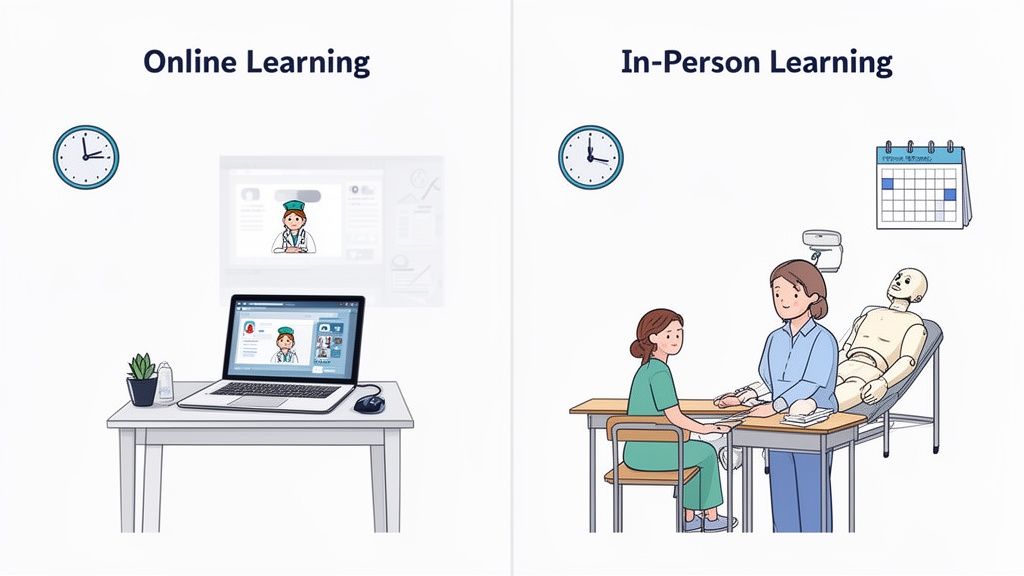
Deciding on the format of your refresher course for an RN is one of the biggest choices you'll make. Not long ago, in-person training was the default. Today, online education has completely changed the landscape, offering a powerful, effective, and often preferred path for busy professionals.
Let's clear the air on a common myth. There's an outdated belief that only in-person classes from big names like the AHA or American Red Cross are truly valid for medical certifications. That’s just not the case anymore. The healthcare industry is evolving, and high-quality, accredited online education is just as effective and widely accepted.
The Undeniable Benefits of Online Learning
The shift to online isn't just about convenience; it's about results. Study after study has shown that for theoretical knowledge and continuing education, online learning produces outcomes that are just as good as—and sometimes even better than—traditional classroom settings. A big reason for this is that online platforms let you learn at your own pace, giving you the freedom to review tricky topics until they click.
Here’s a quick rundown of the major advantages of an online program:
- Unmatched Flexibility: You can study when and where it works for you. Whether that's late at night or on a quiet Saturday morning, a self-paced structure is a lifesaver for anyone juggling work, family, and other commitments.
- Significant Cost Savings: Think about it. In-person courses have hidden costs that go beyond tuition, such as gas, parking, and maybe even taking unpaid time off work. Online programs cut out those extra expenses, making them a much smarter choice for your wallet.
- Time Efficiency: All those hours spent driving to a classroom? You can now use that time for actual studying. Online learning lets you focus your energy right where it's needed, allowing you to move through concepts you remember and spend more time on areas that need review.
For a closer look at the specifics, you can learn more about how online and in-person medical certifications compare in our detailed guide.
Why Online Is the Modern Path Back to Nursing
The general consensus in the healthcare industry is shifting. Hospitals, clinics, and state boards are increasingly recognizing the value and legitimacy of accredited online CE and certifications. They understand that a well-designed online course can deliver the exact same critical knowledge needed for safe, effective patient care. Outcomes for patient care and knowledge retention are equal, and sometimes superior, in online formats.
Online education offers a learner-centric approach that traditional models often lack. By giving nurses control over their learning environment and pace, it fosters deeper knowledge retention and practical application of skills—outcomes that directly benefit patient care.
At the end of the day, your nursing skills and knowledge are what truly matter, not the four walls of the classroom where you refreshed them. A quality online program gives you the same evidence-based information, just in a more accessible and efficient package. It puts you back in the driver's seat of your career, letting you re-enter the workforce on your own terms.
Online vs In-Person RN Refresher Courses at a Glance
To help you visualize the differences and decide what’s right for you, this table breaks down the key features of each format. It’s a great way to see which option best fits your lifestyle, budget, and learning preferences.

Here at ProMed, we’re proud to be at the forefront of this educational shift. We're committed to delivering credible, high-quality online courses that are not only convenient but also perfectly aligned with the future of healthcare education. Our programs are built to give you the knowledge and confidence you need to step back into your nursing career with ease.
The Proven Success of RN Refresher Graduates
Deciding to invest your time and money into a refresher course for an RN can feel like a huge step, but the payoff is very real. Graduates don't just get a certificate; they step back into the nursing world with fresh confidence, up-to-date skills, and a serious advantage in the job market.
Think of it like this: a well-designed program is a direct investment in your professional future. Finishing a course tells employers you're proactive, current on best practices, and truly committed to safe, evidence-based patient care.
Real-World Results and High Placement Rates
Let's talk about tangible outcomes. Success after a refresher course isn't just a hopeful idea—it's a measurable reality. High-quality programs consistently report impressive job placement rates for their graduates.
These courses are designed to bridge the gap between your career break and a successful return to nursing. By sharpening your clinical knowledge and rebuilding your self-assurance, you immediately become a more capable and appealing candidate. It's the launchpad you need to get back into the career you love.
A fantastic example is the NC AHEC RN Refresher Program, which has been running for over 30 years. In just the last three years, they've graduated more than 400 nurses, and an incredible 75% of those actively looking for jobs landed new positions. This self-paced online program has helped thousands of nurses return to the bedside, with one graduate calling it the "best preparation for re-entering after a 13-year hiatus." Find out more about how this program supports returning nurses.
Showing Off Your Renewed Expertise
Once you've completed your course, the next move is to show potential employers what you've accomplished. Your resume is the perfect place to highlight this new chapter. It's not just about adding another line; it's about telling a story of your dedication and readiness.
Completing a refresher course completely changes your professional story. It shows a deep commitment to excellence and frames you as a motivated, current, and valuable asset for any healthcare team.
To really nail this, you'll want to craft a compelling resume that showcases your revitalized skills. It's a similar strategy to building a strong resume of a nursing student—you want to frame your course completion as a recent, highly relevant achievement that makes you the ideal candidate right now.
Choosing an online program, in particular, demonstrates that you're self-motivated and comfortable with modern learning tools—both highly valued traits in healthcare today. Ultimately, the success of graduates proves one thing: the right education is the key to unlocking your successful return to nursing.
Your Checklist for Choosing the Right Program
Deciding on the best refresher course for an RN is a big step, but it doesn't have to feel overwhelming. If you go in with a clear plan, you can confidently pick a program that lines up with your career goals, fits your schedule, and works for your budget. This simple checklist will guide you through the process, step by step, so you can find the perfect match.
Think of it like putting together a patient care plan. You start by assessing the situation, diagnosing your own needs, planning the intervention (picking a course), and then implementing it to get the outcome you want—a successful return to nursing.
A refresher course builds that bridge from learning and skill-building to renewed confidence and, ultimately, employment.
The key takeaway here is that the right program is your most direct route back to active practice. It's designed to make you feel competent on the floor and look like a great hire to employers.
Step 1: Confirm Your State Board Requirements
Before you even think about browsing courses, your first move is to check with your state's Board of Nursing. They are the final authority on what you need to do.
Get in touch with them and ask for specifics on license reactivation. You'll want to know:
- Total Theory Hours: How many hours of classroom-style learning do they require?
- Total Clinical Hours: Is there a mandatory number of supervised clinical practice hours?
- Specific Coursework: Do they require courses on certain topics, like pharmacology or nursing ethics?
Getting this info straight from the source is critical. It saves you from wasting time and money on a program that won't actually get your license reactivated.
Step 2: Verify Program Accreditation
Accreditation is basically your seal of quality. It proves that an independent organization has vetted the program and confirmed it meets high educational standards.
Most state boards will only recognize hours from an accredited provider. As you review different courses, make sure they are backed by a reputable accrediting body. This is a non-negotiable step to ensure your investment pays off.
Step 3: Assess the Curriculum and Format
Once you've got a list of accredited programs that meet your state’s rules, it’s time to dig into what they actually teach. A solid curriculum should feel modern and directly relevant to today's healthcare world.
A program's curriculum should be a direct reflection of modern nursing practice. It must cover current technology, evidence-based protocols, and the critical thinking skills needed to ensure patient safety and deliver high-quality care.
Look for essential topics like:
- Electronic Health Records (EHRs): Being proficient with digital charting is a must-have skill.
- Pharmacology Updates: The world of medications is always changing, and you need to be current.
- Current Patient Safety Standards: The course should cover the latest national patient safety goals.
Next, consider the format. Do you learn best in a structured, in-person class? Or does the flexibility of an online, self-paced course fit your life better? As we've covered, modern online programs offer excellent educational value and are just as effective and widely accepted, making them a great option for busy professionals. Many nurses find that flexible CE bundles are a smart way to meet requirements, and you can even look into options for free continuing education units for nurses to supplement your learning.
Step 4: Compare the True Costs
Finally, it’s time to talk money. The price you see on the website is often just the starting point.
To get a real sense of the total investment, you need to ask about all the potential expenses:
- Tuition: The base price for the course itself.
- Books and Materials: Are textbooks, software, or lab supplies included, or are they extra?
- Hidden Fees: Look out for things like technology fees, lab fees, or liability insurance costs.
- Travel Costs: If you're considering an in-person program, don't forget to factor in gas, parking, and your time.
By breaking down the true cost of each option, you can make a financially smart decision that fits your budget. Often, an affordable and high-quality online course provides the best overall value, giving you the education you need without all the extra expenses.
What to Expect on Your Refresher Course Journey
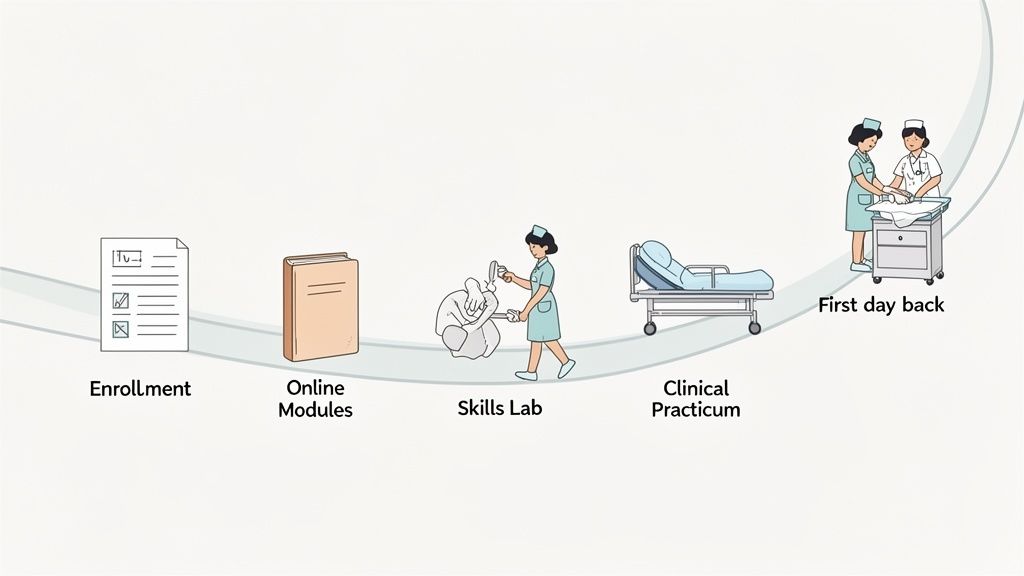
So, what does this journey back to the bedside actually look like? Let’s pull back the curtain on the whole process, from the day you enroll to your first shift back on the floor. Think of an RN refresher course as a structured path designed to methodically rebuild your skills and, just as importantly, your confidence. The goal is to make your return to nursing feel manageable and exciting, not overwhelming.
The entire process is built on a few core components. You can picture them as building blocks, each one stacking on the last to create a solid foundation for your renewed nursing practice. Every part serves a specific purpose, making sure you aren't just memorizing facts but truly integrating up-to-date knowledge into your clinical judgment.
Core Components of Your Course
Most accredited refresher programs, whether they're online or in a classroom, will include a blend of these key elements. It’s a proven structure that works time and again to get inactive RNs back into practice safely and effectively.
Your journey will almost always include:
- Theoretical Modules: This is the "book smarts" part of your course. You’ll dive deep into updated pharmacology, get a handle on current standards of care, and reacquaint yourself with modern nursing principles. This is often done through engaging online modules you can tackle at your own pace.
- Skills Labs or Virtual Simulations: Here’s where theory meets practice. You'll get your hands on equipment again in a controlled setting, either in a traditional skills lab or through incredible virtual simulations that mimic real-world patient scenarios.
- Clinical Practicum: This is the final piece of the puzzle, where everything clicks. You’ll work with a preceptor in a real clinical environment, applying your refreshed knowledge and skills to actual patients. This is the ultimate confidence-booster before you officially re-enter the workforce.
The Power of a Structured Return
This step-by-step approach isn't just a good idea—it's highly effective. A landmark study from Rutgers University found that of the nurses who completed a refresher program and answered a follow-up survey, an incredible 70.2% successfully returned to practice as registered nurses. This really shows the powerful impact these courses have on relaunching careers.
A refresher course is more than just an educational requirement; it's a strategic pathway back to the profession you love. It provides the structure, support, and updated knowledge needed to transition from inactive to indispensable.
With the flexibility of today's online programs, you can often power through the theory portion much faster than in a traditional semester system. By setting a simple study schedule and linking up with fellow nurses online for support, you can navigate the process efficiently. This whole journey is designed to empower you, ensuring that when you step back onto the unit, you do it with the competence and confidence you deserve.
Your Top Questions About RN Refresher Courses, Answered
If you're looking into an RN refresher course, you've probably got some questions. Let's tackle the most common ones head-on with some straight-up answers from what we've seen in the field.
How Much Does An RN Refresher Course Usually Cost?
The price tag on these courses can be all over the map. A full-blown, university-run program that includes a hands-on clinical component could easily run you several thousand dollars. On the flip side, you can find targeted continuing education (CE) bundles for just a few hundred.
This is where online providers really offer fantastic value. They can package all the CEs you need, plus essential certifications like BLS or ACLS, for a fraction of what traditional institutions charge. It’s a smart way to get everything you need without breaking the bank.
Do Employers Really Accept Fully Online Courses?
Yes, they absolutely do. Any outdated belief that only in-person training from specific providers like the AHA or Red Cross "counts" is long gone. The reality is, accredited online education is now a respected and well-established standard across the healthcare industry.
Healthcare facilities know that a rigorous, accredited online program is just as effective, especially for nailing down the theoretical knowledge and getting mandatory certifications. If you're still a little wary, look for a provider that puts their money where their mouth is with a money-back acceptance guarantee—that’s the sign of real confidence.
The growing acceptance of high-quality online education is a huge step forward for healthcare. It’s a shift that recognizes what truly matters: a nurse's competency and the quality of patient care, not the format of their training.
How Long Does It Take to Finish a Refresher Course?
Your timeline is almost completely dictated by the course format. A traditional, in-person program is usually locked into a semester schedule, which means you could be looking at several months from start to finish. It’s a rigid path.
The flexibility of online, self-paced programs is a game-changer here. With no set class times, you’re in the driver's seat. Many nurses find they can power through all the coursework in just a few weeks or a couple of months, easily fitting study sessions around their life's demands. It’s the fastest and most efficient way to get back into practice.
Can a Refresher Course Actually Help Me Find a Job?
Without a doubt. Finishing a refresher course is a massive green flag for hiring managers. It shows you’re serious about your profession, up-to-date on the latest evidence-based practices, and genuinely invested in your career.
Think of it this way: it’s the final piece of the puzzle that not only gets your license active again but also relaunches your career. It gives you a fresh dose of skills and a major confidence boost, helping you stand out from other applicants. When an employer sees that on your resume, they know you're ready to hit the ground running from day one.
Ready to get back to the career you love, fully prepared and confident? ProMed Certifications is at the forefront of this industry shift, offering a complete range of accredited, online CE courses and certifications built for your busy schedule and designed to meet state board requirements.
.avif)
Stay compliant with ProMed+
Certifications included: ACLS, BLS, PALS, CPR & Neonatal Resuscitation
Unlimited continuing education: over 200 hours of accredited CME
All-inclusive: One price. No surprises.
Get certified today

The Advanced Cardiac Life Support (ACLS) is an accredited online medical certification course that teaches medical professionals to respond to nearly all cardiopulmonary emergencies.

The Pediatric Advanced Life Support (PALS) Recertification instructs medical professionals on performing pediatric cardiopulmonary resuscitation in emergencies.

The Basic Life Support (BLS) Recertification is intended to teach healthcare professionals the basic steps of CPR and rescue breathing for adults, children, and infants.

Our online medical certification course for CPR, Automated External Defibrillator (AED), and First Aid is designed to teach adult, child, and infant CPR and AED use.

The Neonatal Resuscitation Certification trains medical professionals in performing resuscitation procedures and life-saving techniques for newborns at the time of delivery.

.png)
.png)
.png)