
ProMed+
Unlimited certifications + CE, from $14/moAll certs + CE from $14/mo
Interactive guide · 12 min read
The short answer
ROSC (return of spontaneous circulation) means the heart is producing circulation on its own again after cardiac arrest. It's confirmed by a palpable pulse and a measurable blood pressure, not by the monitor alone, and it starts a new, time-critical phase: post-cardiac arrest care.

The turning point
ROSC means you've restored circulation. It doesn't mean the patient is stable, neurologically intact, or out of danger. The cause may still be there, the heart muscle may be stunned, and rearrest is a real risk. Here's how the job changes the moment the pulse returns.
During the code
Ventilate a pulseless patient
After ROSC
Support oxygen delivery while avoiding secondary injury
During the code
Compressions create flow
After ROSC
A pulse without enough pressure still starves the brain, kidneys and heart
During the code
Run the algorithm
After ROSC
Find and fix the trigger, or the patient may arrest again
During the code
Restart circulation
After ROSC
Protect neurologic recovery from post-arrest injury
How often teams get to ROSC
Rapid response and resources shape the odds.
A successful code buys time. Your post-ROSC care determines what that time is worth.
The definition
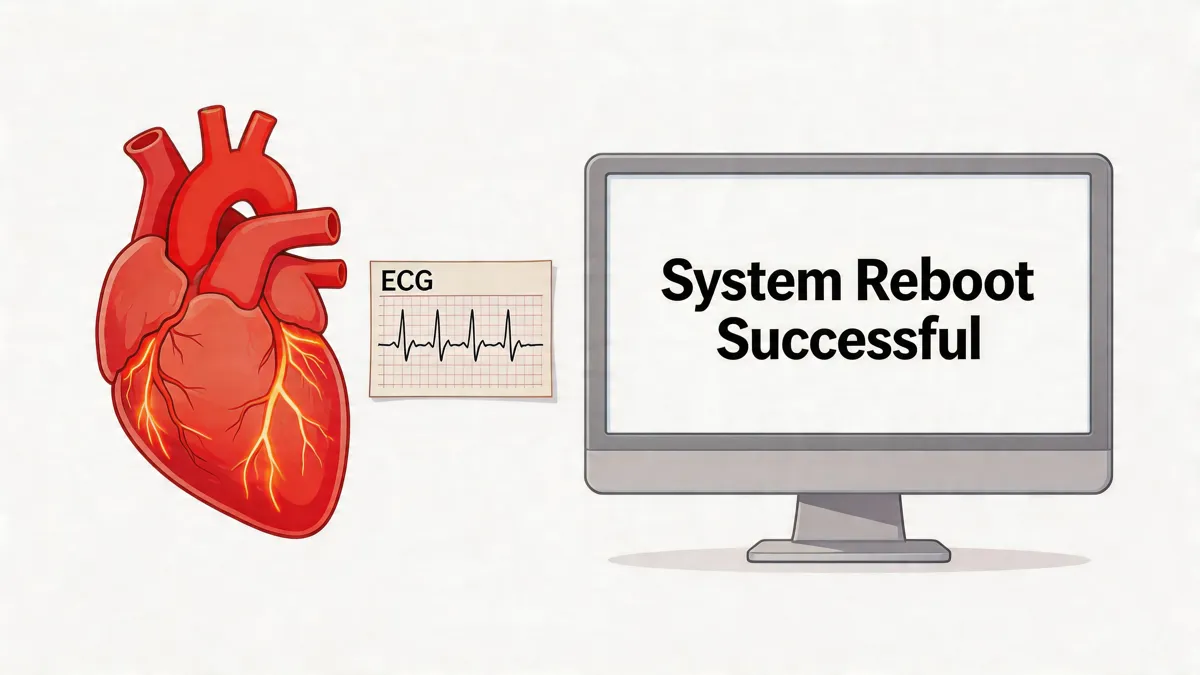
ROSC means Return of Spontaneous Circulation: the heart is generating circulation on its own again after cardiac arrest. Think of restarting a pump. The motor may turn on, but the real question is whether fluid is moving and reaching the organs.
At the bedside, ROSC means more than electrical activity. It means a sustained rhythm that produces perfusion. New clinicians often look at the screen before the patient. Rhythm recognition starts the assessment; perfusion confirms it.
Waveform capnography (EtCO2)
During CPR, EtCO2 reflects the flow your compressions create, so it stays low. A persistently very low reading suggests compressions need to improve.
Bedside check
Pick the signs you see at the pulse check. The checker tells you whether that's enough to call ROSC.
Tap what you're seeing at the pulse check.
Tap each card to check yourself.
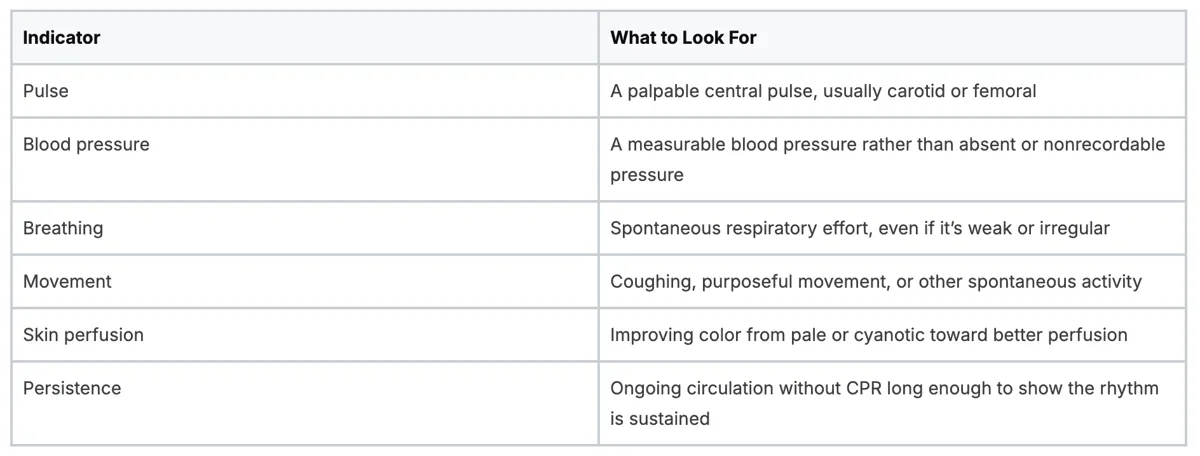
The pulse return is fragile. ROSC is the handoff between successful resuscitation and post-arrest management. Recognize it quickly, confirm it carefully, then be ready to support a patient who may look better for a moment but is still at high risk.
Reversible causes
A patient can get ROSC and still be one missed diagnosis away from another arrest. The ACLS Hs and Ts are a working differential, not just a list. Getting ROSC without fixing the cause is like restarting a pump while the line is still blocked.
These causes often involve oxygen delivery, circulation or metabolic failure.
The heart can't pump what it doesn't have. Severe blood or fluid loss leaves the ventricle too empty to generate output.
The heart muscle and brain need oxygen continuously. When oxygenation fails, rhythms deteriorate and arrest follows.
Significant acidosis interferes with cell function and blunts the response to resuscitation. It often reflects long downtime or poor ventilation.
Potassium disturbances destabilize conduction, leaving the heart irritable, slow or electrically chaotic.
A very cold patient may have depressed cardiac activity and altered metabolism, which changes rhythm interpretation.
These causes often involve obstruction, poison or an acute vascular event.
Pressure in the chest collapses the lung and impairs venous return. The heart may be electrically active but mechanically trapped.
Fluid around the heart restricts filling, so the ventricle can't expand enough to maintain output.
Overdose, medication effects and poisonings can suppress breathing, injure conduction or cause circulatory collapse.
A large pulmonary embolus suddenly blocks flow through the lungs, sharply reducing oxygenation and forward flow.
An acute coronary occlusion can trigger malignant arrhythmias or profound pump failure.
Pair the list with what you're seeing. Match each bedside clue to its most likely cause.
The strongest resuscitation teams don't just run the algorithm. They keep asking why the patient arrested in the first place.
Post-arrest care
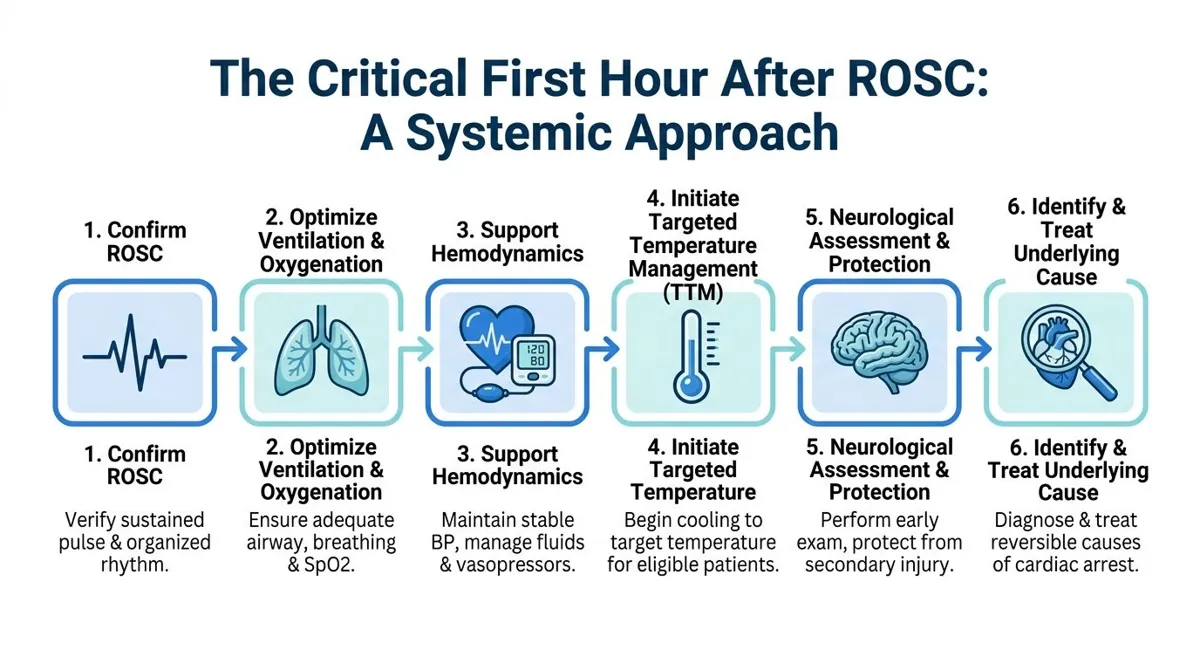
A few seconds ago the team was restarting circulation. Now the job is to protect the brain, support a stunned heart, and prevent rearrest. Work through the six steps and check each one off.
Target: Pulse, BP, rhythm, airway, level of consciousness
Check and document a central pulse, blood pressure, cardiac rhythm, airway status and level of consciousness. Don't rely on the monitor alone. Assign roles early: airway, hemodynamics, and a documenter preparing the next orders.
Target: SpO2 92–98% · PaCO2 35–45 mmHg
Secure the airway if the patient can't protect it, confirm ventilation with exam and waveform capnography, and titrate oxygen instead of leaving maximum support on. Too much oxygen can hurt; too little hurts faster.
Target: SBP ≥ 90 mmHg · MAP ≥ 65 mmHg
Ask why the pressure is low: a weak ventricle, vasodilation, ongoing bleeding, sepsis or obstruction? Fluids help one patient and flood another. Vasopressors, an arterial line and frequent reassessment are often part of early care.
Target: 12-lead ECG early
Get a 12-lead early, especially if a coronary event is possible: ROSC with an untreated occlusion may need urgent cath lab activation. Other clues may point to electrolytes, pulmonary embolism, sepsis, hemorrhage or overdose.
Target: Temperature control 32–37.5 °C if not following commands
If the patient remains comatose, temperature control and structured neurologic monitoring begin. Serial exams, glucose control, seizure recognition, imaging when indicated and careful sedation (oversedation blurs the exam) all matter.
Target: ICU, cath lab, CT or transfer
Where is this patient going next, what monitoring is needed, and what complications are likely in the next 30 minutes? Strong teams say the plan out loud, which reduces missed tasks.
See the full ACLS post-cardiac arrest care algorithm for the step-by-step sequence.
Prognosis
Will this patient wake up? Outcome prediction works less like reading one monitor value and more like building a picture from several pieces. Toggle the factors to see how the starting point shifts.
More favorable starting point
For learning only. This is not a prognostic tool.
Two patients can both achieve ROSC and still have very different trajectories. One collapsed in a monitored setting with compressions started almost immediately; another was found down after an unknown downtime. Both have pulses, but they're not starting the post-arrest phase in the same place.
Outcome isn't only about what happened during the arrest. Good oxygenation without hyperoxia, stable perfusion, temperature control when indicated, seizure recognition, glucose management and timely treatment of the cause all shape the path ahead. You're not just observing the outcome; you're still influencing it. More in our guide to care after cardiac arrest.
Training
If you only know the algorithm that leads to a pulse, you're missing half the job. ACLS and PALS also cover what happens once the pulse is back: rhythm recognition, teamwork, hemodynamic thinking, airway judgment and a working differential.
✓ Recognition skills
so you know when ROSC is present
✓ Decision-making skills
so you move into post-arrest care fast
✓ Retention support
so algorithms stay usable under stress
✓ Scenario-based review
so you connect the protocol to bedside action
Online learning lets clinicians pause, repeat complex sections and review algorithms before a shift. ProMed's ACLS and PALS courses are built on the latest AHA and ILCOR guidelines and include post-cardiac arrest content.
Check yourself
1. What does ROSC stand for?
2. The monitor shows an organized rhythm. What confirms ROSC?
3. On capnography, ROSC often shows as…
4. Which is an early priority right after ROSC?
5. Unequal breath sounds and high airway pressure suggest…
FAQ
ROSC stands for return of spontaneous circulation. It means the heart is producing circulation on its own again after cardiac arrest, confirmed by a palpable pulse and measurable blood pressure, not just an organized rhythm on the monitor.
Check for a palpable central pulse and a measurable blood pressure. A sudden, sustained rise in end-tidal CO2, breathing, coughing, movement and improving skin color support it. The monitor alone never confirms ROSC.
Confirm ROSC is holding, support oxygenation and ventilation, restore blood pressure, get an early 12-lead ECG to look for the cause, protect the brain with temperature control and neurologic monitoring, and build a team plan.
No. ROSC is a turning point, not the finish line. The patient can rearrest, and outcome depends on the cause, how long circulation was lost, and the quality of post-arrest care.
Yes. Both courses cover recognizing ROSC and the post-cardiac arrest care that follows.
ROSC is the moment a code changes direction: compressions give way to stabilization, cause-finding and protecting the brain. Build that skill set online, on your schedule.
Adult resuscitation
Nurses, physicians, paramedics and other providers who manage cardiac emergencies in adults.
From $129
Get ACLS certifiedPediatric resuscitation
Providers who care for infants and children in emergencies (pediatrics, ER, ICU).
From $129
See PALSNot ready yet? Review the post-arrest algorithm or take the free ACLS practice test.
This guide is for education and certification prep. It isn't a substitute for professional training or medical advice.