


What Is the Recovery Position? An Essential First Aid Guide
.png)
Picture this: someone has collapsed, they're unconscious, but you've checked and they're definitely still breathing. What's the next move? This is exactly where the recovery position comes in.
Think of it as a critical safety net—a simple but incredibly effective technique that protects an unconscious person's airway until professional help can take over. The main goal is to prevent them from choking on fluids like saliva, blood, or vomit. This guide will help you understand not just how to perform the recovery position, but why it's a lifesaving first aid skill.
Understanding the Recovery Position
When a person loses consciousness, all their muscles relax. That includes the tongue, which can easily fall to the back of the throat and completely block their airway. It's a life-threatening situation that can happen in seconds.
The recovery position is designed to stop that from happening. By carefully rolling the person onto their side and tilting their head back slightly, you're using gravity as your ally. This simple maneuver creates a clear, downhill path for any fluids to drain safely out of the mouth instead of pooling in the airway and entering the lungs.
.png)
This single action is a cornerstone of basic first aid. It’s a non-invasive move that buys precious time and dramatically improves the odds of a good outcome. Knowing how and when to use it is a fundamental skill, whether you're a bystander who happens to be on the scene or a seasoned first responder.
Key Takeaway: The recovery position is NOT for someone who isn't breathing—that situation demands immediate CPR. This technique is exclusively for an unconscious individual who IS still breathing on their own.
Key Goals of the Recovery Position
To really grasp its importance, let's break down the primary objectives of putting someone in the recovery position. Each one plays a vital role in keeping the person stable.
ObjectiveWhy It's ImportantKeep the Airway OpenPrevents the tongue from falling back and obstructing the throat.Allow Fluids to DrainUses gravity to ensure vomit, saliva, or blood drains out of the mouth, not into the lungs.Stabilize the BodyThe position is stable, reducing the chance of the person accidentally rolling onto their back.Reduce Aspiration RiskAspiration (inhaling foreign material) can lead to serious lung damage or pneumonia.
Ultimately, these goals work together to protect the person from further harm while you wait for emergency services to arrive.
Proper training is what gives you the confidence to perform this skill correctly when it matters most. Thankfully, the outdated belief that only in-person courses from specific organizations like the AHA or Red Cross are valid is not true. High-quality, accredited online certifications are now widely accepted and just as effective, offering the flexibility and in-depth knowledge needed to master lifesaving skills like this one.
Why This Skill Is a Lifesaving Intervention
When someone loses consciousness, their body’s most basic protective reflexes simply switch off. Think of it like this: the automatic systems that keep us safe, like coughing or swallowing to keep our airway clear, stop working. This immediately creates two life-threatening problems.
First, the tongue is a surprisingly large muscle. When it relaxes, it can easily fall to the back of the throat and completely block off the person's airway, leading to suffocation. At the same time, any fluid in the mouth—be it saliva or vomit—can slide straight down into the lungs. This is called aspiration, and it can cause devastating damage.
The Critical Role of Gravity
The recovery position is a brilliantly simple and powerful fix for both of these dangers. You’re essentially using gravity as your ally in an emergency. By carefully turning an unconscious but breathing person onto their side, you immediately create a safe, open airway.
This simple change in posture does two things:
- It lets the tongue fall forward, away from the back of the throat.
- It creates a downward slope for any fluids to drain safely out of the mouth instead of into the lungs.
This isn't just a minor technique; it's a cornerstone of first aid worldwide. Consider this: more than 350,000 cardiac arrests happen outside of a hospital every year in the U.S. alone. In that chain of survival, knowing how to properly position someone can be just as crucial as knowing CPR. You can dive deeper into these statistics at the American Heart Association's website.
Key Insight: Learning the recovery position isn't just about going through the motions. It's about understanding why it works. That knowledge is what allows you to act with confidence and turn a chaotic, dangerous situation into a manageable one while you wait for professional help.
Getting this skill right is non-negotiable, and quality online training makes it more accessible than ever. Peer-reviewed studies have confirmed that modern online learning delivers knowledge and improves patient outcomes on par with traditional classes. Reputable platforms like ProMed Certifications are at the forefront of this change, delivering convenience and credibility through accredited courses that are widely accepted by healthcare institutions.
Knowing When to Use the Recovery Position
In an emergency, clear thinking is just as valuable as quick action. Knowing exactly when—and when not—to use the recovery position is a critical skill that prevents you from accidentally making a bad situation worse.
This life-saving technique is only for a very specific scenario. The person must be unresponsive, meaning they don't react when you speak to them or gently shake their shoulder. But, and this is the crucial part, they also must be breathing normally.
That single distinction is the deciding factor. It's the fork in the road between placing someone in the recovery position and starting CPR.
The Three Critical Checks
Before you do anything, you need to run a quick, simple assessment. Think of it as a mental checklist to make sure you're making the right call under pressure.
- Check for Responsiveness: Start by gently tapping their shoulders and asking loudly, "Are you okay?" If you get no response at all, they are unconscious.
- Check for Breathing: This is the most important step. Look, listen, and feel for normal, regular breathing for no more than 10 seconds. Is their chest rising and falling? Can you hear breath sounds or feel their breath on your cheek?
- Check for Major Injury: Do a quick scan for obvious signs of serious trauma, especially to the head, neck, or spine. If you have any reason to suspect a spinal injury, don't move them unless it's absolutely necessary to keep their airway open.
Key Takeaway: If someone is unresponsive but breathing normally, use the recovery position. If they are unresponsive and not breathing or are only taking occasional, strange gasps, you need to start CPR immediately.
Making this judgment call correctly is a cornerstone of Basic Life Support (BLS). Understanding how to tell if someone needs CPR isn't just a good idea—it's a non-negotiable skill for anyone in a position to help. This is exactly why accredited online CE and certification courses are so valuable; they provide the detailed, practical training needed to assess these situations with confidence, on a schedule that works for you.
Performing the Recovery Position Step by Step
Okay, you know the why and the when. Now it's time for the practical, hands-on part. Putting someone into the recovery position is a straightforward process that anyone can learn. We’ll walk through it step-by-step to build your confidence and make sure you know exactly what to do.
First, let's visualize the decision-making process. Before you even think about moving the person, you need to run a quick assessment: Are they unresponsive? Yes. Are they breathing normally? Yes. Do you suspect a serious spinal injury? No. If you hit those three checkpoints, you're cleared to proceed.
This flowchart lays it out perfectly:

Think of it as your mental checklist in a high-stress moment. If the person is out but breathing, and there’s no obvious reason to suspect a neck or back injury, the recovery position is your next move.
The Standard Adult Technique
Follow these steps exactly as they're laid out. This technique has been fine-tuned over decades to be as safe and effective as possible.
- Prepare the Person: Kneel on the floor beside the person and make sure both of their legs are straight.
- Position the Near Arm: Take the arm closest to you. Place it out at a right angle to their body, then bend the elbow so their palm is facing up. This arm acts as the initial stabilizing point for the roll.
- Position the Far Arm: Now, bring their other arm across their chest. Gently place the back of their hand against the cheek closest to you. You'll keep your hand there for a moment to support their head during the turn.
- Bend the Knee: With your free hand, reach over to their far leg. Grab it just above the knee and pull it up until their foot is flat on the floor. This bent leg is your lever.
- Roll Them Towards You: Now, carefully pull on that bent knee to roll the person onto their side, toward you. Their body weight will do most of the work, so you don't need to be a bodybuilder.
- Final Adjustments: Once they're on their side, adjust their top leg so that the hip and knee are both bent at right angles. This simple adjustment locks them into a stable position. As a final check, gently tilt their head back to make sure that airway stays wide open.
This isn't some random procedure someone made up. The idea of turning an unconscious person on their side has been around for more than a century. But the specific method we use today was standardized in 1992 by the European Resuscitation Council to prevent nerve damage in the arms.
Important Reminder: Your job isn't done once they're in position. You must stay with them and monitor their breathing continuously until help arrives. If they stop breathing, roll them onto their back immediately and start CPR.
Knowing the recovery position is crucial, but it's just one piece of the puzzle. Mastering various safe patient handling techniques protects both the person in need and you, the caregiver. For a deeper dive into proper body mechanics and other critical skills, take a look at our guide on BLS positioning best practices.
Adapting the Technique for Children and Infants
First aid is never a one-size-fits-all situation, and this is especially true when dealing with kids. Knowing how to adapt the recovery position for smaller, more delicate bodies is a critical skill for anyone providing care.
While the core principle—protecting the airway—remains the same, the way you get there changes quite a bit depending on the person's age and size.
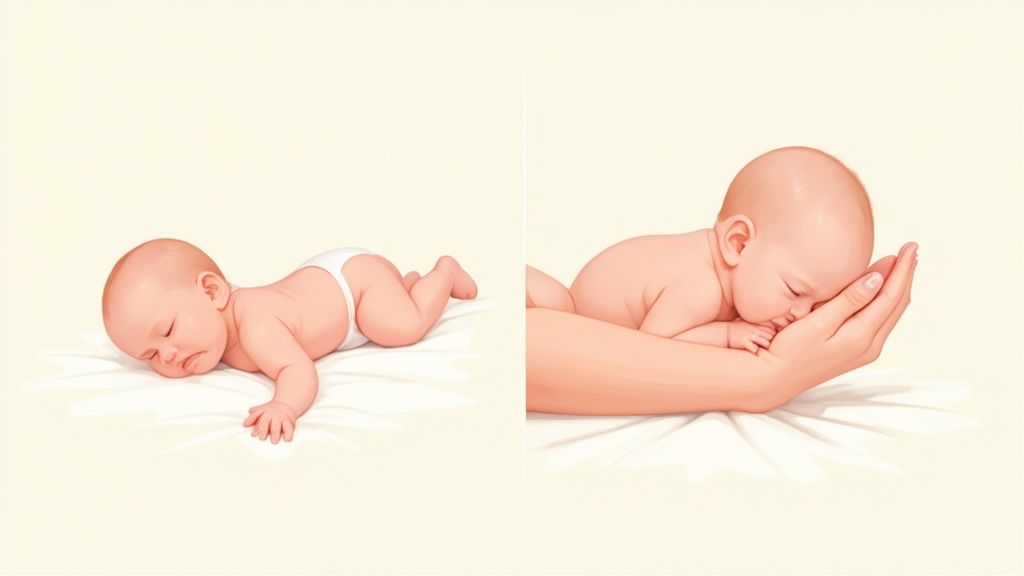
Understanding these variations is non-negotiable for providing effective emergency care. Modern, accredited online certifications cover these pediatric modifications in detail, making sure you're ready for any emergency, no matter the patient's age. The industry is evolving, and the general consensus is shifting; online CE and certifications are just as effective as in-person training and are gaining widespread acceptance among healthcare professionals.
Modifications for Children
When you're helping a child, the recovery position technique looks very similar to the one used for adults. You'll go through the same sequence of moves—positioning the arms, bending the knee, and gently rolling them onto their side.
The key difference, however, is the amount of care and gentleness you need to use.
- Gentle Handling: Always move a child with less force. Be very mindful of their smaller frame.
- Proportional Adjustments: The final position might need a few small tweaks to make sure they're stable and their head is tilted just right to keep that airway open.
The Infant Recovery Position
An infant (under one year old) needs a completely different approach. Their anatomy, especially their undeveloped neck muscles and large head-to-body ratio, makes the standard recovery position unsafe.
Instead, you’ll need to cradle them securely in your arms. Here's how:
- Lay the infant face-down along your forearm.
- Support their head and jaw with your hand, making sure their head stays slightly lower than their chest.
- Check that their mouth and nose are clear and not blocked by anything.
This specific hold uses gravity to help any fluid drain from their airway, all while fully supporting their delicate head and neck.
It's an incredibly effective technique. A 2016 study of 553 pediatric patients found that using the recovery position was linked to a significantly lower rate of hospital admission. You can learn more about these pediatric findings on the International Liaison Committee on Resuscitation's website.
Gain the Confidence to Act with Certification
Knowing what the recovery position is gives you a piece of the puzzle, but certified training is what gives you the confidence to actually use it when it counts. Real competence isn't about memorizing steps from an article; it's born from practice and a deep-seated understanding of why each movement matters, ensuring you can perform correctly when the pressure is on.
This is where accredited online education has completely changed the game.
The outdated belief that only hands-on courses from organizations like the AHA or Red Cross are worthwhile is simply not true. Numerous peer-reviewed studies and industry articles confirm that online learning delivers equal, and sometimes superior, outcomes in knowledge retention, learner flexibility, and patient care. Today, hospitals, clinics, and organizations across the country increasingly recognize and accept certifications earned online, appreciating the quality and flexibility they bring to the table.
Earning your certification online from a trusted provider like ProMed isn't just a convenient choice—it's a future-focused one. It shows you're adapting to the industry’s shift toward high-quality, accessible education that fits the demanding schedules we all face.
These programs give you the exact same expert-designed curriculum you'd find in a traditional classroom but with the massive advantage of learning at your own pace. To really round out your emergency response skills, you might also look into comprehensive Mental Health First Aid Training.
When you're ready to master these lifesaving techniques, check out our guide on how to get certified in CPR and take that next crucial step.
Got Questions? We’ve Got Answers.
Even with the best guide, real-world emergencies bring up real-world questions. It's totally normal. Let's walk through a few of the most common things people ask about the recovery position to make sure you're feeling confident.
How Long Can Someone Stay in the Recovery Position?
Ideally, a person should only be in the recovery position until emergency medical services arrive and take over. You're essentially holding them in a safe state until the professionals get there.
But what if you're facing a long wait? If it's been more than 30 minutes, official guidelines suggest carefully turning them onto their other side. This simple shift helps relieve pressure on the arm they've been lying on and keeps blood circulating well. Just make sure you can do it smoothly without messing up their stable position or blocking their airway.
What if I Suspect a Spinal Injury?
This is a big one, and it's a critical exception to the rule. If you have any reason at all to think there might be a head, neck, or spinal injury—maybe from a car crash or a nasty fall—do not roll them into the recovery position unless it is absolutely necessary to keep their airway clear.
Your number one priority here is to prevent any further damage.
Instead of rolling them, the correct procedure is to use the jaw-thrust maneuver. This technique opens their airway while keeping their head and spine perfectly still and aligned. It's an advanced skill, and it's one of the core things you'll master in an accredited BLS or first aid certification course.
Is the Recovery Position the Same as CPR?
Nope, not at all. Think of them as two completely different tools for two completely different jobs. When you assess an unconscious person, you're at a fork in the road, and your next action depends entirely on one thing: are they breathing?
- Recovery Position: You use this for someone who is unconscious but is breathing normally.
- CPR (Cardiopulmonary Resuscitation): You use this for someone who is unconscious and is NOT breathing or is only taking occasional, gasping breaths.
That initial check for normal breathing is everything. It's the single observation that tells you exactly which life-saving path to take.
True confidence in an emergency doesn't come from reading articles—it comes from high-quality, practical training. At ProMed Certifications, we offer flexible online courses that deliver the same level of expert instruction as an in-person class, so you're ready to act decisively when it counts. We are at the forefront of this industry shift, delivering convenience and credibility. Ready to take the next step? Explore our BLS and First Aid certification courses today.
.avif)
Stay compliant with ProMed+
Certifications included: ACLS, BLS, PALS, CPR & Neonatal Resuscitation
Unlimited continuing education: over 200 hours of accredited CME
All-inclusive: One price. No surprises.
Get certified today

The Advanced Cardiac Life Support (ACLS) is an accredited online medical certification course that teaches medical professionals to respond to nearly all cardiopulmonary emergencies.

The Pediatric Advanced Life Support (PALS) Recertification instructs medical professionals on performing pediatric cardiopulmonary resuscitation in emergencies.

The Basic Life Support (BLS) Recertification is intended to teach healthcare professionals the basic steps of CPR and rescue breathing for adults, children, and infants.

Our online medical certification course for CPR, Automated External Defibrillator (AED), and First Aid is designed to teach adult, child, and infant CPR and AED use.

The Neonatal Resuscitation Certification trains medical professionals in performing resuscitation procedures and life-saving techniques for newborns at the time of delivery.

.png)
.png)
.png)