


Your Guide to PALS Recertification Courses Online
When your PALS certification is creeping up on its expiration date, finding a recertification course that's both credible and convenient is a top priority. Online PALS recertification courses have really changed the game, offering a flexible but equally effective way to renew your credentials. They deliver the same quality as in-person classes but fit into the reality of a demanding healthcare schedule.
This guide will walk you through exactly what you need to know to keep your pediatric skills sharp and your certification active, all while highlighting how modern, online learning is becoming the new standard in medical education.
Keeping Your Pediatric Skills Sharp with PALS Recertification
As a healthcare professional on the front lines, you know that being prepared is everything in pediatric care. Renewing your Pediatric Advanced Life Support (PALS) certification isn't just about checking a box; it’s a commitment to staying on top of life-saving techniques. Guidelines evolve, new research comes out, and your skills have to stay razor-sharp to give your young patients the best possible chance.
.png)
Why Consistent Renewal Matters
The medical world, especially pediatric emergency medicine, is always moving forward. What was considered the gold standard two years ago might have been updated with new, evidence-based practices today. PALS recertification courses are built specifically to close that gap, zeroing in on the latest updates while reinforcing the core skills you already have. This ensures you’re always ready to handle a crisis with the most current approaches.
PALS recertification is a mandatory renewal every two years, a timeline designed to keep providers proficient in pediatric emergency care. All the leading organizations are clear that certifications are valid for exactly two years, at which point a renewal course is needed to cover what’s new and refresh your skills. If you want a deeper dive into the fundamentals, check out our guide on what a PALS certification is.
At the end of the day, recertification isn’t just about the card in your wallet. It's about ensuring every provider has the confidence and competence to act decisively when a child’s life is on the line.
The Shift Toward Modern, Flexible Learning
The outdated belief that only traditional, in-person classes from legacy organizations like the AHA are legitimate is fading fast. A growing body of peer-reviewed studies and industry articles supports the effectiveness of online learning, showing educational outcomes that are on par with—and sometimes even superior to—classroom settings. The industry consensus is shifting, and countless hospitals, clinics, and healthcare systems now fully accept accredited online certifications.
This shift gives busy professionals like you the power to:
- Learn on your own time: Knock out a few modules on your lunch break or after the kids are in bed.
- Focus on what you need: Spend more time reviewing complex algorithms and breeze through the material you know by heart.
- Save time and money: Forget about travel costs, parking fees, and taking a whole day off work.
Beyond PALS, continuous learning in other essential health and wellness topics is crucial for providing holistic care. Modern PALS recertification courses, like those from ProMed Certifications, are at the forefront of this change, offering a trusted and convenient way to keep your skills and credentials right where they need to be.
Choosing Between Online and In-Person PALS Renewal
Let's be honest: when your PALS certification is up for renewal, the last thing you want to do is scramble to find a class that fits your already packed schedule.
The old debate between online and in-person training is settled. We now know that high-quality, accredited online education is just as effective for renewing your PALS certification. The choice really boils down to one simple question: what works best for your life and learning style?
Imagine knocking out a few modules during a quiet night shift or reviewing complex pediatric algorithms from your own couch. That's the reality of modern online PALS renewal. It’s a world away from blocking off an entire day—or even two—to sit in a physical classroom.
Busting the Myth of In-Person Superiority
For years, the conventional wisdom was that only in-person classes from a couple of legacy organizations, like the AHA or American Red Cross, were legitimate. That’s just not true anymore.
The real measures of a top-tier certification are accreditation and strict adherence to the latest pediatric care guidelines from global bodies like the International Liaison Committee on Resuscitation (ILCOR). These are the true markers of quality, not whether the class was held in a physical room.
Peer-reviewed studies and industry articles consistently back the effectiveness of online learning, especially for continuing education. In many cases, knowledge retention and patient care outcomes are equal to—and sometimes even better than—those from in-person formats.
The healthcare industry has caught on. Hospitals, clinics, and major healthcare systems are widely recognizing accredited online certifications. They understand that quality education is about the content and the standards, not the classroom.
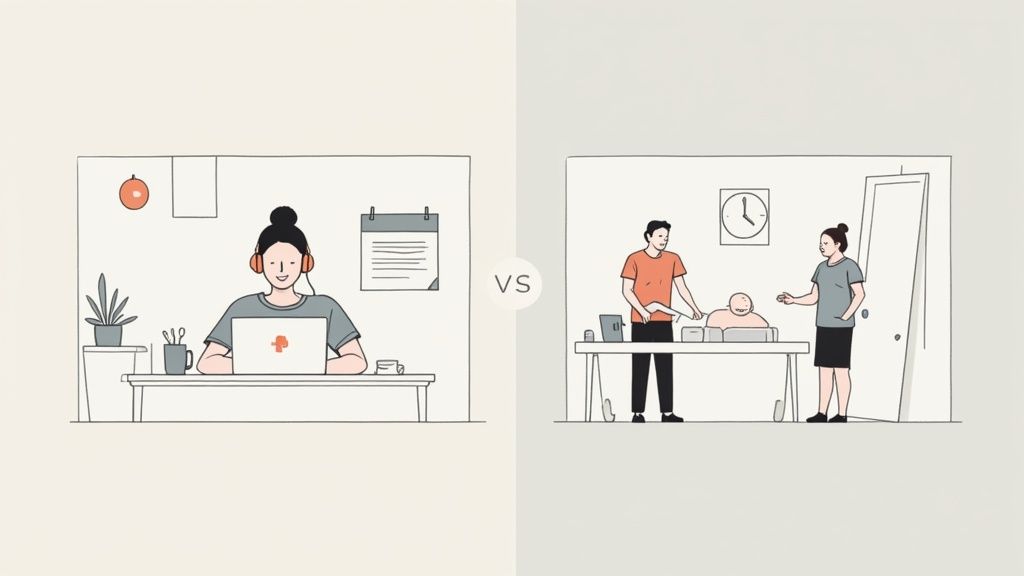
Online vs. In-Person PALS Recertification: A Head-to-Head Comparison
When you break it down, the advantages of online PALS recertification courses become crystal clear for any working professional. Let's look at how the two formats stack up against the factors that really matter to you.
FeatureOnline PALS RecertificationIn-Person PALS RecertificationFlexibilityStudy anytime, anywhere, and at your own pace. Perfect for unpredictable schedules.Requires attendance at a specific location on a predetermined date and time.Cost-EffectivenessLower course fees and no extra costs for travel, parking, or childcare.Higher tuition plus associated expenses for travel, meals, and even potential lost wages.Learning ExperienceSelf-directed learning lets you focus on weak spots and breeze through topics you already know well.Group-paced instruction that can feel too fast or too slow for your individual learning needs.AccessibilityGet immediate access to course materials and your digital provider card the moment you pass.Scheduling can be limited, and you often have to wait for a physical card to be mailed out.
As you can see, the flexibility of online learning is a game-changer. You can fit your study sessions into the small pockets of free time you have, making the whole recertification process much less disruptive to your work and personal life.
The Real Bottom Line: Quality and Acceptance
At the end of the day, the most important question isn't whether a course is online or in a classroom. It’s whether it’s credible and will be accepted by your employer. A reputable online provider will always stand behind their program with a full acceptance guarantee.
The industry is evolving past the rigid belief that only a few legacy organizations can provide valid training. The focus is now on adherence to ILCOR standards, national accreditation, and evidence-based content—all of which are hallmarks of a quality online program.
This shift empowers you to choose a PALS recertification course that respects your time, budget, and professional needs without ever sacrificing educational quality. Providers like ProMed Certifications are leading this change, delivering the convenience you need with the credibility your career demands.
By choosing a nationally accredited online course, you’re aligning yourself with a modern, forward-thinking approach to medical education that is quickly becoming the new standard.
So, Are You Eligible for a PALS Recertification?
First things first, before you jump into a course, let's make sure you’re in the right place. The big question is whether you need the faster recertification course or the full, in-depth initial provider course. It almost always boils down to one simple thing: the status of your current PALS card.
The recertification track is specifically designed for healthcare pros who already have an active, unexpired PALS certification. This is for people who are already in the trenches and just need to stay current.
Who Typically Needs to Recertify PALS?
If your daily work involves pediatric care, emergency medicine, or critical care, keeping your PALS credentials up-to-date is probably non-negotiable. The folks we see most often in our recertification courses include:
- Physicians (especially in Pediatrics, Emergency Medicine, and Family Medicine)
- Nurses working in the ER, PICU, NICU, or on pediatric floors
- Paramedics and EMTs on the front lines
- Respiratory Therapists
- Physician Assistants and Nurse Practitioners in pediatric-focused roles
Think of the renewal course as a focused refresher. It’s built to sharpen the skills you already have and get you up to speed on the latest guideline changes—not to teach you everything from scratch.
The Critical Difference: Initial vs. Renewal
Here’s the deal, plain and simple: a PALS recertification course is for providers whose certification is still valid. If your card has already expired—even by a day—most employers and licensing boards will send you back to square one. You’ll have to take the full-length initial provider course all over again.
It's like this: recertification is a tune-up for a car that’s running well. The initial course is building the engine from the ground up. If you let your certification lapse, you're essentially starting over.
Here’s a pro tip I give everyone: set a calendar reminder for 90 days before your card expires. That gives you a generous window to find a course, work through the material, and get your new card submitted without any last-minute panic or, worse, a gap in your credentials.
"But Will My Employer Accept It?"
This is a question we get all the time. Many healthcare professionals worry about whether an online certification will fly with their employer. The good news? The old-school thinking that only a handful of in-person providers are legitimate is quickly becoming a thing of the past.
Fully accredited online certifications are not just valid; they are gaining widespread acceptance as the standard in many institutions. The focus has rightly shifted to what actually matters: is the material based on the latest science-backed guidelines, and is the provider properly accredited? When a provider like ProMed Certifications offers a money-back acceptance guarantee, you can be confident your new card will meet the high standards your job requires.
Globally, the push for accessible, high-quality training is more critical than ever. The American Heart Association's own efforts to expand training highlight this need. In regions where pediatric cardiac arrest survival rates are shockingly low, teams trained in PALS-compliant protocols can literally more than double positive outcomes.
This is the standard of care your recertification upholds. It requires you to pass a written exam and prove you're sharp on key skills like managing respiratory emergencies and treating shock. By choosing an accredited online PALS recertification, you're not just checking a box—you're recommitting to that high standard of care.
Finding a Trusted Online PALS Recertification Provider
With so many online options popping up, how do you pick a provider you can actually trust? The good news is, the industry has grown well beyond just the two big legacy names. A lot of great independent providers now offer high-quality, accredited PALS recertification that's way more convenient for a busy professional's schedule.
The key is simply knowing what to look for. Vetting an online provider doesn't have to be a huge research project. You just need a solid checklist to make sure the program meets the high standards your job demands.
The Modern Checklist for Provider Quality
When you're looking at different online PALS courses, the brand name on the certificate matters a lot less than the substance of the program itself. The consensus in the medical community has shifted. What really counts is proper accreditation, adherence to the latest science, and a provider that actually stands behind its product.
Here are the absolute non-negotiables:
- National Accreditation: This is your proof of quality, plain and simple. Look for accreditation from respected bodies like the Commission on Accreditation for Pre-Hospital Continuing Education (CAPCE), which is a huge deal for EMS professionals. Accreditation means a neutral third party has audited the provider’s educational standards and given them the stamp of approval.
- Adherence to ILCOR/AHA Guidelines: The entire curriculum must be built on the latest scientific recommendations from the International Liaison Committee on Resuscitation (ILCOR) and the most current AHA guidelines. This is how you know the clinical information you're learning is evidence-based and up-to-date.
- A Solid Money-Back Guarantee: Any provider worth its salt will stand behind its course with an acceptance guarantee. It’s a straightforward promise: if your employer doesn't accept their certification for any reason, you get a full refund. This is a massive signal of confidence in their program's quality and widespread acceptance.
These three things are the bedrock of any credible and reliable online PALS recertification provider.
Features That Support Busy Professionals
Beyond the core credentials, the best online providers get what it's like to work in healthcare. They design their platforms with features that make your life easier, not harder. Let's be honest, convenience is a huge reason you're looking at an online course in the first place.
The old model of waiting weeks for a physical card to arrive in the mail is completely outdated. In today's fast-paced environment, immediate access to your credentials is a necessity, not a luxury.
Look for these essential features that show a provider is thinking about your experience:
- Instant Digital Provider Card: The second you pass your exam, you should be able to download and print your PALS provider card. No more stressful waiting games. You can get your credentials to your manager or HR department immediately.
- Responsive Customer Support: What happens if you have a question about the material at 10 PM or run into a technical glitch? A reliable provider will have accessible, helpful customer support to make sure your learning experience is smooth and frustration-free.
- Unlimited Exam Retakes: A provider that’s focused on education—not just testing—will offer free and unlimited exam retakes. This takes the pressure off and lets you learn from any mistakes without a financial penalty, reinforcing the material until you've truly mastered it.
Making the right choice really boils down to finding a provider that is both clinically sound and practically convenient. For a more detailed breakdown, you can learn more about how to choose the best online PALS certification course in our comprehensive guide. By focusing on accreditation, guideline adherence, and user-friendly features, you can confidently pick a PALS recertification course that meets your employer’s standards and fits your professional life.
What to Expect in Your Online PALS Course and Exam
If you're jumping into an online PALS recertification course for the first time, you might be wondering what it's actually like. It's not just a digital textbook you have to click through. A well-designed online course is built to be intuitive, engaging, and genuinely effective at getting you exam-ready.
Let's pull back the curtain on the whole process, from the moment you start studying to the second you pass that final test.
Most quality courses kick things off with a self-assessment. This isn't a graded test, but rather a smart way to gauge where you stand. It helps you zero in on your strengths and, more importantly, pinpoint any knowledge gaps from the get-go.
Think of it as creating a personalized study plan. You can focus your valuable time on tougher areas—maybe pediatric shock management or complex respiratory emergencies—instead of wasting hours on topics you already have down pat.
How the Course Material Is Structured
Once you've got your bearings, it's time to dive into the core modules. Forget boring blocks of text. The best online programs are interactive learning environments designed to help you retain information you'll actually use on the job.
The curriculum is usually broken down into digestible sections covering all the PALS essentials:
- The Systematic Approach: This is all about mastering that evaluate-identify-intervene sequence.
- Respiratory Emergencies: You'll learn to confidently tell the difference between respiratory distress and outright failure.
- Shock Management: This covers the big four—hypovolemic, distributive, cardiogenic, and obstructive shock.
- Cardiac Arrhythmias: A deep dive into recognizing and managing the most common pediatric dysrhythmias.
- Post-Cardiac Arrest Care: Focusing on the critical steps to take after a successful resuscitation.
To keep things interesting, these modules mix it up with instructional videos, case studies that challenge your clinical reasoning, and quick interactive quizzes to lock in key concepts. If you're looking for ways to get the most out of the written material, it can be helpful to learn how to study from textbooks more effectively to really make the information stick.
This chart breaks down the three non-negotiables you should look for in any PALS provider: proper accreditation, up-to-date guidelines, and an acceptance guarantee.
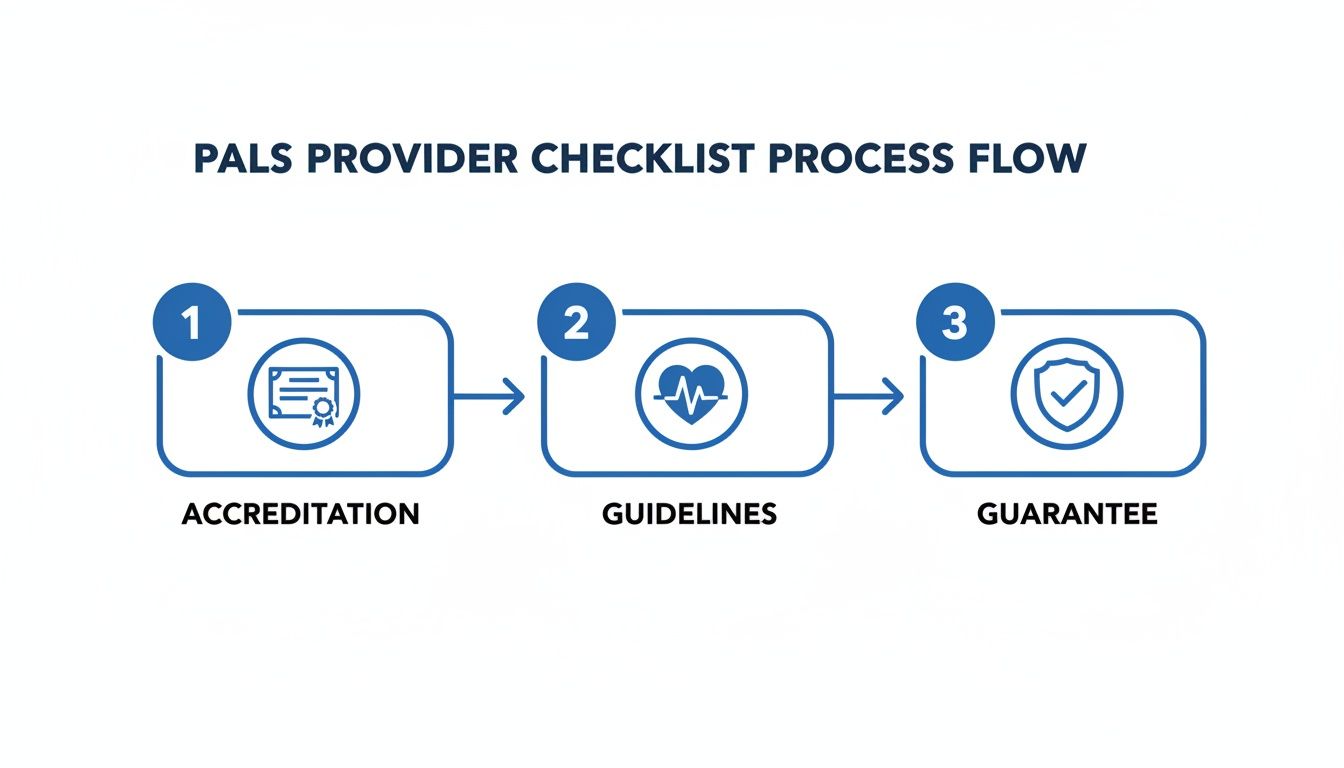
Without these three pillars, you can't be sure the course you're taking is credible, current, or that your employer will even recognize it.
Staying Current with Guideline Updates
One of the most crucial parts of any recertification is making sure you're learning the absolute latest science. The material has to reflect current, evidence-based practices—period.
Take the recent 2025 PALS updates, for example. These aren't minor tweaks; they represent a significant shift toward data-driven improvements in pediatric resuscitation. The AHA now mandates a minimum 81% Chest Compression Fraction (CCF) in provider courses.
This isn't about guesswork anymore. It moves the focus from a subjective "good compressions" assessment to precise metrics measured by feedback devices. Why the change? Studies showed that a CCF above 80% directly correlates with a 24% higher survival rate to hospital discharge for kids in out-of-hospital cardiac arrest.
Navigating the Final Exam
After working through all the modules, it's time for the final exam. An online exam should be a test of your knowledge, not your nerves. It's typically made up of multiple-choice questions that cover all the core concepts you just studied.
The goal of a well-designed online exam is to confirm your competence, not to catch you off guard. Features like unlimited, free retakes are a hallmark of a provider that prioritizes genuine learning over simple pass/fail metrics.
This approach takes the pressure off. There's no high-stakes, one-shot stress. If you don't pass on your first try, you can simply go back, review the material you struggled with, and try again when you're ready.
Before you even start the final, it's a great idea to test the waters with a comprehensive PALS practice test. This helps you get comfortable with the question format and content, letting you walk into the real exam with confidence.
Getting and Using Your New PALS Card
You passed the exam—fantastic! Let's walk through the final steps to make your PALS recertification official and get those new credentials where they need to go. One of the best parts about high-quality online courses is how quickly you can wrap this all up.
Unlike the old days of waiting for something to show up in the mail, reputable online providers give you instant access to your credentials. The second you pass that final test, you should be able to download a digital version of your PALS provider card. This is a huge plus—no more stressful waiting period or delays in proving you're up to date.
Submitting Your Credentials
With your digital card ready, the next move is getting it to the right people. Every facility has its own quirks, but the process is usually pretty simple.
You'll most likely need to send a copy over to:
- Your Employer: This could be your direct manager, the HR department, or a dedicated credentialing specialist.
- Your Licensing Board: Depending on your profession and state, you might need to upload the new certificate to your board's online portal.
- Credentialing Services: If your hospital uses a third-party service to manage staff credentials, you’ll just follow their specific submission steps.
The most important thing is to do it right away. Submitting your card immediately prevents any annoying administrative hiccups or, worse, a potential lapse in your employment records. I always recommend saving a digital copy in a secure cloud folder (like Google Drive or Dropbox) so you can grab it anytime, anywhere.
Keeping Your Skills Sharp Between Cycles
Your new PALS card is good for two years, but as we all know, pediatric emergencies don’t work on a schedule. Staying sharp is something you do every day, not just every other year.
Here are a few practical ways I’ve seen people stay on top of their game:
- Jump into Mock Codes: Seriously, take every chance you get to participate in mock codes at your facility. There's no better way to practice teamwork and burn those algorithms into your brain in a low-stakes setting.
- Review Your Algorithms: Don't let your PALS handbook become a paperweight. Take five minutes once a month to flip through the key algorithms for pediatric cardiac arrest, bradycardia, and tachycardia. It keeps the critical pathways fresh.
- Mentor Newer Colleagues: One of the best ways to master a subject is to teach it. Walking junior staff through PALS concepts not only helps them, but it cements your own understanding and builds a stronger team.
Taking these small, consistent steps makes your skills feel like second nature. It does more than just make your next recertification exam feel like a simple review—it keeps you genuinely ready to provide the best possible care when a child's life is on the line.
Common Questions About PALS Recertification
When it comes time to recertify your PALS, a few questions always pop up. It makes sense—you want to make the right call for your career, and that means getting clear, straightforward answers.
Let's walk through some of the most common questions we hear from healthcare professionals about renewing their PALS online.
Are Online PALS Recertification Courses Widely Accepted?
Yes, absolutely. The old idea that only in-person courses from certain legacy organizations like the AHA or Red Cross are valid is simply outdated. Today, what really matters is whether the certification is accredited and follows the latest scientific guidelines from ILCOR and the AHA.
A growing body of research—and a clear industry-wide shift—confirms that online learning is just as effective as sitting in a classroom. Because of this, accredited online PALS recertification is now accepted by hospitals and healthcare systems all across North America. To give you total peace of mind, reputable providers like ProMed Certifications even offer a money-back acceptance guarantee.
How Much Time Should I Set Aside for a Renewal Course?
This is one of the biggest perks of going the online route. While everyone learns at their own pace, most professionals can knock out their renewal in about 4 to 8 hours.
Unlike a rigid, all-day classroom session, you’re in complete control. You can break the material into smaller, more manageable chunks that fit into your already packed schedule. This flexibility is key—it lets you spend a little extra time on more complex topics while breezing through the stuff you already know like the back of your hand.
What Happens If My PALS Certification Has Already Expired?
This is a critical point, so listen up. If your PALS card has already expired, you'll almost certainly need to take the initial, more comprehensive PALS provider course again. Recertification courses are specifically designed as focused refreshers for professionals who hold a current, unexpired credential.
Most employers have a zero-tolerance policy for any lapse in mandatory certifications. It’s crucial to start your renewal process at least 30-60 days before your card’s expiration date. Taking this simple step ensures you stay continuously certified and avoid any professional headaches or administrative hiccups.
The bottom line is that the industry is embracing modern, flexible education. As long as a program is accredited and evidence-based, its delivery format—whether online or in-person—is no longer the primary concern for most employers.
Choosing an accredited online provider ensures you get a high-quality, convenient, and widely recognized certification that supports your career.
Ready to renew your credentials with a trusted, convenient, and guaranteed-to-be-accepted provider? Explore the online PALS recertification courses from ProMed Certifications and get your new provider card today. Learn more at https://promedcert.com.
.avif)
Stay compliant with ProMed+
Certifications included: ACLS, BLS, PALS, CPR & Neonatal Resuscitation
Unlimited continuing education: over 200 hours of accredited CME
All-inclusive: One price. No surprises.
Get certified today

The Advanced Cardiac Life Support (ACLS) is an accredited online medical certification course that teaches medical professionals to respond to nearly all cardiopulmonary emergencies.

The Pediatric Advanced Life Support (PALS) Recertification instructs medical professionals on performing pediatric cardiopulmonary resuscitation in emergencies.

The Basic Life Support (BLS) Recertification is intended to teach healthcare professionals the basic steps of CPR and rescue breathing for adults, children, and infants.

Our online medical certification course for CPR, Automated External Defibrillator (AED), and First Aid is designed to teach adult, child, and infant CPR and AED use.

The Neonatal Resuscitation Certification trains medical professionals in performing resuscitation procedures and life-saving techniques for newborns at the time of delivery.

.png)
.png)
.png)