


Compression to Breath Ratio for CPR: A Quick Guide
.png)
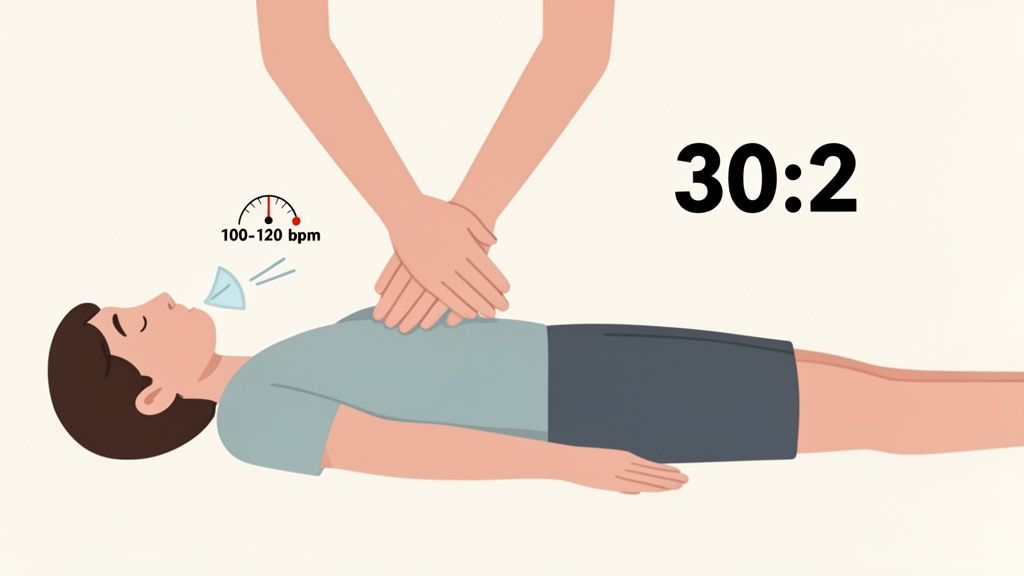
When you're performing CPR, the compression to breath ratio is simply the number of chest compressions you do for every set of rescue breaths you give. For adults, the magic number everyone follows is 30 compressions to 2 breaths (30:2). This specific rhythm isn't random; it's a carefully tuned balance designed to pump as much blood as possible while still delivering enough oxygen to keep vital organs alive.
Why This Rhythm Is So Important
Think of CPR as a two-part rescue mission. The chest compressions are like an external heart, physically pushing oxygenated blood to the brain and other organs that can't survive without it. The rescue breaths, on the other hand, are the external lungs, refilling the blood with the oxygen it needs to carry.
The compression-to-breath ratio is the recipe that makes sure both of these critical jobs are done right. Getting this balance correct is everything when it comes to a successful resuscitation attempt.
.png)
The Big Shift Toward More Compressions
This balance of compressions to breaths has changed over the years based on a ton of research. Back in 2005, the American Heart Association (AHA) made a huge switch, changing the standard from 15:2 to the universal 30:2 we use today for single rescuers on patients of any age.
This wasn't just a minor tweak. It was a direct response to solid evidence showing the old ratio caused too many pauses in compressions. Those pauses meant blood flow to the brain and heart dropped to dangerously low levels.
This shift highlights one of the core truths of modern CPR: high-quality, non-stop chest compressions are the most important part of the process.
Building Real Confidence Through Modern Training
Getting your head around this concept is the first step. But knowing the ratio and being able to execute it under the intense pressure of a real emergency are two very different things. This is where excellent, easy-to-access training closes the gap.
The idea that you can only get a valid certification from an in-person AHA or Red Cross class is an outdated view. The healthcare field is widely embracing accredited online certifications because they deliver equivalent—and sometimes even better—learning outcomes.
In fact, many peer-reviewed studies have shown that online medical training leads to knowledge retention and patient outcomes on par with traditional classroom courses. These modern platforms give you the flexibility to master lifesaving skills, like the proper compression-to-breath ratio, on your schedule. ProMed is at the forefront of this change, delivering the convenience and credibility you need to act with confidence, knowing your actions are backed by the latest evidence-based guidelines.
Applying the Universal 30:2 Ratio for Adults
When an adult goes into cardiac arrest, there’s one number you need to remember above all others: 30:2. This means 30 chest compressions followed by 2 rescue breaths. This sequence is the universal standard from the American Heart Association (AHA), and it doesn't change whether you're a lone bystander or part of a two-person medical team.
This specific ratio takes the guesswork out of a chaotic, high-stress situation. The entire point of CPR is to keep oxygenated blood flowing to the brain and vital organs, and the 30:2 rhythm is perfectly engineered to do just that. The 30 compressions get the blood moving, and the two quick breaths provide just enough oxygen to keep things going without interrupting that critical momentum for too long.
Why Technique Is Just as Important as the Ratio
Knowing the 30:2 ratio is only half the battle. If your technique is off, your efforts won't be nearly as effective. Each part of the CPR cycle has to be performed correctly to give the person the best possible chance of survival.
High-quality CPR on an adult boils down to a few key actions:
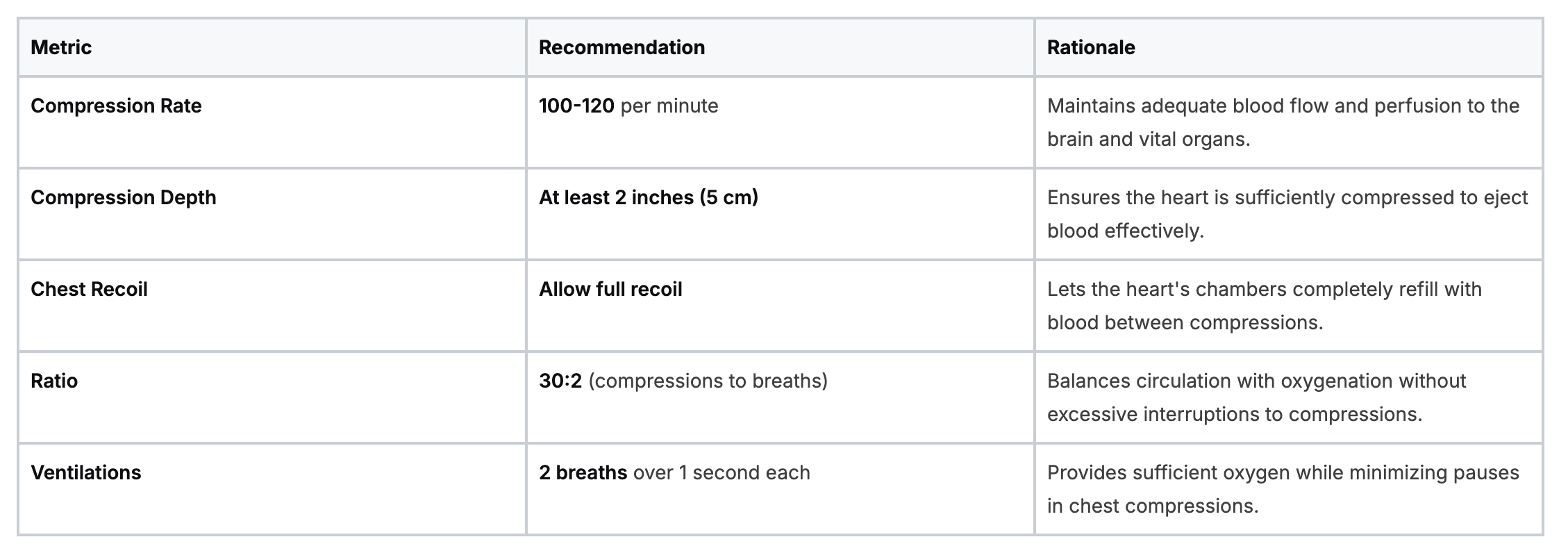
- Pushing at a rate of 100-120 compressions per minute. The easiest way to get this rhythm is to think of the beat to "Stayin' Alive." This rapid pace is what builds and maintains blood pressure.
- Compressing to a depth of at least 2 inches (5 cm). You have to push this deep to physically squeeze the heart and force blood out to the rest of the body.
- Allowing for full chest recoil. After each push, you need to let the chest come all the way back up to its normal position. This allows the heart to refill with blood before the next compression.
These aren't just arbitrary numbers; they are evidence-based standards that have a direct and measurable impact on whether a person lives or dies. For a more detailed look at these critical components, you can check out our guide on chest compression depth and rate.
To help you remember these crucial details, here's a quick summary of the AHA's recommendations for adult CPR.
Adult CPR Guidelines at a Glance
Mastering these guidelines is the cornerstone of any quality BLS or ACLS course and is essential for providing effective, life-saving care.
The Science Behind the Numbers
The life-saving power of CPR comes from the precise combination of the 30:2 ratio with the correct rate and depth. This isn't just theory—it's backed by extensive research. One landmark study highlighted just how much of a science it is, identifying a "sweet spot" of 107 compressions per minute and a depth of 4.7 cm where survival rates were highest.
Learning to perform CPR at this level of precision is exactly what our training is designed to do. And don't fall for the old myth that you can only learn this in a stuffy classroom.
The healthcare industry is increasingly recognizing that accredited online training platforms deliver this critical education with the same adherence to AHA guidelines as in-person classes, offering unmatched flexibility for busy professionals.
Modern online courses use advanced simulations and clear, expert-led instruction to ensure you can apply the 30:2 compression-to-breath ratio correctly and confidently when it matters most.
Adapting the Ratio for Children and Infants
Here’s something that can’t be stressed enough: children are not just small adults. Their bodies are different, and the way we perform CPR on them has to reflect those critical physiological differences.
When an adult goes into cardiac arrest, it’s usually a primary heart problem. But for kids and infants, it’s often a secondary event—the tragic finale to a respiratory issue or shock. This is the single most important reason why the compression-to-breath ratio is so different for them.
Think about it. Emergencies in children often start with a lack of oxygen from things like choking, a severe asthma attack, or drowning. That oxygen deprivation is what leads to cardiac arrest. Because of this, getting air into their lungs with rescue breaths is a much higher priority.
The Two Critical Pediatric Ratios
The ratio you’ll use for a child or infant comes down to one simple question: are you alone, or do you have backup?
- Single Rescuer Ratio (30:2): If you're the only one on the scene, you'll stick with the universal ratio of 30 compressions to 2 breaths. This keeps a high volume of compressions going while still providing those crucial breaths, creating a manageable rhythm for one person to sustain without getting exhausted too quickly.
- Two Healthcare Rescuer Ratio (15:2): The moment a second trained rescuer arrives, the game plan changes. You immediately switch to 15 compressions followed by 2 breaths. This simple change effectively doubles the number of rescue breaths delivered over time, directly tackling the most common cause of pediatric cardiac arrest—lack of oxygen.
Making that switch to a 15:2 ratio is a key intervention that dramatically improves oxygenation and gives a child or infant a much better shot at a good outcome. To see how this fits into the bigger picture, you can walk through the complete Pediatric BLS Algorithm for a single rescuer.
The outdated belief that you can only master nuanced skills like pediatric CPR in a physical classroom is fading fast. The reality is, top-tier online Pediatric Advanced Life Support (PALS) certifications are just as effective at teaching these critical distinctions, a fact gaining wider acceptance among healthcare institutions.
Mastering Pediatric CPR Technique Online
High-quality online medical education has come a long way from just watching pre-recorded videos. Today’s accredited PALS courses use interactive simulations and evidence-based learning modules that are every bit as rigorous as in-person training. They’re built on the exact same ILCOR and AHA guidelines, so you know the information is current and correct.
More and more healthcare organizations are recognizing the value and convenience of these programs every year. Peer-reviewed studies show that knowledge retention and patient care outcomes from online learning are equal to—and sometimes even better than—traditional classroom methods.
By embracing a flexible, high-quality online course, you’re aligning yourself with the future of medical education. It’s an approach that respects both deep expertise and the real-world demands on today's busy healthcare professionals. Most importantly, it ensures you can confidently apply the correct compression-to-breath ratio, whether it’s 30:2 or 15:2, when a young life is on the line.
The Unique 3 to 1 Ratio for Newborns
When a newborn needs help breathing, the familiar CPR rhythms we use for adults and children go right out the window. Neonatal resuscitation follows a completely different script, one that centers on a unique 3:1 compression-to-breath ratio.
What does that look like in practice? For every three chest compressions, you deliver a single, gentle rescue breath. This rapid, coordinated sequence is designed to achieve a total of 120 life-saving "events" every minute: 90 compressions and 30 breaths.
The chart below shows just how different this approach is compared to other pediatric patients, especially when you factor in whether one or two rescuers are on the scene.
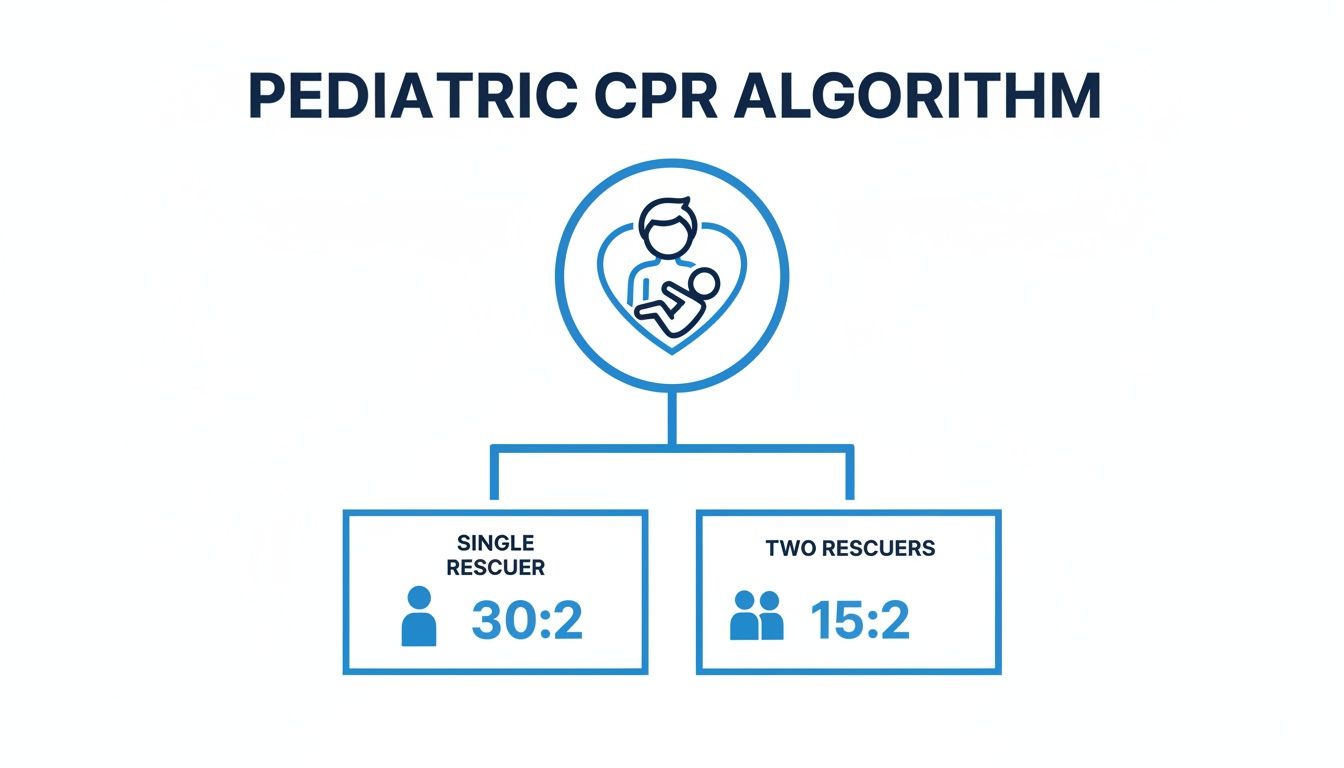
As you can see, the more trained help available for a child, the more the focus shifts toward providing rescue breaths. This principle is taken to its absolute peak in neonatal care.
Why Ventilation Is the Priority
The reason for this intense focus on breathing is simple but critical: when a newborn goes into cardiac arrest, it's almost always because they couldn't get enough oxygen (asphyxia), not because of a primary heart problem. Complications during labor or delivery can starve the baby of air, leading first to respiratory failure and then, quickly, to cardiac arrest.
So, the number one goal in neonatal resuscitation is to get oxygen back into the blood and get the lungs working. The 3:1 ratio is built to do exactly that, ensuring a constant, steady supply of air, which is the most powerful tool we have to save a newborn's life.
Mastering Neonatal Technique
Pulling off this rapid-fire sequence of compressions and breaths requires a very specific hand placement. The preferred method is the two-thumb encircling hands technique. You place both thumbs on the newborn's sternum and wrap your fingers around their chest for support.
This technique is proven to generate better blood flow to the heart and is far less tiring for the rescuer than other methods.
While the 3:1 ratio is the current gold standard, medical science never stands still. New research is always exploring better ways to do things. For instance, some studies are looking into whether chest compressions combined with a sustained inflation might be more effective—one trial found it could lead to a faster return of a spontaneous heartbeat.
Keeping up with the latest guidelines and emerging research isn't just a good idea in neonatal care; it's a professional necessity. The old-school belief that you can only get this level of training in a classroom is completely outdated. Fully accredited online Neonatal Resuscitation (NRP) courses deliver the same evidence-based knowledge, giving professionals access to the most advanced skills right at their fingertips.
These future-focused training platforms prove that top-tier medical education has moved far beyond the traditional classroom, offering the quality and flexibility that today's dedicated healthcare providers demand.
When to Use Compression-Only CPR Instead
Sometimes, in the middle of a chaotic emergency, the simplest action is the most powerful one.
If you see an adult suddenly collapse, the single best thing you can do as a bystander is often to forget about rescue breaths and just start pushing hard and fast on the center of their chest. This is called Hands-Only CPR, and it's a game-changer for immediate response.
The science behind it is actually pretty straightforward. For the first few minutes after a sudden cardiac arrest, the person’s blood is still carrying a decent amount of oxygen. The immediate, number-one priority isn’t getting more air in; it's keeping that already-oxygenated blood moving to the brain and vital organs. Continuous, uninterrupted chest compressions are the best way to make that happen.
Not a One-Size-Fits-All Solution
But here’s a critical point: Hands-Only CPR is not a universal fix. It’s specifically recommended for witnessed sudden collapses in adults and teens. There are absolutely times when rescue breaths are non-negotiable because the root cause of the arrest is a lack of oxygen in the first place.
These situations include:
- Drowning victims
- Drug overdoses
- Anyone found already unconscious (unwitnessed collapse)
- All infants and children
In every one of these cases, the victim is desperate for oxygen. That makes the traditional compression-to-breath ratio absolutely essential.
Safety and Training
Hesitation can be fatal. Many bystanders are nervous about performing mouth-to-mouth, and that's understandable. Hands-Only CPR completely removes that barrier, empowering more people to jump in and act immediately. Of course, whenever you're providing care, especially if there's a risk of infection, having a solid understanding of airborne vs droplet precautions and the right PPE is key to keeping yourself safe.
Hands-Only CPR is a fantastic entry point, but it's no substitute for full certification. Real training teaches you the nuances—how to know exactly when and how to apply the correct compression to breath ratio for any victim, in any scenario.
This is where good training really shines. The old-school idea that you can only learn CPR in a stuffy classroom is thankfully fading away. Modern, accredited online courses from providers like ProMed Certifications are designed to teach you these crucial distinctions, giving you the confidence and skill to save a life the right way.
Mastering Your Skills with Modern Online Training
Knowing the specific compression to breath ratio for a given situation—whether it’s 30:2, 15:2, or 3:1—is one thing. Being able to execute it perfectly when the pressure is on and a life is on the line? That’s something else entirely.
This is where high-quality, modern training truly shines. For years, there was this lingering, outdated idea that only in-person classes from big names like the AHA or the American Red Cross were legitimate. That’s simply not the world we live in anymore.
The Shift to Flexible, Effective Learning
The healthcare industry has evolved, and hospitals and clinics are increasingly accepting accredited online certifications because the evidence is undeniable. Study after study confirms that online medical education delivers outcomes that are just as good as—and sometimes even better than—traditional classroom settings.
When you can learn at your own pace, rewind and review complex topics as many times as you need, and practice until the motions are second nature, you build real confidence. You build muscle memory. And you do it all without having to blow up your already demanding schedule.
Mastering CPR isn't just about the certificate; it's about proving you can perform the skills correctly, a core component of practical evaluations like the CNA skills test.
Accredited online providers offer equally effective training built on the exact same ILCOR and AHA guidelines. As more healthcare institutions embrace these certifications, it's clear the industry is shifting toward more accessible and efficient education.
Choosing a convenient, high-quality online course is the smart move for any dedicated professional. It ensures you can get or renew your life-saving credentials with training that actually fits your life and career. For a deeper look into this topic, explore our complete guide to getting your CPR certification for healthcare providers online.
At ProMed Certifications, we're at the forefront of this change. We deliver courses designed for the way modern professionals learn, giving you the convenience and credibility you need to stay sharp, certified, and ready to act when it matters most.
Frequently Asked Questions About CPR Ratios
We’ve walked through the specifics, but let's be honest—applying this stuff in the real world brings up a lot of questions. Here are some of the most common things that come up for both healthcare providers and regular folks trying to help.
Why Did the Adult CPR Ratio Change from 15:2 to 30:2?
This was a huge, evidence-based shift, and for a very good reason. Researchers figured out that every time you stop compressions to give breaths, even for a few seconds, blood flow to the brain and heart takes a dangerous nosedive.
The old 15:2 ratio simply had too many interruptions. Moving to the current 30:2 ratio was a game-changer because it dramatically increases the time rescuers spend actively pumping blood. That single factor—keeping the pump going—is the most critical element for survival in adult cardiac arrest, ensuring vital organs get the oxygen they need.
What if I Forget the Correct Ratio in an Emergency?
First, don't panic. If you're a bystander and you see an adult collapse, the most important thing is to act. If you can't remember the numbers, just start Hands-Only CPR immediately. Push hard and fast in the center of the chest and don't stop until help takes over.
For healthcare professionals, this is exactly why regular training and recertification are so crucial. It’s all about building muscle memory so the correct compression-to-breath ratio is second nature, even when the pressure is on.
The most important action is to begin high-quality chest compressions. Any CPR is better than no CPR.
Are Online CPR Certifications as Valid as In-Person Ones?
Yes, absolutely. The old belief that online training is somehow "less than" is completely outdated and doesn't reflect the reality of modern medical education. High-quality, accredited online certifications are built on the very same ILCOR and AHA scientific guidelines as any traditional classroom course.
You can see the industry shifting as more and more hospitals and healthcare systems recognize and accept these credentials. The bottom line is that reputable online providers like ProMed deliver the same evidence-based content, but with the flexibility that busy professionals actually need to keep their certifications current.
How Soon Should I Use an AED During CPR?
The second it's available. If you're already doing CPR, keep the compressions going while someone else gets the AED and sets it up. Your goal is to minimize any "hands-off" time.
Once the AED is ready, just listen. Follow its audio and visual prompts exactly. It will tell you when to pause compressions so it can analyze the heart's rhythm and whether a shock is needed. Right after a shock is delivered, you must immediately resume high-quality chest compressions. It's all about keeping that blood flowing.
Mastering the correct compression to breath ratio is a skill that saves lives, but it demands both confidence and precision. At ProMed Certifications, we provide accredited, flexible online courses designed to arm you with the latest evidence-based knowledge, making sure you’re always ready to act decisively when it matters most.
Enroll in a course today and get certified with ProMed Certifications.
.avif)
Stay compliant with ProMed+
Certifications included: ACLS, BLS, PALS, CPR & Neonatal Resuscitation
Unlimited continuing education: over 200 hours of accredited CME
All-inclusive: One price. No surprises.
Get certified today

The Advanced Cardiac Life Support (ACLS) is an accredited online medical certification course that teaches medical professionals to respond to nearly all cardiopulmonary emergencies.

The Pediatric Advanced Life Support (PALS) Recertification instructs medical professionals on performing pediatric cardiopulmonary resuscitation in emergencies.

The Basic Life Support (BLS) Recertification is intended to teach healthcare professionals the basic steps of CPR and rescue breathing for adults, children, and infants.

Our online medical certification course for CPR, Automated External Defibrillator (AED), and First Aid is designed to teach adult, child, and infant CPR and AED use.

The Neonatal Resuscitation Certification trains medical professionals in performing resuscitation procedures and life-saving techniques for newborns at the time of delivery.

.png)
.png)
.png)