


Pediatric Sepsis Guidelines: Timing, Shock and Treatment
Sepsis accounted for approximately 48.9 million cases and 11 million sepsis-related deaths worldwide, representing about 20% of all global deaths on 2020 data, according to the World Health Organization. Children carry a disproportionate share of that burden, and the burden lands hardest on hospitals with the fewest resources to absorb it.
For a clinician at the bedside, the difficulty isn't believing that sepsis is dangerous. It's keeping three separate decisions straight: whether to screen this child, whether the child meets a shock classification, and whether a treatment trigger has fired. Most quick-reference summaries compress those into a single checklist, and that compression is exactly where recognition and reaction get delayed.
This review separates the three works from the pediatric sepsis guidelines that practicing teams use, and marks the points where the care setting itself, intensive care available or not, changes the advice for the same child.
Why Pediatric Sepsis Needs Its Own Guidance
Children under 5 account for almost half of estimated global sepsis cases, approximately 20 million cases, and healthcare-associated sepsis affects roughly 15 of every 1,000 hospitalized patients, according to the World Health Organization. That combination should reframe how a pediatric unit thinks about screening: sepsis is a routine risk on every febrile child's differential, and the child who deteriorates on day four of an admission for something else belongs to the same epidemiology as the child wheeled in from triage.
Incidence and mortality are not evenly distributed. They run highest in low- and lower-middle-income countries, where delayed diagnosis, limited intensive-care capacity, antimicrobial access problems and shortages of trained personnel all push outcomes in the same direction. A guideline that assumes a pediatric intensive care unit down the corridor gives different advice than one written for a ward without ventilators, which is why resource setting has to be part of the document rather than a footnote.
Adult protocols do not transfer cleanly. A child's hypotension threshold moves with age, so a blood pressure reading that looks acceptable in an adult can signal decompensation in an infant. Tachycardia works like a compensating brace: it holds blood pressure up until circulation is already failing, which means a child can look stable right up to the edge of collapse. The margin for fluid resuscitation is narrower too, and the same volume that rescues one child can overload another. Screening thresholds, shock definitions and treatment triggers each needed pediatric-specific numbers, and that is why the first international pediatric framework, published in 2020, was written for children rather than adapted from adults.
Scope check: the 2020 Surviving Sepsis Campaign pediatric guideline covers infants, children and adolescents with septic shock or sepsis-associated organ dysfunction. Neonatal sepsis sits with neonatal guidance, not this document.
The panel that wrote it was explicit about the limits of pediatric evidence and about resource variation: a recommendation had to be workable in a hospital with a pediatric intensive care unit down the corridor and in one without. Early recognition, timely antimicrobials, a defensible fluid strategy and escalation tied to available critical care are the threads running through every section that follows.
Timing Targets at a Glance
The targets below are the ones a team looks up mid-resuscitation. Each is set out in the 2020 Surviving Sepsis Campaign.
Element | Guideline target | Applies to | Practical note |
|---|---|---|---|
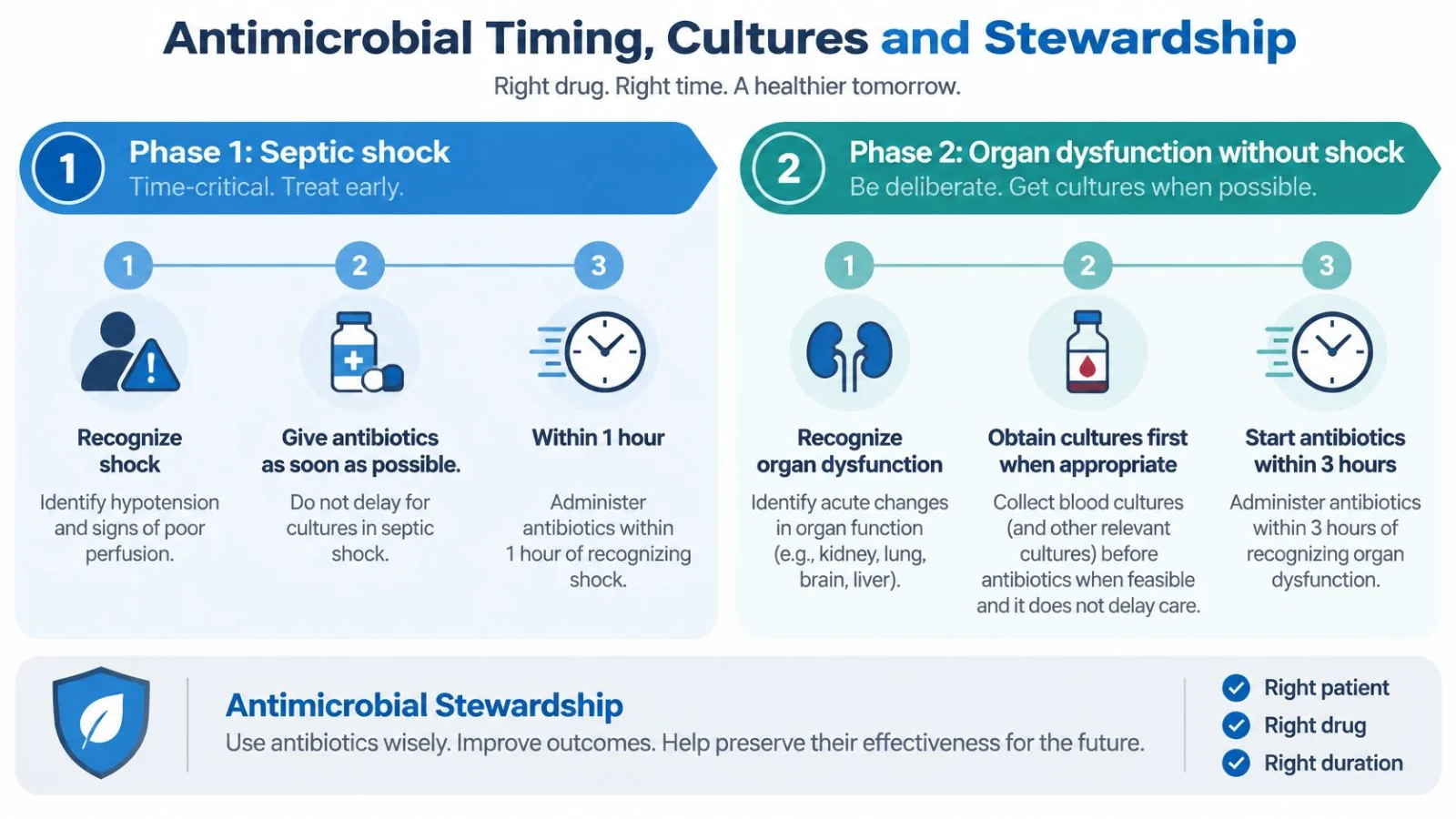
Antibiotics in septic shock | As soon as possible and within 1 hour of recognizing shock | Shock present | Start empiric broad-spectrum therapy without waiting for culture results |
Antibiotics in organ dysfunction without shock | As soon as possible and within 3 hours of recognition | Sepsis-associated organ dysfunction without shock | Begin after appropriate evaluation |
Blood cultures | Before antibiotics when this will not substantially delay treatment | All suspected sepsis | Never hold antibiotics to complete cultures |
Lactate | During the first hour | Suspected shock | Lactate above 5 mmol/L meets the Phoenix shock criterion |
Antimicrobial review | Daily | All treated children | Narrow or stop when culture, susceptibility and clinical course allow |
Reassessment after fluid bolus | After each bolus | Shock or hypoperfusion | Check perfusion, mental status, breathing and urine output |
Reading the Table in the Right Order
The 1-hour target is conditional on shock being recognized. It isn't a universal clock for every child with fever and a suspected infection, and treating it that way produces both unnecessary antibiotic pressure and, worse, a false sense that the clock has already started when it hasn't. The first clinical act is therefore classification, not drug preparation.
The rows also interact, and summaries do the most damage at that point. A child whose lactate comes back above 5 mmol/L has moved into the shock category, which converts a 3-hour window into a 1-hour window. That's the reason lactate is drawn in the first hour rather than ordered as a routine add-on after admission.
Bedside rule: the clock starts at recognition, not at triage and not at the first antibiotic order. Write the recognition time on the resuscitation record, then check every row against that single time.
Post the table in the resuscitation area and treat it as a live document. At the end of each case, compare actual timestamps with the targets and note where the delay happened, usually access, cultures or pharmacy preparation.
Guideline Sources and Recommendation Strength
Clinicians work from two published documents plus a resuscitation evidence base, and mixing them up is a common source of confused local policy.
Three Sources, Three Different Jobs
The 2020 Surviving Sepsis Campaign pediatric guideline is the treatment document. It provides 77 recommendations for infants, children and adolescents with septic shock or sepsis-associated organ dysfunction: six strong recommendations, 52 weak recommendations and nine best-practice statements, a distribution that reflects limited high-certainty pediatric evidence rather than ambiguity about the core actions, as the Society of Critical Care Medicine guideline summary sets out.
The 2024 Phoenix criteria are the classification document. They define what counts as sepsis and what counts as septic shock, and they were developed using data from 172,984 children with suspected infection in the first 24 hours, according to CIDRAP.
The third layer is ILCOR consensus science and the AHA guidelines built on it, which supply the resuscitation framework teams train in: assessment sequence, airway and breathing priorities, vascular access, and team roles.
What the Strength Labels Change in a Local Pathway
Strong recommendations are the actions to build into the pathway as defaults, with no local debate required. Conditional recommendations require local judgment about feasibility, staffing and monitoring capacity, and the pathway should say who makes that call. Best-practice statements describe expected practice in areas where formal evidence is indirect, such as obtaining cultures without delaying treatment.
Anyone drafting or reviewing a pathway needs to read the strength label before the recommendation. That skill, evidence based decision making for nurses, is what stops a conditional suggestion from being enforced as an absolute rule.
When local policy and a published statement disagree, record which document wins, why, and who approved the deviation. An undocumented deviation is indistinguishable from an oversight.
Recognizing Sepsis Before the Criteria Are Met
A more specific definition can produce a dangerous side effect: false reassurance. The 2024 criteria better reflect severity, yet recent analysis reports they may underdiagnose early septic shock, while stricter shock criteria could delay recognition and treatment. The same analysis describes an international cohort of approximately 7,000 children in 128 PICUs across 26 countries in which clinicians' preliminary severe-sepsis diagnoses matched IPSCC-based diagnoses only 46% of the time, according to this analysis of the 2024 pediatric sepsis criteria.
That gap reflects four different decisions that get flattened into one word.
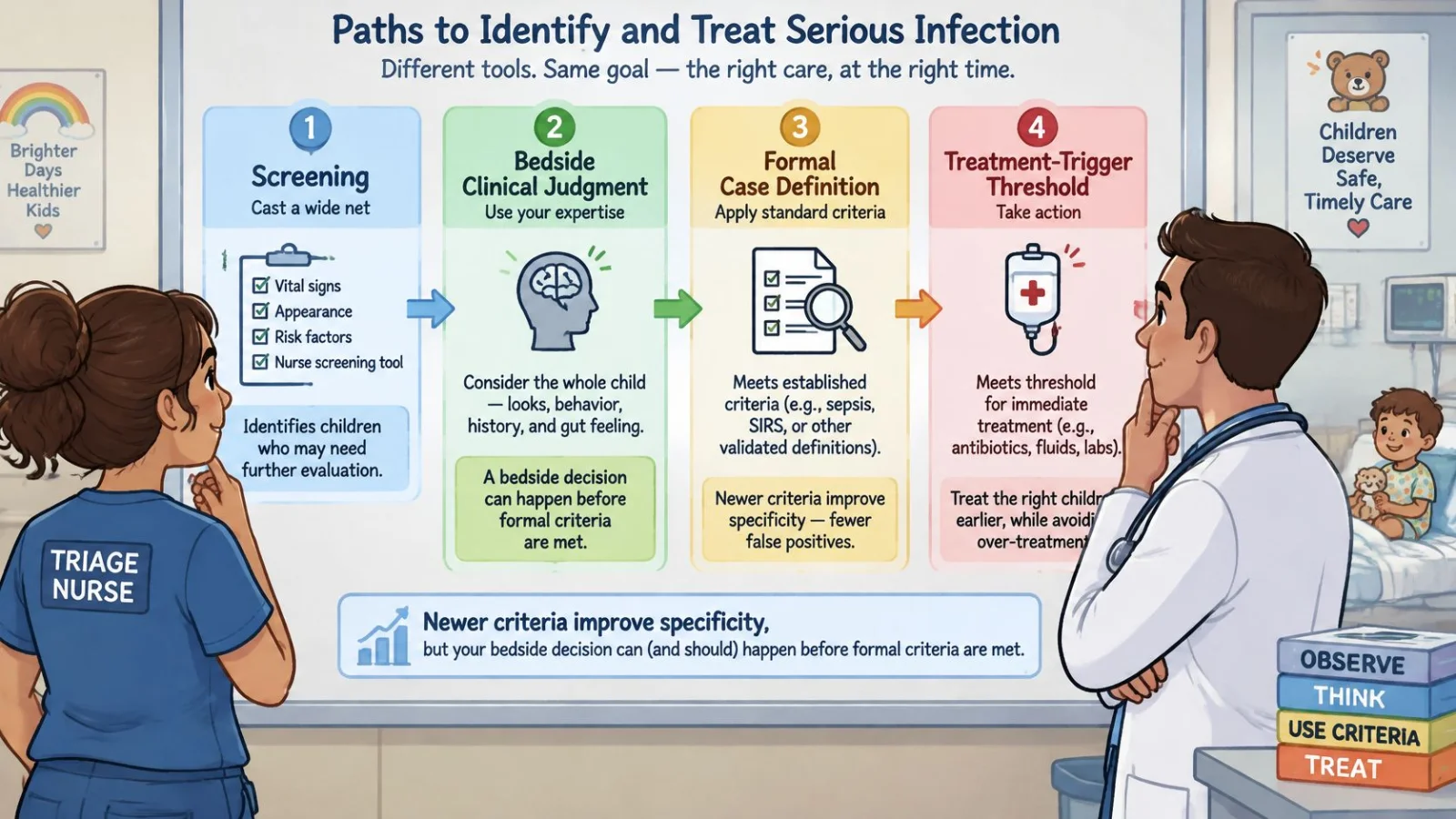
Keep them separate and the confusion mostly resolves:
Screening asks whether this child needs sepsis considered at all. It's a low-cost trigger, deliberately over-sensitive.
Bedside clinical judgment asks whether the child in front of you is deteriorating, regardless of numbers.
Formal case definition asks whether the child meets criteria for a registry, a study or a diagnosis code.
Treatment-trigger threshold asks whether the antibiotic clock, the fluid decision or the vasoactive decision has fired.
Only two of those four belong at the bedside in real time. The other two belong in the chart afterward.
Where the Definition Stops and Judgment Starts
Take a hypothetical 18-month-old brought in with fever, a heart rate of 190, capillary refill of four seconds, mottled knees and reduced urine output. Blood pressure is at the low end of acceptable for age. No formal organ-dysfunction threshold is met yet, so the child does not classify as sepsis on a strict reading.
The team has every reason to keep moving. Repeat perfusion, mental status, respiratory effort, urine output and hemodynamic assessment at short intervals, call for senior review, secure access, draw cultures and lactate, and treat on clinical grounds. A child who is worsening while being observed is the exact scenario the criteria were never designed to rule out.
Treatment should not wait for the newest definition. In a setting without immediate PICU access, that judgment carries even more weight, because escalation and transfer decisions take longer to execute and the observation window is less forgiving.
The most frequent error isn't overtreating a definition, it's waiting for a definition to catch up with a child who has already told you what's happening.
A structured team response shows what that gap looks like in practice.
Classifying Septic Shock by Route and Age
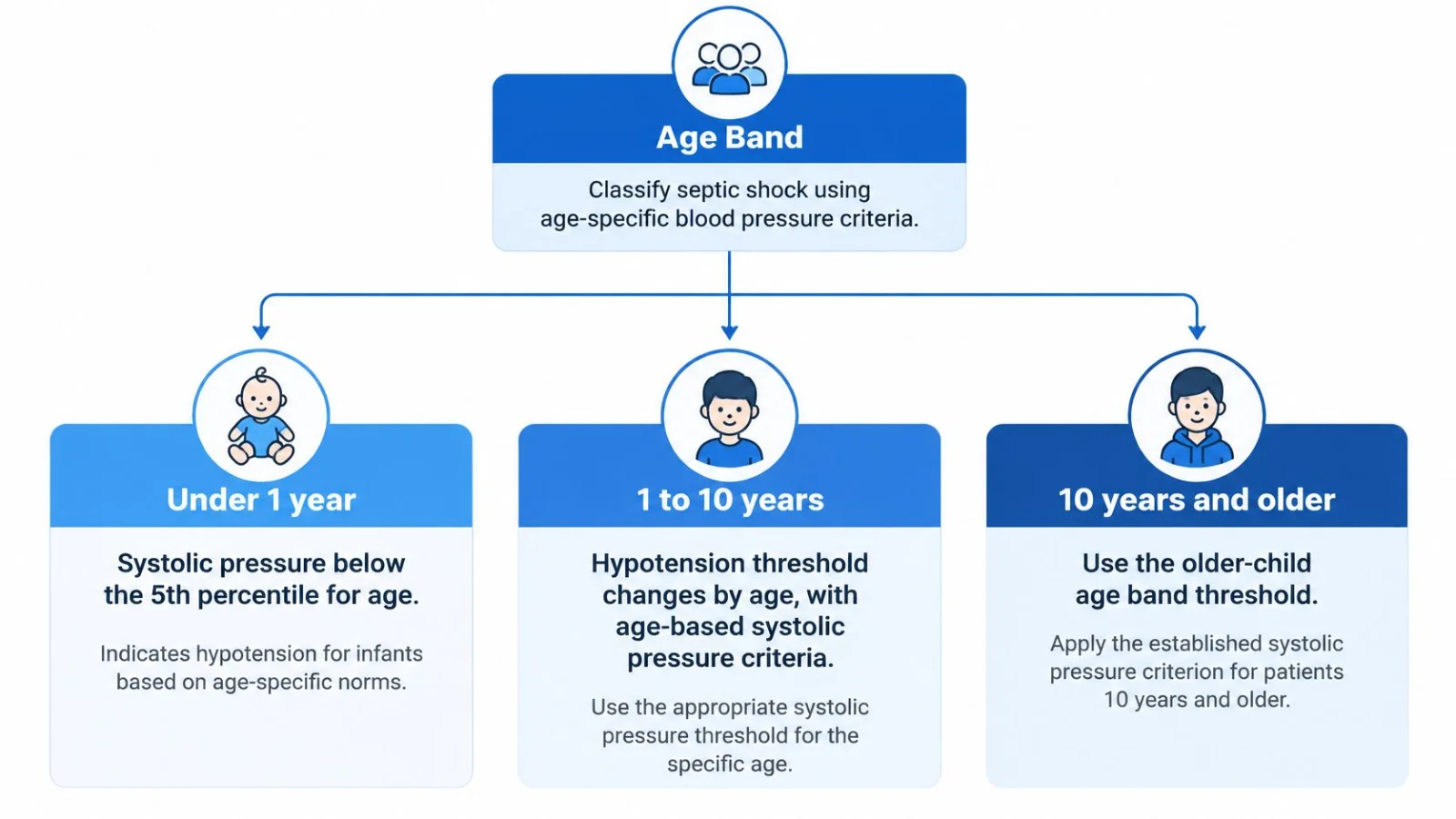
Septic shock under the 2024 Phoenix criteria means cardiovascular dysfunction reached through any of three routes: severe age-specific hypotension, blood lactate greater than 5 mmol/L, or the need for vasoactive medication, per the 2024 Phoenix criteria. One route alone is enough. A child can classify before the pressure falls, and a hypotensive child classifies before the lactate result returns.
Three Routes Into the Shock Category
Read the blood pressure against the child's age band first, because the hypotension threshold moves with age.
Age group | Hypotension threshold | How it is used |
|---|---|---|
Under 1 year | Systolic below the 5th percentile for age | Combine with lactate and perfusion before classifying shock |
1 to 10 years | Systolic below 70 mmHg plus twice the age in years | Any one shock route is enough: hypotension, lactate above 5 mmol/L or vasoactive need |
Over 10 years | Systolic below 90 mmHg | Apply the same route check as younger children |
The lactate route catches children whose pressure has not collapsed yet. A child with suspected infection and a lactate of 6 mmol/L sits inside the shock category even when blood pressure remains acceptable for age, which should prompt urgent senior review, resuscitation, close monitoring and consideration of vasoactive support if hypotension or poor perfusion persists. In settings where lactate measurement is unavailable or delayed, classification leans harder on the pressure threshold and the vasoactive criterion, so repeated perfusion checks carry more of the diagnostic weight.
Run the numbers on two hypothetical patients. A 6-year-old with a systolic pressure of 78 mmHg falls inside the hypotension band, because the threshold is 70 plus twice the age, or 82 mmHg. A 12-year-old with the same 78 mmHg reading is also hypotensive, sitting below the over-10 cutoff of 90 mmHg. One reading, two classifications, with the age band doing all the work.
The bedside checklist stays short. Is systolic pressure below the age threshold? Is lactate above 5 mmol/L? Has a vasoactive infusion been started? Is perfusion still poor after resuscitation? A yes to any of the first three classifies shock, and a yes to the last keeps the team escalating.
Three pitfalls recur. Applying adult thresholds to a child delays everything downstream. Trusting a single blood pressure reading misses the child still compensating with tachycardia. Dismissing cold, mottled extremities because the number looks acceptable is how a compensated child gets mislabeled as stable. Pediatric Advanced Life Support (PALS) training drills these age bands and recognition skills, and teams can sharpen their classification calls with PALS algorithm practice alongside their local pathway.
Antimicrobial Timing, Cultures and Stewardship
For a child in septic shock, the recommendation is to begin antimicrobial therapy as soon as possible and within 1 hour of recognizing shock, according to the Surviving Sepsis Campaign pediatric practice guideline. That hour is mostly an operational problem. The lost minutes tend to sit in vascular access, culture draws and pharmacy preparation, so a team that treats the window as a shared task protects it better than one that treats it as a pharmacy deadline.
Cultures Without Delay
Collect blood cultures before antibiotics only when doing so will not substantially delay treatment. The rule exists to protect the clock, and it works as a sequencing instruction for the team. If access is difficult, draw what can be drawn during the access attempt and start therapy. A missed culture can be corrected with later sampling; a missed hour cannot.
Initial coverage should be empiric, broad-spectrum and directed at all likely pathogens and infection sites. Narrowing comes later, when culture and susceptibility results, the infection site, host risk factors and clinical improvement all support it. Where no pathogen is identified, the decision to narrow or stop rests on the clinical picture discussed with microbiology or infectious diseases input, and continuing requires an active reason.
Optimizing the Dose
Pediatric dosing requires weight, renal function and volume-of-distribution adjustments. In a child who is fluid-resuscitated or capillary-leaking, that third factor alone can shift the effective concentration well away from what a standard weight-based calculation predicts. Where the drug allows it, therapeutic drug monitoring converts those variables into an actual number instead of an assumption.
Daily review of every antimicrobial carries the stewardship load here. Ask each day whether the drug is still justified, still correctly dosed, and still covering what the cultures show.
The culture rule is one sentence long. If obtaining the sample will substantially delay the drug, the drug wins. Write the reason for the sequence in the note.
A hypothetical illustrates the flow. A previously healthy child arrives with fever, altered mental status, weak pulses and suspected bacterial shock. The team draws cultures during access if that costs no meaningful time, then gives broad-spectrum antibiotics inside the first hour without waiting for definitive microbiology. Definitive results arrive days later and inform de-escalation; the first dose never waits for them.
Fluid Resuscitation and the First-Hour Bundle
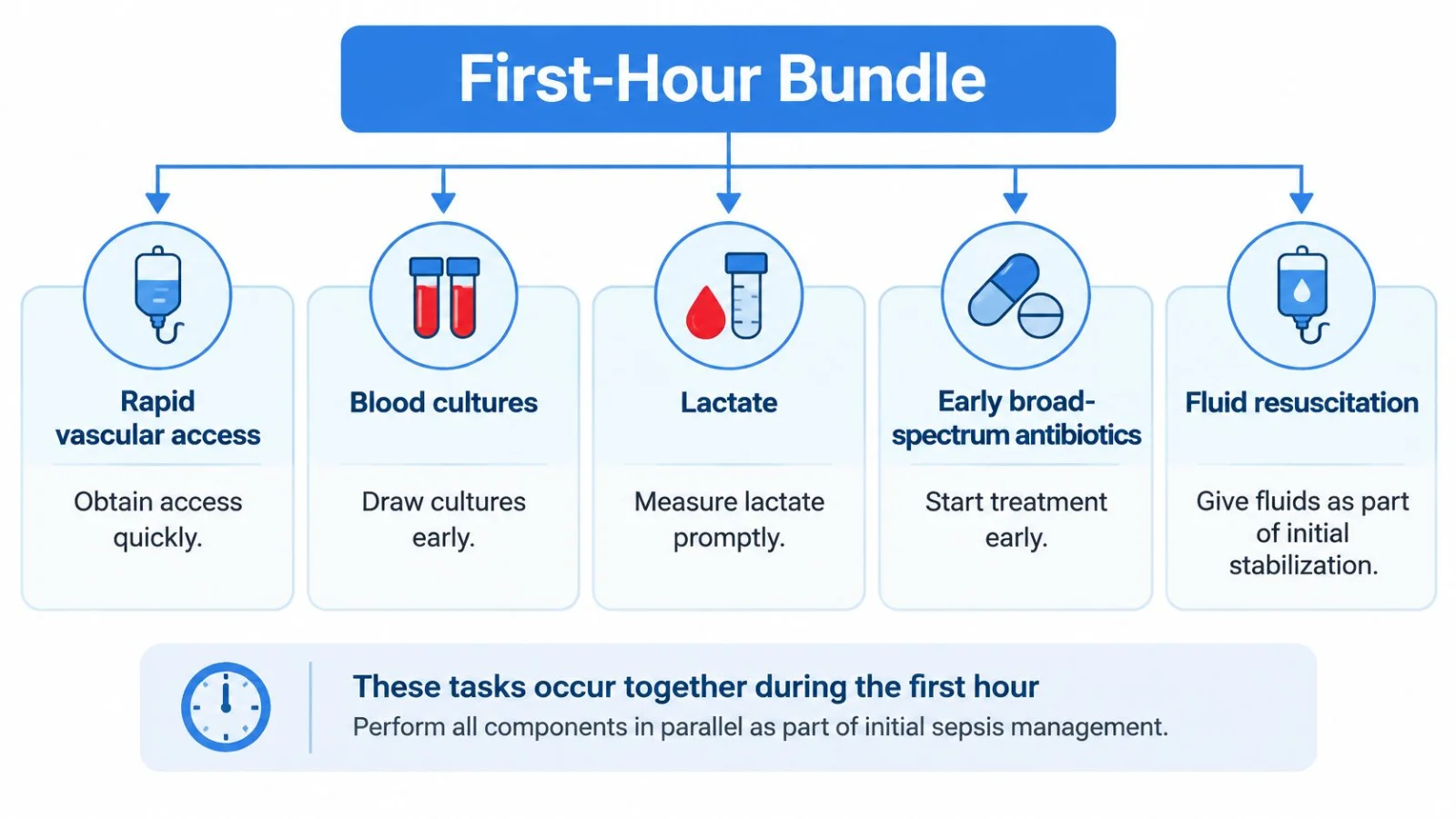
Pediatric sepsis care is organized around a time-sensitive bundle of parallel actions, as described in this review of pediatric sepsis management. A bundle fails when it is run as a queue: one clinician working down a list will always be slower than four clinicians working at the same time.
Run the Bundle in Parallel
The bundle contains rapid vascular access, blood-culture collection, lactate measurement, early broad-spectrum antibiotics, fluid resuscitation when indicated, and early vasoactive medication if shock continues despite appropriate fluids. In a well-drilled emergency department, those run at the same time.
A workable division looks like this. If intravenous access is delayed, one clinician places intraosseous access. A second draws cultures and lactate. A third prepares antibiotics. The team leader reassesses perfusion after each bolus and decides the next move. This is PALS-style team response applied to sepsis care, and it prevents the three delays that show up in case reviews: delayed access, delayed antibiotics, and delayed reassessment.
When Intensive Care Isn't Reachable
Fluid advice is the clearest example in the entire guideline of setting changing the answer for the same child. The 2020 Surviving Sepsis Campaign pediatric guideline ties the approach to whether intensive care can be accessed.
Setting | Fluid approach | Reassessment rule |
|---|---|---|
Intensive care accessible | Up to 40–60 mL/kg during the first hour | Guide by cardiac output and stop if fluid overload develops |
Intensive care not accessible | Generally avoid bolus fluids | Give a bolus only when hypotension is extreme |
Any setting | Give each bolus as a discrete step | Recheck perfusion, mental status, breathing and urine output after each bolus |
The reasoning is straightforward once stated. Where non-invasive or invasive respiratory support, vasoactive infusion and close monitoring are available, aggressive early fluid is defensible and often helpful. Where they aren't, a child who develops fluid overload has nowhere to go, and the harm from a bolus given without a rescue plan outweighs the theoretical benefit. The same bolus volume can be reasonable in one setting and unsafe in another.
The reassessment loop is the part that gets skipped under pressure. After every bolus, document perfusion, mental status, breathing and urine output, then decide explicitly: another bolus, start vasoactive support, or escalate. The ProMed Certifications fluid resuscitation guide covers the monitoring sequence in more detail.
Vasoactive Support, Monitoring and Pathway Audit
Screening flags the child, the Phoenix criteria classify the shock, and starting vasoactive support is the third decision: the treatment trigger. It arrives when shock persists despite appropriate fluid resuscitation, or earlier, when the Phoenix criteria already record a vasoactive requirement. No single agent is backed by strong evidence as the first choice, so the selection follows the child's hemodynamic profile and the local protocol, and the infusion can begin through peripheral access while central access is arranged. Confirmation comes from the repeat assessment, where the response to the drug shows up as a trend across readings.
Where intensive care cannot be accessed, the same trigger changes shape: escalation and transfer planning come first, because a vasoactive infusion without close monitoring trades one risk for another.
The Shift Monitoring Set
Six items belong in every reassessment, and they belong together:
Perfusion and capillary refill, including extremity temperature and pulse quality.
Mental status, compared with the child's own baseline rather than a generic scale.
Respiratory effort, because worsening work of breathing changes the plan.
Urine output, the slowest but most honest perfusion marker.
Blood pressure, measured against the threshold for age.
Lactate trend, read as a direction rather than a single value.
Four mistakes account for most avoidable deterioration. Waiting for a complete fluid response before escalating spends the window in which vasoactive support works best. Treating the start of the infusion as the finish line pauses the monitoring set exactly when it matters most, because the first hour on a vasoactive agent is a fresh reassessment cycle. Skipping the daily antimicrobial review leaves a broad-spectrum drug running on momentum. Failing to record the time of each reassessment makes the whole pathway unauditable, and the next case inherits the same delay.
Escalation trigger: if perfusion hasn't improved after the first hour of treatment, the child needs senior review immediately, with the time of that review written into the record.
A Pathway Audit in Three Steps
Compare local timing with the guideline table. Confirm antibiotics inside 1 hour of shock recognition and inside 3 hours for sepsis-associated organ dysfunction without shock, using real timestamps from the last few cases rather than intent.
Confirm whether intensive care is accessible at the point of care. That single answer determines which fluid rule applies, and it changes at night and on weekends, so the pathway should say so.
Verify training and documentation. Staff managing suspected pediatric sepsis should hold current pediatric resuscitation training, and every bolus and daily antimicrobial review should be traceable in the record.
Recognition is a trained skill, and training belongs on the audit checklist beside the timestamps. A pathway that produced correct timings last quarter can still fail the next child if the people reading the signs have let that skill lapse.
Close the loop with one dated action. Schedule a pathway review within the next month, assign a single named owner, and record the date the timing table goes up in each resuscitation area.
Key Takeaways
Treat the pathway as three separate decisions, then write down who owns each one. This prevents the common failure where everyone sees the same signs and no one is responsible for the next move.
Screen: name the clinician who reassesses perfusion, mental status, breathing, urine output and vital signs, and how often the screen repeats when the answer is still uncertain.
Classify and trigger: keep the shock criteria and timing targets on the posted table; one person calls the category, another starts the agreed actions without waiting for a perfect label.
Match resources: make the fluid and escalation step conditional on whether intensive care is reachable at that hour, including nights and weekends.
Close the loop: record any deviation with reason and reviewer, then give the pathway a named owner and a review date before the next case.
A checklist works only if each line has an owner; otherwise the same delay returns with the next child.
Frequently Asked Questions
What is the practical difference between a positive screen, sepsis and septic shock?
A positive screen is the alarm that sends a clinician to the bedside. Sepsis is the clinical pattern that confirms organ dysfunction is suspected. Septic shock is the higher-acuity classification that changes how aggressively the team resuscitates and escalates. Keeping those three decisions separate prevents a positive screen from becoming an automatic order set, and prevents a shock label from arriving late.
Can a child be in septic shock before blood pressure falls?
Yes. Hypotension for age is only one classification route. A child can still maintain pressure while perfusion, mental status, breathing or urine output deteriorate, so the bedside trend matters more than a single reassuring number.
What if lactate or another test is unavailable?
Use the routes that are available. A lactate value is one classifier, not a prerequisite for acting. Hypotension for age and the need for vasoactive medication still classify shock, and a missing result should not delay cultures, antibiotics, fluid decisions or escalation when the clinical trajectory is worsening.
When should escalation win over continued observation?
Escalate when repeated assessment shows a downward trend despite initial measures, when vasoactive support is being considered, or when the unit cannot provide the level of monitoring and intensive care the child may need. The transfer or PICU call should start while tasks are still being completed, not after every criterion has been documented.
What should happen after each fluid bolus?
Pause and reassess before giving more. Check perfusion, mental status, breathing and urine output, then decide whether the next step is another bolus, vasoactive support, imaging, transfer or a senior review. Where intensive care is accessible, first-hour fluids can be more aggressive; where it is not, bolus fluids are generally avoided and earlier escalation becomes the safer path.
What belongs in the post-event pathway review?
Record the time recognition occurred, which classification route was met, when cultures and antibiotics happened, how much fluid was given, what each reassessment showed, when vasoactive support started, and any deviation from policy with its reason and reviewer. That turns one activation into usable data for the next dated review.
ProMed Certifications offers online PALS, ACLS, BLS, Neonatal Resuscitation and CPR certification and recertification, plus AMA and ANCC accredited continuing education for nurses and physicians. The courses are AHA-aligned, based on the latest ILCOR consensus, nationally accepted, and designed for self-paced credential maintenance. Visit ProMed Certifications to compare course options and choose the credential your role requires.