

Ohio Nursing CE Requirements: Your Guide for 2026
Most Ohio RNs and LPNs need 24 contact hours per two-year renewal, including at least one Category A hour on Ohio nursing law and rules. Your license history can change that requirement, so check the exceptions table before planning your courses.
Could completing the usual number of hours still leave you short of what Ohio requires? Yes, if you choose the wrong topics, miss a qualifying date, or overlook the rules for your licensing path. Ohio nursing CE requirements start with your situation, not your shopping cart.
Ohio Nursing CE Hours at a Glance
For most practicing nurses, the starting point is straightforward. The Ohio eLicense RN renewal instructions specify 24 contact hours, including at least one Category A hour, while recognizing the first-renewal examination exemption and the reduced 12-contact-hour requirement for eligible nurses endorsed into Ohio for one year or less.
But the standard answer isn't a complete answer for everyone. An experienced nurse moving into Ohio, a new graduate, and a nurse returning after inactivity shouldn't automatically enroll in the same course bundle.
Think of CE planning like checking a medication order. You need the right amount, but you also need the right indication and timing.
Match your license history before choosing courses
Use this sequence before you compare providers:
Identify your license type. Are you planning for an RN, LPN, or APRN license? An advanced practice requirement needs its own review.
Identify your route into Ohio licensure. Check whether you qualified through NCLEX examination or endorsement. For endorsement, confirm how long you've held the Ohio license.
Check first-renewal status. Initial licensure and a later renewal aren't interchangeable. Don't assume an exemption applies because you're new to an employer.
Check your current status. Confirm whether your Ohio license is active, inactive, or lapsed. If you're returning, also check whether you hold a current license elsewhere.
Match your situation to the table. Use the applicable hours, content, and timing together. Don't select the hours column and ignore the rest.
The Ohio continuing education rule distinguishes first renewals, endorsement of one year or less versus more than one year, and reinstatement or reactivation, which generally requires 24 hours within the 24 months before application.
Required CE hours by Ohio license situation
Your situation | Hours required | Key content rule | Timing window |
|---|---|---|---|
Routine RN or LPN renewal | 24 contact hours | At least 1 Category A hour on Ohio nursing law and rules | Each renewal period |
First renewal after NCLEX licensure in Ohio | None | No CE required for this renewal | First renewal only |
Endorsed into Ohio for one year or less | 12 contact hours | Include the applicable Category A Ohio law and rules content | Renewal period |
Endorsed into Ohio for more than one year | 24 contact hours | At least 1 Category A hour | Renewal period |
APRN renewal, CNS, CNM, CNP | 24 contact hours | At least 12 hours in advanced pharmacology | Renewal period |
APRN first renewal after initial licensure | None | Exempt from the standard CE requirement | First renewal only |
Reinstatement, inactive or lapsed under 2 years, or valid license in another state | 24 contact hours | 1 hour Ohio law and rules, 23 hours general nursing practice | 24 months before application |
Reactivation, lapsed 2 years or more, no current license elsewhere | 24 contact hours | Fixed topic mix, detailed under required topics | 24 months before application |
The APRN and return-to-practice rows also require the additional provider and topic checks explained below. If your circumstances overlap, confirm your application category with the Board instead of combining exemptions yourself.
What the table means for your course choices
Say you've just moved to Ohio and received a license by endorsement. Your years of nursing experience don't, by themselves, determine your Ohio CE obligation. Your Ohio licensure history matters.
Or say you passed NCLEX and are approaching your first renewal. Buying a large CE package before checking your exemption could mean completing education you don't need for that application.
The rules establish the educational obligation, not a classroom-only pathway. Qualifying online courses can meet that obligation when their approval, content, and documentation match Ohio's requirements. Choose the applicable row first, then evaluate individual courses.
How the 24-Month Renewal Cycle Works
Timing and documentation are separate responsibilities. A completed course doesn't help if it falls outside the applicable window, and an accurate hour total isn't enough if you can't substantiate it.
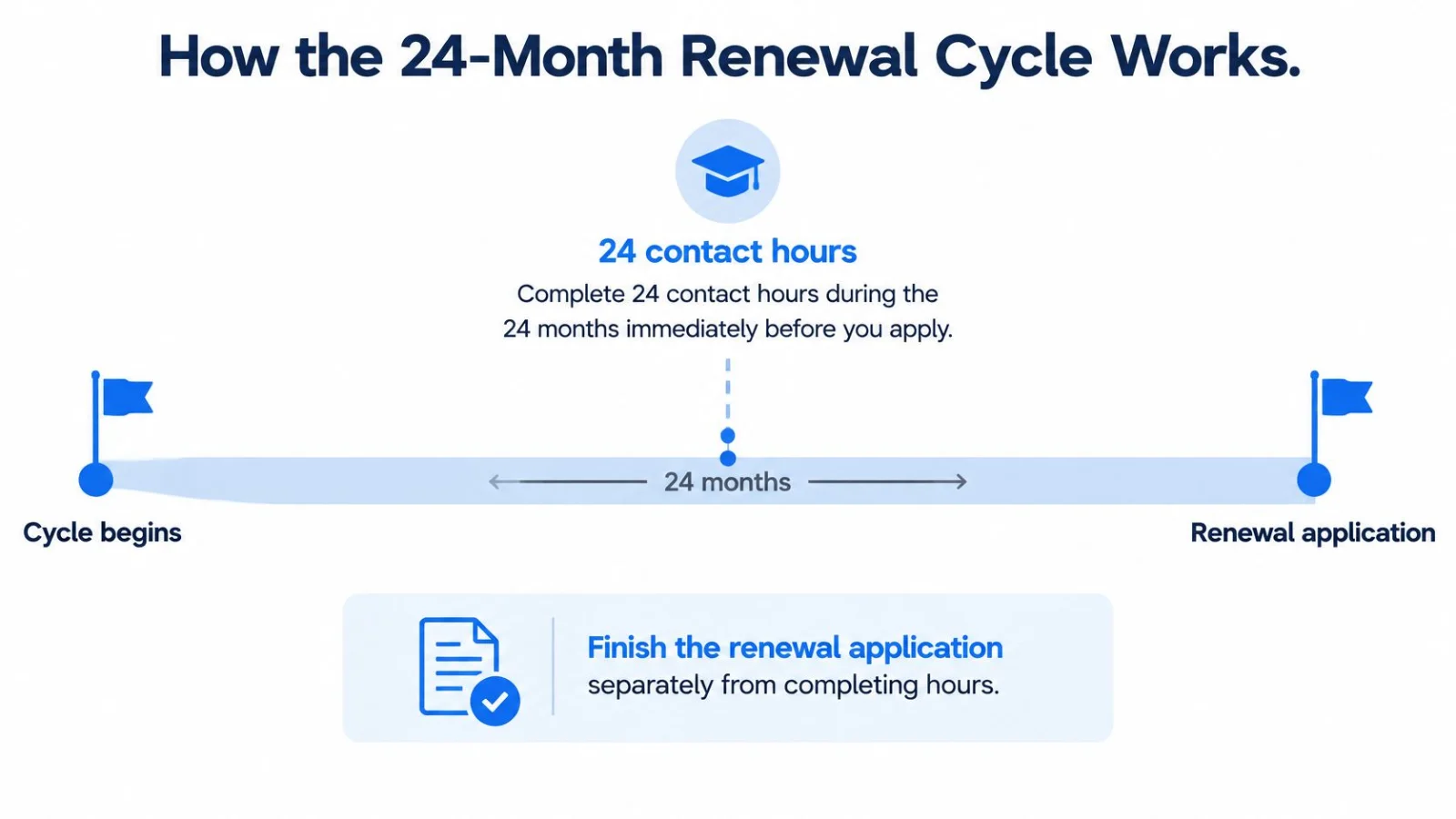
The Ohio Board of Nursing's CE requirements notice describes the foundational requirement as 24 contact hours during the 24 months immediately preceding the renewal application, with supporting documentation retained for six years. Its 2025 notice also explains that the planned certificate-upload requirement was removed for that renewal period while attestation continued.
Complete the education and preserve the proof
Attestation means you affirm that you've met the requirement. It doesn't mean the Board has reviewed every certificate or that you can discard your records afterward.
Under the Board's published guidance, qualifying CE must be approved by an Ohio Board of Nursing approver or offered by an Ohio-approved provider unit headquartered in Ohio. Read the approval statement before enrolling, particularly when you're selecting Ohio-specific content.
The timeline separates completing education from submitting the application.
Build a calendar you can actually follow
Start tracking after your last renewal, but verify the Board's current reporting-period instructions before deciding which completion dates qualify. Don't treat a remembered deadline or an old employer checklist as your authority.
Spread your learning around your shifts. Complete required content early enough to resolve a missing certificate or unclear approval statement without rushing your application.
Practical rule: Finishing a course and renewing a license are separate tasks. Put both on your calendar.
If you also practice internationally, separate each regulator's requirements. CliniRoo's AHPRA recency guide is useful for understanding Australian recency obligations, but it doesn't replace Ohio's CE rules.
Before your next renewal:
Mark your application date. Verify it against your license record and current Board instructions.
Log completed learning by month. Keep course dates visible instead of relying on a provider dashboard alone.
Check approval language. Save certificates that clearly identify the provider and applicable approval.
For a current application, check the current submission instructions. A historical notice explains a past process; it doesn't guarantee that every later renewal uses identical paperwork.
Category A and Required Topics Explained
Category A means education directly related to Ohio nursing statutes and rules. A general course on professional ethics or national nursing regulation isn't automatically Ohio Category A education.
For routine renewal, choose content explicitly identified for that purpose. Don't infer eligibility from a title containing “legal issues” or “professional responsibility.”
Returning to practice requires a different conversation. The Ohio Board of Nursing's Winter 2022 Momentum guidance describes 24 hours consisting of one hour on Ohio law and rules plus 23 hours of general nursing practice for an Ohio license inactive or lapsed for less than two years, or when the applicant holds a current valid license elsewhere. It gives the following 24-hour topic distribution, completed within the 24 months before application, for a license inactive or lapsed for at least two years without a current license elsewhere.
Build a return-to-practice plan by topic
Reactivation topic hours after a two-year lapse
Topic area | Hours | Planning note |
|---|---|---|
Ohio law and rules | 2 | Find a course that names Ohio law explicitly |
Critical thinking, clinical reasoning, nursing process or nursing judgment | 6 | Look for these terms in course descriptions |
Pharmacology | 6 | Confirm the course covers pharmacology as its own topic |
Clinical or organizational ethical principles | 2 | Check that ethics content is included |
Practice-relevant nursing content | 8 | Choose a topic tied to your current or intended practice |
Total | 24 | All completed within the 24 months before application |
Begin with the Ohio-law course because a general nursing package may not include jurisdiction-specific material. Save its description along with the certificate.
Next, examine the reasoning content. Case-based learning can be useful, but confirm that the objectives explicitly address clinical reasoning, judgment, critical thinking, or the nursing process.
Then allocate pharmacology and ethics separately. A medication-safety course might discuss ethical issues, but that doesn't automatically establish that its hours satisfy both allocations. Don't assign the same completed hours to multiple categories without confirmation.
Finally, select practice-relevant content. If you're returning to outpatient nursing, look for learning that supports the assessments, patient education, and clinical responsibilities you expect to perform.
Why a generic package may fall short
A bundle can reach the correct total while leaving a required topic uncovered. The certificate may also be too vague to show how the education fits the required distribution.
Course-planning check: Match every required topic to an identifiable course or documented portion of a course before you enroll.
There is also a distinction to resolve between the detailed topic distribution and the rule's Category A language. The continuing education rule identifies additional Ohio-law content for certain long-lapsed applicants, including scope of practice, safe practice, and delegation. Those descriptions aren't identical to the topic table.
Confirm the current Board requirement for your specific reactivation or reinstatement application. Ask which Ohio-law hours must carry the Category A designation, and retain course descriptions naming each required area.
Routine renewal doesn't automatically require this return-to-practice topic breakdown. Don't add those allocations to your plan unless your licensing situation calls for them.
APRN Renewal and the Pharmacology Requirement
For APRNs, general nursing content alone may not satisfy renewal. The Ohio APRN continuing education rule requires 24 contact hours, with clinical nurse specialists, certified nurse-midwives, and certified nurse practitioners completing at least 12 hours in advanced pharmacology; the first renewal after initial APRN licensure is exempt from the standard requirement.
That exemption makes your initial licensure date important. Check it before scheduling a pharmacology-intensive program solely for renewal.
Evaluate the provider and the subject
The pharmacology education must come from an accredited institution recognized by the Board. A course's clinical relevance doesn't replace that provider requirement.
Use this checklist when evaluating a program:
Accreditation status. Identify the institution or accrediting statement rather than relying on a promotional badge.
Board recognition. Confirm that the provider meets the applicable Ohio requirement.
Advanced pharmacology coverage. Look for clear learning objectives, not just occasional references to medications.
Verifiable records. Make sure the completion documentation identifies the learner, course, date, and applicable credit.
Our pharmacology CME for nurse practitioners resource can support your topic review. Match any course you select to the nursing credit and advanced pharmacology requirements that apply to your license.
Online delivery doesn't invalidate pharmacology education
An eligible online course can meet the requirement when the provider, subject matter, and completion records qualify. Being in a classroom doesn't compensate for the wrong accreditation or insufficient advanced pharmacology content.
The belief that only AHA or American Red Cross in-person classes are valid pathways for healthcare education is incorrect. The APRN rule doesn't establish either organization as the exclusive source of qualifying education.
Keep separate questions separate: Does the education qualify for Ohio licensure? Does a particular certification meet your employer's policy? Those decisions can involve different standards.
For an APRN balancing prescribing responsibilities and clinical shifts, online study allows learning in manageable blocks. Keep a running record of completed pharmacology content so your schedule stays flexible without making your compliance plan harder to verify.
Why Online CE Counts Toward Your Ohio License
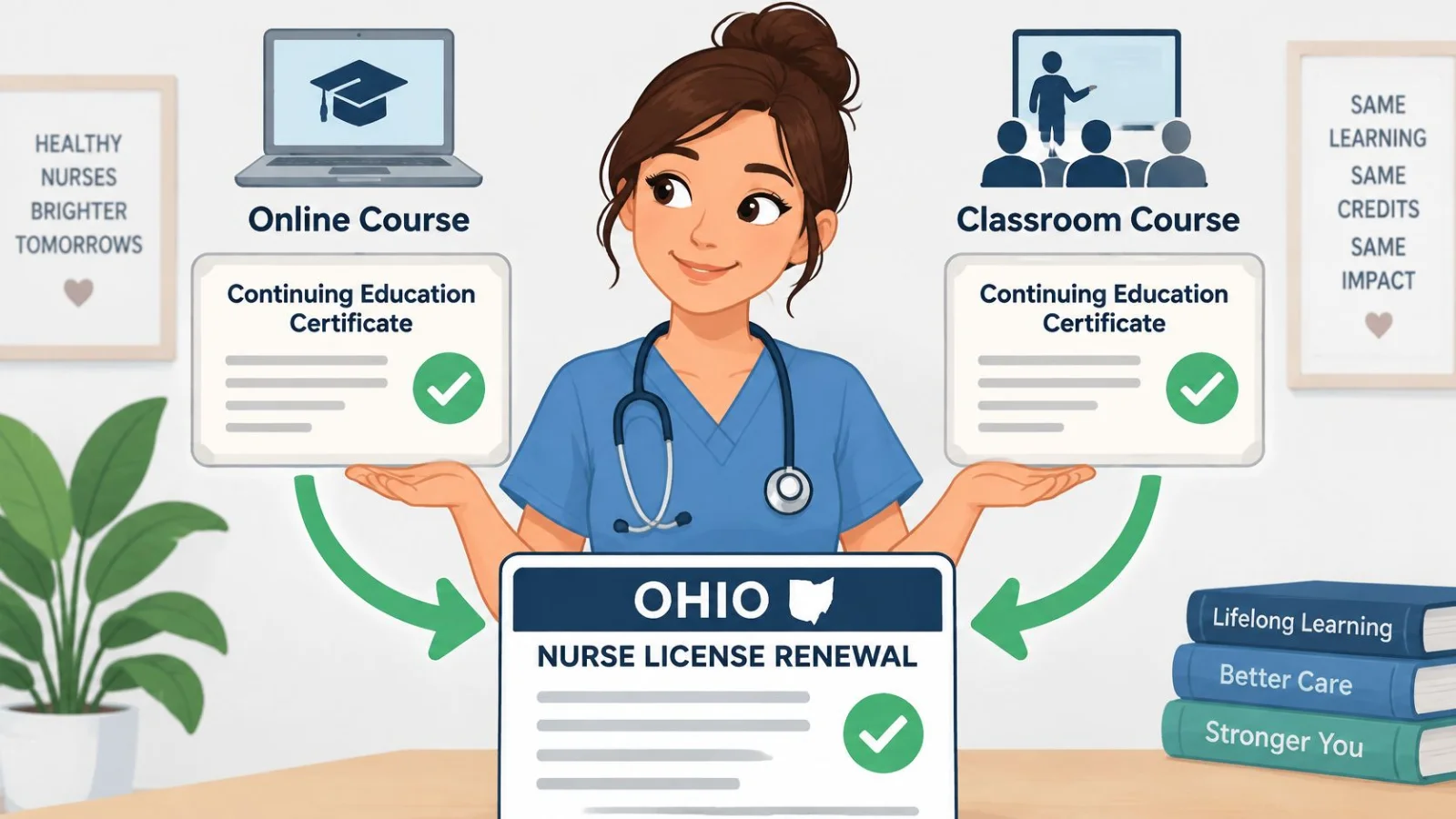
You don't need to choose an in-person AHA or American Red Cross class because you're completing nursing CE. Ohio eligibility depends on the applicable approval and content requirements, not on whether you sat in a classroom.
Online education is a valid, accessible option when the course meets those requirements. The same careful review should apply to both formats.
The delivery method can differ while the documentation standard stays consistent.
Compare the learning experience rather than the label
Online CE lets you study around shifts, revisit explanations, and keep electronic records. Avoiding travel can also reduce transportation expenses and time away from work or family.
In-person education offers a fixed schedule and direct interaction. Some learners prefer that structure, especially when a program includes supervised physical practice.
Neither format guarantees quality by itself. A well-designed online lesson can provide clear explanations, relevant cases, and meaningful assessment, while a poorly matched classroom course can still miss your licensing needs.
Consideration | Online CE | In-person education |
|---|---|---|
Scheduling | Often supports self-paced study | Usually follows scheduled sessions |
Travel | Can be completed remotely | Requires attendance at a location |
Reviewing material | May allow replay or revisiting lessons | Depends on access to course materials |
Physical skills | Check whether a separate practical component is needed | May include supervised practice |
Ohio eligibility | Requires qualifying approval and content | Requires qualifying approval and content |
Don't confuse CE acceptance with certification acceptance. Hospitals and clinics may maintain specific credentialing policies, including practical assessment requirements. Confirm those policies before purchasing a certification.
Peer-reviewed studies and industry articles can help evaluate online education, but they need to match the actual outcome being discussed. Evidence about knowledge retention doesn't automatically establish equal patient-care outcomes or hands-on competence. Without course-specific evidence, don't assume either superiority or inferiority from delivery format alone.
Apply a provider checklist
Before enrolling:
Verify Ohio eligibility. Check the applicable Board approval or recognized provider pathway.
Read the accreditation statement. Accreditation and a course-specific designation aren't interchangeable.
Inspect the certificate details. Confirm nursing contact hours and Category A designation where applicable.
Match the topics. Look for the precise subject your licensing path requires.
Our continuing education is AMA and ANCC accredited. Nurses receive ANCC Contact Hours, while physicians receive AMA PRA Category 1 Credits; other professions receive their applicable credit types.
AHA and American Red Cross remain options for many certifications. They aren't the only pathways to healthcare education, and their names aren't substitutes for checking the requirements attached to your specific license or job.
Keeping Audit-Ready CE Records
An audit-ready record should answer a simple question: Can someone verify what you completed, when you completed it, and why it qualifies? Build that record immediately after each course, while the certificate and course description are easy to retrieve.
Don't rely exclusively on an employer's learning system. You may change jobs or lose access to an account before you're asked for documentation.
Save a complete course record
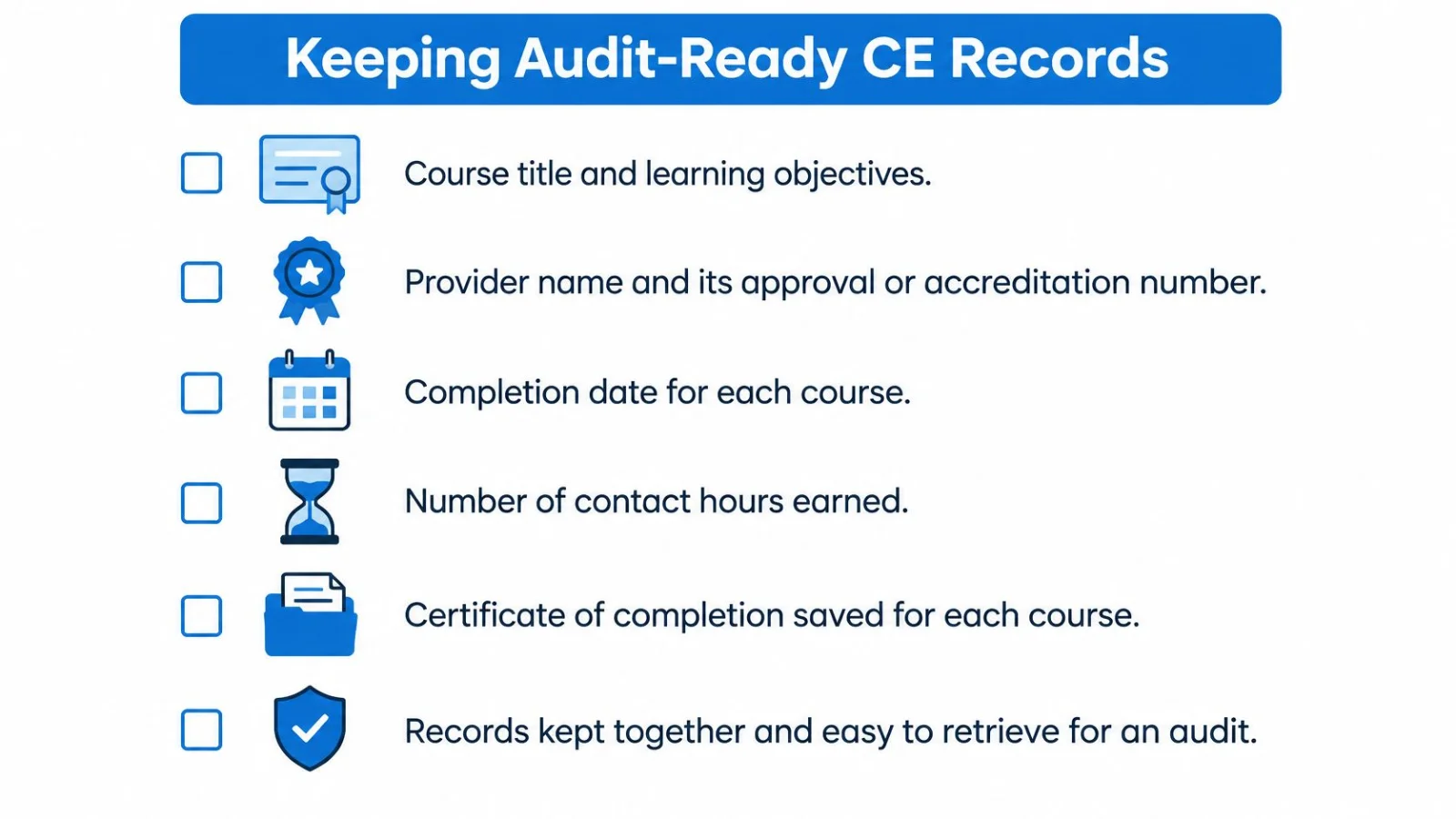
Use this checklist for every completed activity:
Course identity. Keep the title and learning objectives.
Provider details. Save the provider's name and approval or accreditation statement.
Completion date. Record the date shown on the certificate, not the enrollment or purchase date.
Contact hours. Enter the nursing hours awarded.
Content classification. Identify Category A status and any applicable reactivation or pharmacology topic.
Completion evidence. Download the certificate or transcript as a PDF.
Keep the supporting files together rather than storing certificates separately from the information that explains them.
Make retrieval easy
Create a digital folder for each renewal period and back it up somewhere you control. Name files consistently, using the completion date, provider, and course title.
A spreadsheet works well for your index. Include columns for date, provider, hours, Category A status, topic area, and certificate filename. For a return-to-practice plan, the topic column helps you identify gaps that a simple total would hide.
For broader ideas about organizing evidence, you can browse documentation audit checklists from PatientNotes. Use that resource for documentation habits, not as an authority on Ohio nursing CE eligibility.
Keep the certificate and the reason it qualifies together. A folder full of PDFs isn't useful if you can't match them to your application.
If the Board requests records, follow its instructions and deadline. Organize the matching certificates, course index, and renewal attestation information so the reviewer can follow your submission.
A polished certificate can't correct an ineligible provider or an out-of-window completion date. Check those details before filing the record.
Common CE Mistakes and Renewal Deadlines
Most avoidable CE problems start with an assumption: that your coworker's requirement is yours, that all nursing education counts, or that completing courses automatically renews your license.
Use your license record as the starting point. Your employer's reminder is helpful, but you're responsible for confirming the applicable application and education requirements.
Watch for these planning errors
Reusing an exemption. A first-renewal exemption isn't a permanent exception. Recheck your obligation when the next renewal approaches.
Buying a generic package after a lapse. Review the required topic distribution before choosing courses. A complete-looking total can conceal missing pharmacology or ethics content.
Counting the wrong completion dates. Check the applicable reporting window before adding an older certificate to your total.
Overplanning after endorsement. Your Ohio licensure history may place you on a reduced-hours pathway. Verify that history before enrolling.
Overlooking Category A or provider eligibility. A broad nursing-law title or attractive certificate doesn't establish Ohio compliance.
Treat the deadline as a verification task
Check your current license record and the Board's current renewal instructions. Record the application deadline separately from any license expiration or lapse date.
Also verify the current CE reporting-period dates. Don't assume that subtracting a familiar interval from the date you intend to submit will always resolve every reporting-period question.
Use the ProMed Certifications RN renewal walkthrough to organize the administrative steps alongside your education plan. Keep your license number, login access, completed-course index, and payment method ready before you start the application.
Before attesting, compare your records with the requirements for your actual path. If something is unclear, resolve it with the Board rather than guessing.
Don't wait until submission day to discover a documentation gap. Leave time to retrieve a missing certificate, clarify a course designation, or complete an eligible replacement activity.
Confirm Your Path Before You Enroll
A useful CE plan starts with a decision, not a purchase. Identify your licensing situation, then choose education that fills the exact gaps in your record.
Use these final checks:
Confirm your path. Match your license type, licensure method, first-renewal status, and current license status to the applicable requirement.
Review dates and content. Count only eligible completed education and identify missing Ohio-law, advanced pharmacology, or return-to-practice topics.
Check your evidence. Make sure each course has retrievable documentation and that your retention plan meets the Board's requirement.
Use our guide to nursing CE requirements while comparing course information with your plan. Read the approval language and nursing contact-hour statement before enrolling, rather than assuming a course qualifies because it addresses healthcare.
Make compliance part of your routine
Bookmark the Board's current instructions and revisit them before each renewal. Keep your course log updated as you learn, rather than reconstructing it when the application is due.
We're committed to making education accessible without treating flexibility as a substitute for quality. You're still responsible for verifying that selected education meets your licensing and regulatory requirements.
A clear plan turns CE from a last-minute task into a manageable routine that fits your shifts.
ProMed Certifications offers CE/CME for nurses and physicians, with Nursing Plans and Physician Plans to support ongoing education. Visit ProMed Certifications to review your options, compare course details with your Ohio requirements, and choose education that addresses your next renewal's specific needs.