

Neonatal Resuscitation Protocol: A Quick Reference Guide
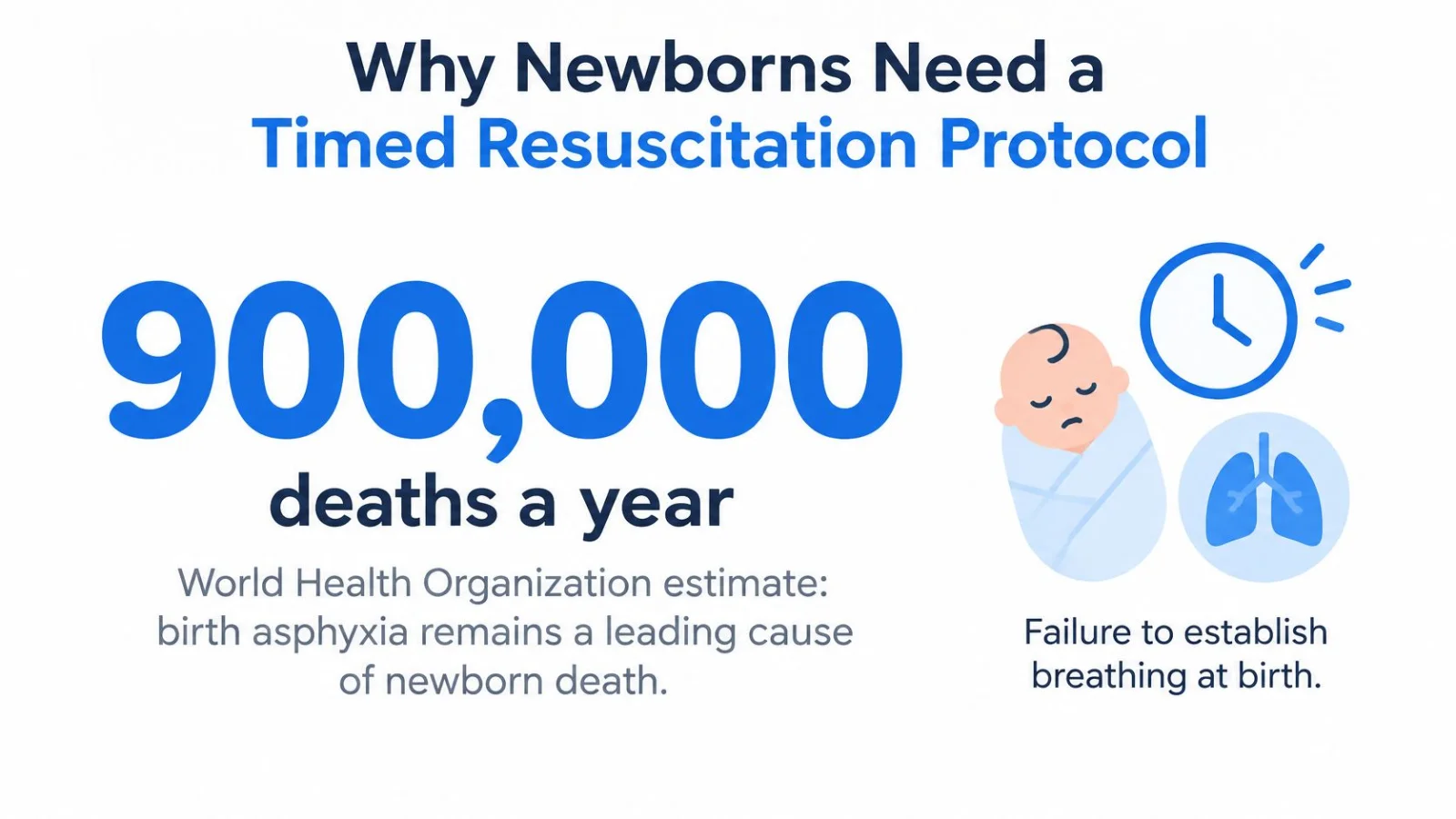
Birth asphyxia, the failure to establish breathing at birth, causes approximately 900,000 newborn deaths annually, according to the World Health Organization. That burden reframes the neonatal resuscitation protocol: the central skill isn't progressing rapidly to compressions. It's establishing effective ventilation and recognizing the newborn's response quickly enough to change course.
Why Newborns Need a Timed Resuscitation Protocol
A newborn who doesn't breathe effectively needs a different clinical response from an older patient with sudden cardiac arrest. At the warmer, the immediate problem is often failure to aerate the lungs and establish gas exchange. The team therefore begins with warmth, airway positioning, drying, stimulation, and assessment, then provides assisted ventilation when spontaneous breathing is inadequate.
The clock matters because prolonged assessment can become delayed treatment. However, elapsed time alone doesn't prove that a treatment worked. A team can deliver mask breaths without delivering enough air into the lungs, especially when the mask leaks or the airway isn't positioned well.
The infographic emphasizes the scale of breathing failure at birth.
Why ventilation comes before advanced procedures
Bag-and-mask ventilation is a practical, high-impact intervention because it directly addresses the newborn's failure to breathe. Advanced equipment can help, but equipment availability doesn't change the immediate need to provide effective respiratory support.
Consider a hypothetical delivery in a small maternity unit. A newborn remains limp and apneic after initial stimulation, while the clinician capable of intubation is still approaching the room. The bedside team shouldn't wait for that clinician before beginning competent bag-mask ventilation.
The same principle applies in a tertiary center. More staff, monitoring, and airway devices don't make an ineffective mask seal acceptable. They should help the team recognize and correct the problem sooner.
Key takeaways for the delivery-room team
Treat breathing failure promptly. Don't let repeated stimulation postpone assisted ventilation.
Use heart-rate response as feedback. Delivering breaths and successfully ventilating the lungs aren't necessarily the same thing.
Escalate for the clinical finding. A newborn who needs ventilation doesn't automatically need compressions or medication.
Prepare for practical constraints. Cord length, equipment placement, staffing, and available airway devices affect what can happen immediately.
Nurses, physicians, and respiratory therapists need a shared interpretation of these findings. The ventilation clinician should describe whether air entry appears effective, while another team member communicates the heart-rate trend and the leader states the next action.
This page is a study reference for delivery-room teams, not a replacement for the Neonatal Resuscitation Program textbook, hospital policy, or the clinical leader at the warmer. Check treatment targets against the guideline edition the unit has adopted.
Heart Rate Thresholds That Drive Every Action
Neonatal resuscitation actions by clinical finding
Finding | Time cue | Action | Reassess |
|---|---|---|---|
Breathing, heart rate above 100 beats/min, term and vigorous | After initial steps | Warmth, drying, routine care; delayed cord clamping if policy allows | Ongoing observation |
Labored breathing or cyanosis, heart rate above 100 beats/min | After initial steps | Consider CPAP or titrated free-flow oxygen, guided by preductal pulse oximetry | Heart rate, breathing, and saturation targets |
Apnea, gasping, or heart rate below 100 beats/min | Start by 60 seconds of life | Positive-pressure ventilation at 30–60 inflations/min, initial PIP approximately 20–30 cm H₂O | Chest movement and heart rate |
Heart rate still below 60 beats/min after ventilation that moves the chest | After at least 30 seconds of effective ventilation | Coordinated 3:1 compressions and ventilation, alternative airway, and 100% oxygen | Heart rate after about 60 seconds of coordinated care |
Heart rate still below 60 beats/min after coordinated compressions | After compressions with effective ventilation | Umbilical venous or intraosseous access and epinephrine every 3–5 minutes | Heart rate; also consider hypovolemia and pneumothorax |
The decision bands and ventilation settings above follow the American Heart Association and American Academy of Pediatrics neonatal resuscitation algorithm description. Use the table as a decision aid, not as a ladder every newborn must climb.
Choose the finding, not the most dramatic intervention
Start with the newborn's breathing and heart rate. Identify the applicable row, perform its action, and reassess before changing categories of treatment. Preparing equipment for a possible escalation is appropriate; performing that escalation without its indication isn't.
For example, a newborn who breathes spontaneously but has increased work of breathing needs assessment of respiratory support and oxygenation. CPAP supports an infant who is breathing; free-flow oxygen addresses an oxygen requirement. Neither replaces assisted breaths in an apneic infant.
Likewise, visible cyanosis doesn't by itself establish a need for intubation. The team should evaluate breathing, obtain preductal oxygen saturation, and select support that matches the physiology.
Decision rule: Prepare ahead, but treat the finding that's present. Don't skip ventilation because the newborn looks critically ill.
Why most teams remain in the ventilation pathway
A peer-reviewed review of neonatal resuscitation updates reports that approximately 5% of term infants receive positive-pressure ventilation, while 0.1% receive chest compressions. These proportions explain why ventilation deserves more rehearsal than its position near the beginning of an algorithm might suggest.
The clinician communicating heart rate should report a trend, not announce that a pulse exists. A rising rate supports continued respiratory management; a persistently low rate requires confirmation that the current intervention is effective.
Basic infant CPR skills remain useful background, including locating the brachial pulse in infants. Delivery-room assessment, however, shouldn't become a prolonged peripheral pulse search that delays respiratory support or appropriate monitoring.
Assign roles before birth whenever possible. One clinician manages the airway, another obtains and communicates monitoring information, and the leader integrates those findings. Clear statements such as “mask leak corrected, chest movement present, heart rate rising” give the team more useful information than “ventilation done.”
Delayed Cord Clamping When Breathing Fails
Delayed cord clamping isn't an automatic waiting period for every newborn. A vigorous infant and an apneic infant present different priorities, even when both were born during an otherwise uncomplicated delivery.
The ILCOR evidence update addressing umbilical-cord management identifies cord management as a major revision area and describes insufficient evidence for a universal approach in particular maternal, fetal, placental, and compromised-newborn circumstances. Much of the relevant evidence remains low or very-low certainty, so a single timer can conceal clinically important differences.
Cord management must fit the infant's condition and the team's ability to deliver immediate care.

A vigorous newborn and a nonbreathing newborn need different plans
A crying term newborn with good tone can usually remain with the parent while the team follows its local delayed-clamping policy. The immediate task is supportive transition care and continued observation.
A limp preterm newborn who isn't breathing needs prompt respiratory support and gestational-age-appropriate thermal care. If effective ventilation can only be delivered at the warmer, preserving a planned cord delay must not postpone that treatment.
Intact-cord resuscitation may resolve the apparent conflict, but only when the equipment, positioning, and trained staff make it feasible. The theoretical ability to bring a bag toward the bedside isn't the same as being able to obtain a reliable seal, maintain warmth, and monitor the infant.
Make the decision before the emergency
Use these checks during the delivery briefing:
Clinical condition: Is the newborn likely to need immediate respiratory support, and is there a maternal or placental reason to change the plan?
Gestational age: What thermal protection and respiratory equipment should already be ready?
Equipment reach: Can the team position the newborn safely and ventilate effectively with the cord intact?
Practiced capability: Has the team rehearsed the setup, including access for monitoring and escalation?
No single half-minute or minute-long cord rule covers every nonbreathing infant. The practical priority is timely effective ventilation, with cord management chosen around the clinical situation rather than defended despite it.
The briefing should name the fallback location and who will announce the change. That prevents an obstetric and neonatal team from debating equipment placement after the infant's condition has deteriorated.
Initial Steps and Positive Pressure Ventilation
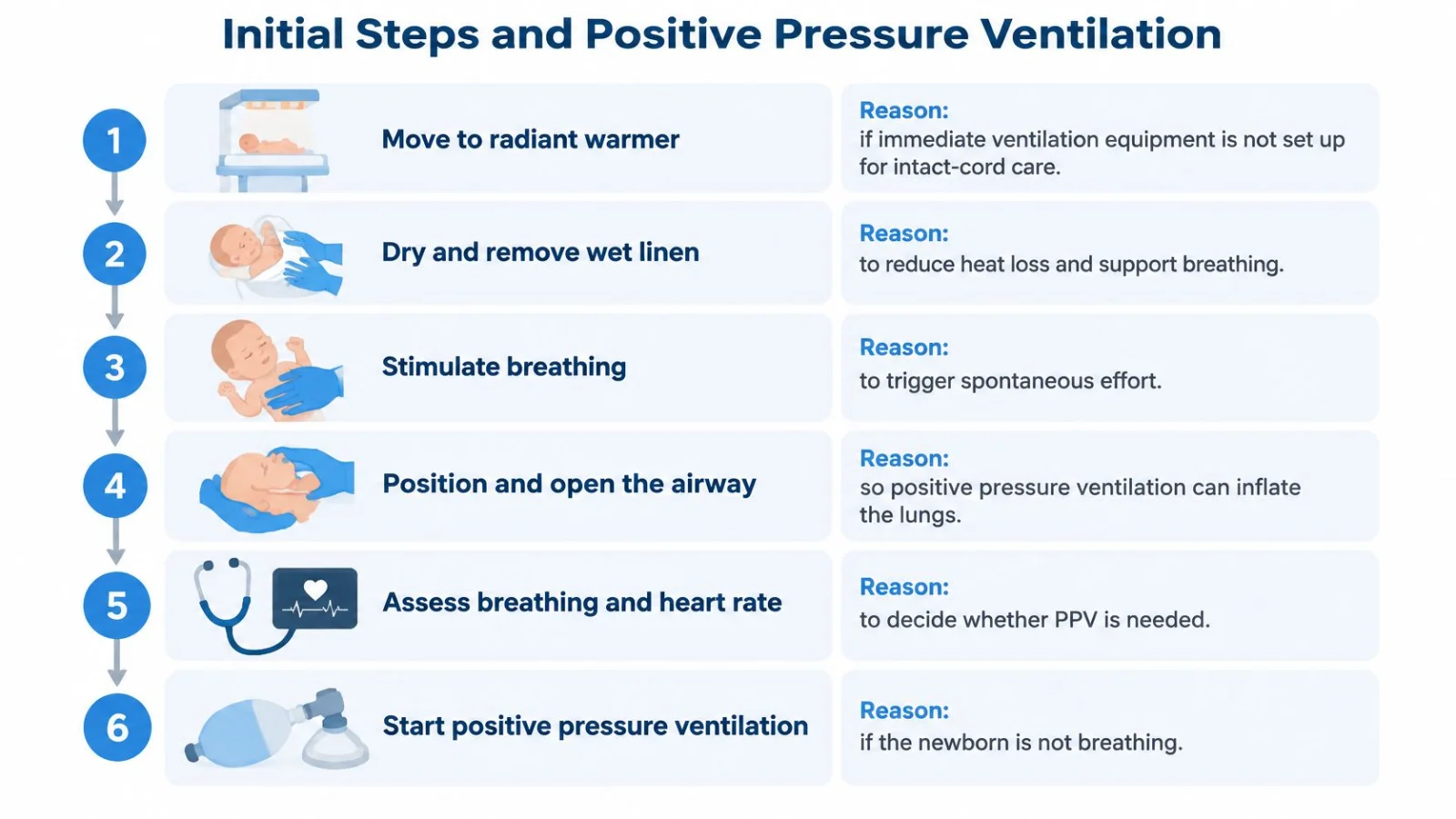
The initial sequence should make respiratory support faster and more effective, not create a checklist that must be completed slowly before treatment begins. Assign assessment and monitoring tasks in parallel when staffing permits.
The visual below summarizes the early workflow.
Perform each action for a clinical reason
Move to an appropriate resuscitation surface when needed, because the team must be able to provide warmth, position the airway, and deliver ventilation without equipment or access barriers.
Provide thermal care and remove wet linen when drying is appropriate, because avoiding heat loss is part of stabilization; very preterm infants need the unit's specialized thermal-protection approach rather than an automatic term-infant drying routine.
Position the head in slight extension and stimulate briefly, because airway alignment and spontaneous respiratory effort can improve the transition without unnecessary procedures.
Assess breathing and heart rate promptly, because apnea, gasping, and bradycardia identify the need for assisted ventilation rather than further waiting.
Start positive-pressure ventilation when indicated, using a face mask or an appropriate laryngeal mask and observing the response rather than assuming the device is delivering effective breaths.
Adjust inflation pressure to achieve effective lung ventilation, because a pressure setting is a starting point, not proof of adequate air entry.
Apply preductal pulse oximetry to the right hand or wrist when respiratory support or supplemental oxygen is needed, because oxygen should be adjusted using measured saturation rather than skin color alone.
The WHO basic newborn resuscitation guidance hosted by NCBI emphasizes prompt assisted ventilation when a newborn remains apneic, gasping, or has a heart rate below 100 beats/min, ideally within the first minute, with a ventilation rate of 30–60 inflations/min. The heart-rate response is the most important practical feedback on whether respiratory support is succeeding.
Separate ventilation from oxygen delivery
Term newborns generally begin resuscitation in room air. For infants born before 32 weeks, an initial oxygen concentration of approximately 30%, when blending is available, is a starting strategy described in the AHA neonatal life-support highlights; gestation-specific local guidance and prompt saturation-guided adjustment remain essential.
Oxygen concentration and ventilation effectiveness are separate decisions. Turning up oxygen won't correct a mask leak or an obstructed airway, and a pulse oximeter shouldn't delay the first assisted breaths.
A demonstration can support procedural review alongside supervised skills practice.
In a hypothetical case, the newborn remains apneic after drying and stimulation, with a heart rate in the ventilation band. The immediate action is assisted ventilation, not compressions. If the rate doesn't improve, the clinician should investigate air delivery rather than continue squeezing the bag unchanged.
Fixing Ventilation Before the Next Step
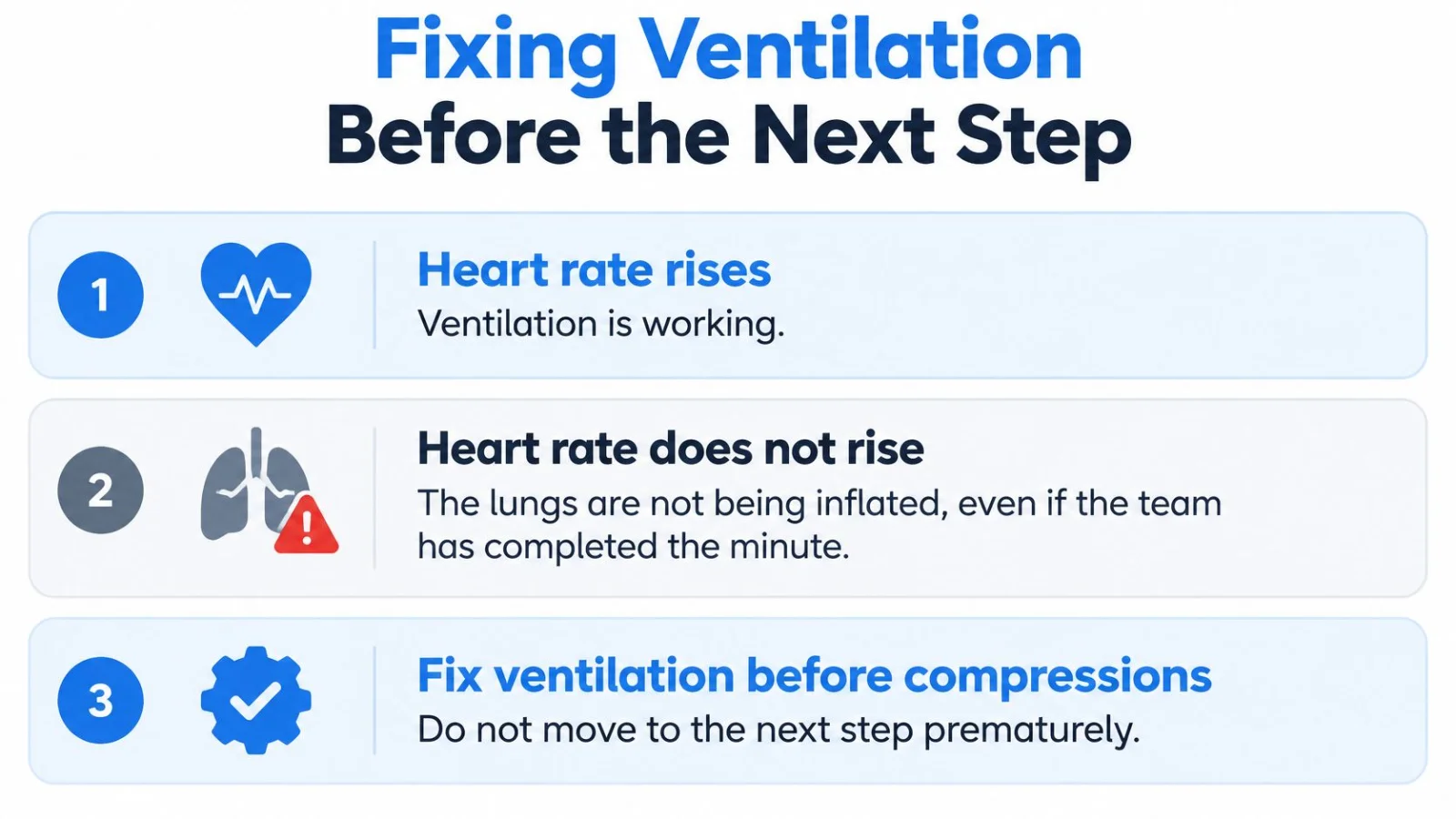
A rising heart rate is the clearest bedside sign that ventilation is helping. When it doesn't rise, investigate ineffective lung inflation promptly, but don't assume inadequate ventilation is the only possible explanation for persistent bradycardia.
The ILCOR neonatal life-support update addresses ventilation interfaces, oxygen therapy, video laryngoscopy, and delivery-room monitoring. It also withdrew prior support for delivery-room sodium bicarbonate, reinforcing that medication isn't a substitute for correcting respiratory support.
The checklist emphasizes reassessment before escalation.
Correct the mechanics in a deliberate sequence
Adjust the mask seal. Check mask size, placement over the nose and mouth, and whether pressure on the face is compromising the airway. Use a second clinician to assist with the seal when needed.
Reposition the head. Restore a neutral-to-slightly extended position instead of increasing pressure against a poorly aligned airway.
Clear suspected obstruction. Suction the mouth and then the nose when secretions appear to obstruct ventilation. Don't interrupt effective breaths for routine suction.
Open the mouth. Reassess air entry after changing the jaw and mouth position.
Increase pressure carefully when necessary. Adjust until lung inflation is effective, observing chest movement and the heart-rate response.
Use an alternative airway. Select an appropriate laryngeal mask or endotracheal tube when mask ventilation remains ineffective or the clinical situation requires more reliable airway access.
The sequence is purposeful troubleshooting, not a ritual that must delay a clearly necessary airway intervention. A clinician who identifies an obvious mask leak should correct it immediately; another who recognizes persistent failure despite correction should prepare the alternative airway without unnecessary repetition.
Elapsed ventilation time isn't effective ventilation time when the mask leaks and the chest doesn't move.
Match the solution to the room
Video laryngoscopy can support airway management where it's available and staff are trained. It isn't a prerequisite for beginning neonatal resuscitation, and the team shouldn't wait for advanced equipment before using a functioning bag and mask.
In a minimum-equipment setting, assign someone to observe breathing and heart-rate response while the ventilation clinician focuses on seal and airway position. In a fully equipped room, ECG and pulse oximetry add information, but neither monitor corrects the airway.
For a hypothetical newborn who is gasping and bradycardic during the initial transition, begin assisted ventilation promptly. If the rate remains unchanged and delivered breaths don't move the chest, correct seal, position, and airway patency. Neither compressions nor epinephrine solves that mechanical failure.
Once lung inflation is demonstrably effective, persistent severe bradycardia has a different meaning. The team can then escalate on the basis of physiology rather than an unsuccessful attempt to finish the ventilation step.
Oxygen Compressions and Epinephrine Thresholds
Oxygen delivery, chest compressions, and epinephrine answer different clinical problems. Keeping those decisions separate helps the leader avoid treating low oxygen saturation with medication or treating inadequate air entry with compressions.
Oxygen should follow preductal measurements
Use the saturation targets as titration guidance during respiratory support, not as a reason to postpone ventilation while waiting for a monitor signal. The right-hand or right-wrist measurement reflects preductal oxygenation.
Preductal oxygen targets during neonatal resuscitation
Minute of life | Target preductal SpO₂ | Starting oxygen before compressions |
|---|---|---|
1 minute | 60–65% | Term: room air; under 32 weeks: about 30% if blended, according to the adopted gestation-specific protocol |
2 minutes | 65–70% | Titrate to target; don't automatically jump to 100% |
3 minutes | 70–75% | Titrate with the right-hand pulse oximeter |
4 minutes | 75–80% | Titrate with the right-hand pulse oximeter |
5 minutes | 80–85% | Titrate with the right-hand pulse oximeter |
The saturation targets and advanced-resuscitation thresholds follow the AHA/AAP neonatal resuscitation algorithm, which directs compressions for a heart rate below 60 beats/min after at least 30 seconds of ventilation that moves the chest, coordinated at 3:1, with 100% oxygen during compressions and intravascular epinephrine repeated every 3–5 minutes when indicated. That compression-to-ventilation pattern produces 90 compressions and 30 inflations per minute, or 120 coordinated events.
Compressions require effective lung ventilation
Use the two-thumb, encircling-hands technique, compressing the lower third of the sternum while avoiding the xiphoid. An endotracheal tube or appropriate laryngeal mask helps establish reliable ventilation during coordinated care.
The leader should explicitly confirm effective ventilation before announcing compressions. “Chest movement confirmed through the airway” is more useful than “the ventilation interval has elapsed.”
Coordination matters because hurried, uncoordinated activity can interfere with ventilation. The compressor and ventilation clinician need a shared rhythm, while another team member tracks the reassessment interval.
Epinephrine requires access and a medication check
Persistent severe bradycardia despite coordinated ventilation and compressions calls for vascular access, preferably an umbilical venous catheter or an intraosseous route when appropriate. Use the epinephrine concentration and weight-based dose printed on the current neonatal algorithm and the unit's medication sheet, with an independent check when staffing permits.
Medication clinician: Confirms drug, concentration, calculated dose, route, and administration time.
Airway clinician: Continues to verify air delivery rather than assuming an inserted airway must be functioning.
Team leader: Considers hypovolemia and pneumothorax alongside persistent respiratory or equipment problems.
After compressions stop, reduce supplemental oxygen toward the saturation target rather than leaving the compression-phase concentration unchanged. Compressions and medication support circulation, but neither replaces ventilation that reaches the lungs.
After the Heart Rate Recovers
Recovery changes the treatment plan immediately. When the heart rate reaches the compression-stop threshold, stop compressions while continuing assisted ventilation if spontaneous breathing remains inadequate. Reduce oxygen using preductal saturation feedback and reassess respiratory effort, tone, and ongoing support needs.
An improving heart rate isn't permission to disconnect every monitor or transfer the infant without a plan. The team must establish whether the newborn can maintain breathing and circulation without active assistance.
Carry the same newborn through recovery
Consider a hypothetical teaching case. At 40 seconds, a limp newborn has a heart rate of 70 beats/min and receives mask ventilation. After corrective measures and placement of a laryngeal mask, the rate is 50 beats/min despite sustained ventilation that demonstrably moves the chest, so the team begins coordinated compressions and increases oxygen.
After approximately 60 seconds of coordinated care, reassessment shows a heart rate of 110 beats/min. The team stops compressions, continues respiratory support as needed, titrates oxygen, and arranges monitored postresuscitation care.
These values describe a simulation scenario, not a universal recovery schedule. The clinical lesson is that the team changes treatment when the finding changes, rather than continuing a procedure merely because it has started.
Recovery checkpoint: A recovered heart rate doesn't prove that breathing, temperature, glucose, and neurologic status are normal.
Wean support without losing observation
Taper assisted ventilation as spontaneous breathing becomes effective and the heart rate remains adequate. Maintain warmth and monitoring, and restart ventilation promptly if apnea or bradycardia returns. Recheck mask seal, airway position, and patency rather than reflexively resuming compressions.
A term or near-term newborn with a significant perinatal event and signs of encephalopathy needs prompt neonatal assessment. Avoid hyperthermia, check glucose according to the postresuscitation protocol, and arrange evaluation for therapeutic hypothermia eligibility rather than initiating an improvised cooling approach.
The handoff should make the resuscitation reconstructable:
Initial condition: Breathing, tone, heart-rate findings, and relevant perinatal concerns.
Respiratory treatment: First ventilation time, interfaces used, corrective measures, and continuing support.
Advanced interventions: Compressions, oxygen changes, vascular access, and medications if given.
Response and follow-up: Heart-rate recovery, current observations, temperature and glucose plans, and destination.
Documentation should include the appropriate newborn assessments. Guidance on interpreting a newborn's Apgar results can support communication, but an Apgar score doesn't replace the immediate breathing and heart-rate findings that determine treatment.
Confirm the Current Guideline Before You Act
Before the next delivery, compare the unit's warmer poster, medication sheet, and training materials with the official AHA/AAP neonatal algorithm and the ILCOR guidance the hospital has adopted. A recently published update isn't automatically the protocol displayed in every delivery room.
Version differences become practical risks when team members prepare different oxygen settings or expect different equipment. The safest response is a shared local plan, not competing recollections during an emergency.
Check the items that change bedside action
Oxygen preparation: Confirm the term and preterm starting strategy, blender function, and the location of the preductal saturation targets.
Medication safety: Check the epinephrine concentration, weight-based dose reference, access equipment, and documentation method.
Cord-management capability: Establish whether intact-cord ventilation can be performed in that room.
Airway readiness: Confirm mask sizes, functioning ventilation equipment, available alternative airways, and who can place them.
Practice the ventilation-correction sequence aloud during simulation. Have one clinician announce a mask leak, another communicate the heart-rate trend, and the leader state why the team should correct ventilation or escalate. That rehearsal tests clinical reasoning as well as memory.
Match cognitive review with hands-on readiness
ProMed's certification training in neonatal care prepares medical professionals for resuscitation procedures and life-saving techniques at delivery through an online format. Its curricula are AHA-aligned and follow the 2020–2025 ILCOR and AHA Consensus on Science, providing structured cognitive preparation and review.
Online study doesn't replace the unit protocol, supervised equipment practice, or employer-required hands-on skills assessment. Clinicians who also care for older infants and children need pediatric-specific preparation rather than transferring delivery-room techniques unchanged to every pediatric emergency.
Before the following shift, match the certification knowledge, warmer poster, medication reference, and adopted official algorithm. Resolve discrepancies with the clinical educator or neonatal lead before a newborn needs treatment.
ProMed Certifications offers online neonatal resuscitation education for clinicians preparing to recognize breathing failure and apply a structured delivery-room response. Visit ProMed Certifications to review training options, then pair cognitive preparation with a team rehearsal using the equipment and protocol at the warmer.