


IV Compatibility Chart: How to Read Results Safely

A blank cell in an IV compatibility chart can be more important than a compatible result. Guidance from the Medicines Learning Portal emphasizes identifying how medicines will mix, their concentrations, diluents, line configuration, and contact duration before deciding whether they can be administered together. Without that information, a reassuring symbol may answer a different question from the one at the bedside.
For nurses and physicians, the useful deliverable isn't a yes or no. It's a documented result with the conditions that make it applicable, or a clear acknowledgment that the evidence doesn't resolve the planned administration.
Compatibility Results at a Glance
Compatible, incompatible, variable, and not tested each require a different action. Start by identifying the category, then determine whether the entry covers the preparation and delivery method being considered.
Compatibility result categories and required actions
Result | What it means | Action before co-administering |
|---|---|---|
Compatible | Can be given together without notable physicochemical change under the tested conditions | Confirm that the planned concentration, diluent, and method match the tested conditions |
Incompatible | Changes that may compromise stability, safety, or efficacy | Do not share the line, container, or syringe under those conditions; use separate access or an alternative plan |
Variable | The result changes with conditions such as concentration, diluent, or equipment | Seek pharmacy guidance; use a separate line if the question isn't resolved |
Not tested or not listed | No reliable evidence is available in that reference for the combination | Treat as unknown; obtain pharmacist review before combining |
A compatible designation isn't permission to combine any products bearing the same drug names. It applies to the strength, formulation, fluid, container, and administration method described in the underlying reference.
Likewise, an incompatible result needs to be read in its stated context. It prohibits the tested combination under those conditions, not necessarily the use of both medicines in the same patient through an appropriately designed administration plan.
Unknown is a usable result
A not-listed entry tells the clinician that the reference doesn't establish compatibility. It doesn't establish incompatibility either, but that distinction doesn't justify an empirical trial through the patient's line.
The practical response is to stop the proposed combination from proceeding until pharmacy resolves the question or an alternative arrangement is established. Checking another authoritative reference may help, but finding an unlabeled blank in a different chart isn't confirmation.
Practical rule: A clear answer requires both a result category and matching administration conditions.
This article doesn't provide bedside clearance for individual drug pairs. Specific combinations need verification in a current compatibility database or with pharmacy, including every relevant running solution and medication.
When references disagree
Don't choose whichever reference gives the most convenient answer. Compare the products, concentrations, methods, and endpoints first, because apparently contradictory results may describe different experiments.
The bedside pharmacist study describes a conservative hierarchy for unresolved disagreements: incompatible overrides variable, variable overrides compatible, and incompatible overrides compatible. Apply that approach while obtaining pharmacy guidance rather than averaging the findings or assuming a clear solution settles the question.
Published Compatibility Results by Combination
Published findings illustrate how narrowly a compatibility conclusion should be read. The table below records study-specific outcomes, not standing authorization to administer these medicines together.
Published compatibility results by combination
Combination | Test setting | Reported result | Source |
|---|---|---|---|
Ciprofol with five cardiovascular drugs, with other cardiovascular combinations also evaluated | Simulated Y-site, up to 8 hours | Compatible and stable with five; incompatible with three others | 2025 ciprofol cardiovascular study, according to the authors |
Ciprofol with six cephalosporins | Y-site, room temperature, up to 8 hours | Relative drug content maintained at 95% to 105% | |
Etoposide with 45 IV drug combinations | Within 4 hours | Compatible with 38 of 45 combinations, or 84% | |
Reduced glutathione with 44 IV drugs | Over 4 hours | Physically compatible with 33 of 44; incompatible with 11 | |
Pantoprazole with ondansetron, a bolus pair | Observed bolus administration in an Indian ICU; detailed preparation conditions require verification | Most frequent bolus-pair incompatibility, representing 85.4% of bolus-pair cases | |
Meropenem infusion with pantoprazole bolus | Observed infusion–bolus administration in the same ICU; detailed preparation conditions require verification | Accounted for 16.6% of incompatibility cases | Same Indian ICU study |
Laboratory results and observed events answer different questions
The laboratory rows describe outcomes during defined tests. The ICU rows describe the distribution of incompatibilities identified in clinical practice, not the probability that a pair will react whenever administered.
The endpoints also differ. Physical compatibility alone doesn't demonstrate preserved drug content, and a measured drug-content range doesn't independently answer every question about particles or emulsion integrity.
Before acting on any row, retrieve the full conditions and match the planned concentration, diluent, container, and delivery method. An unstated condition is information to obtain, not a gap to fill by assumption.
Why Compatibility Charts Protect Patients
In 31.35% of observed medication-administration situations, more than one medication was given to the same patient at the same time in a 2018 observational study of IV preparation and administration. Among those simultaneous combinations, 17.89% were classified as compatible using Micromedex, 56.84% as incompatible, and 25.26% as untested.
These findings make compatibility checking a patient-safety control rather than an optional reference task. The untested group is especially important: uncertainty requires pharmacist review, separate access, or another administration plan, not an assumption that no warning means no problem.
The same study found that hand hygiene was omitted in 70.29% of preparation observations, while aseptic technique wasn't used in 80.85%. A correct chart entry therefore addresses only part of safe IV medication administration.
Connect the reference to the actual line
Consider a patient receiving several continuous infusions when an intermittent medicine becomes due. A nurse who checks only the newly ordered drug against the primary fluid may miss the other medicines that meet downstream.
The bedside check needs to connect the medication record to the physical setup:
Trace the tubing: Identify which medicines share a connector, manifold, or lumen.
Confirm the preparation: Check the labeled concentration and diluent against the order and reference.
Protect asepsis: Use the required hand hygiene and line-access technique.
Plan the sequence: Establish whether administration requires separate access or an approved flushing and timing arrangement.
A compatibility result supports safe administration only when the clinician applies it to the line the patient actually has.
Preserve the broader clinical assessment
Compatibility doesn't establish that the prescribed dose, rate, indication, or access device is appropriate. Those questions remain part of medication verification even when the physicochemical result is favorable.
Consult the chart before drugs share a line or container, not after an unexplained change appears. Use its findings alongside the patient's condition, available access, institutional protocols, and professional assessment. The reference structures judgment; it doesn't replace it.
Variables That Change a Compatibility Result
Compatibility is conditional. Changing a preparation or delivery variable can make an otherwise relevant entry unsuitable for the planned administration.
The ASHP injectable-drug reference user guide separates solution, additive, syringe, and Y-site evidence and describes Y-site testing that typically uses a 1:1 mixture. Its structure matters because brief contact in shared tubing isn't equivalent to storage together in a syringe or bag.
Variables that change a compatibility result
Variable | Why it matters | What to confirm |
|---|---|---|
Drug concentration | The result applies to the tested strength | Match the product and prepared concentrations stated in the chart entry |
Diluent or IV fluid | Solution composition and pH can change physical stability | Confirm the exact fluid being used, not a similar one |
Container material | Plastic material may affect the medication | Check that the container matches the reference |
Administration setup | Syringe, Y-site, additive solution, and shared-line arrangements are assessed differently | Match the delivery method and relevant infusion equipment |
Temperature | Stability can change with storage and ambient conditions | Note the temperature conditions stated in the reference |
Contact time | A finding may hold only for the duration tested | Compare planned contact time with tested duration |
Read the conditions in order
Begin with concentration, including the prepared concentration rather than just the vial strength. A result for a dilute infusion shouldn't be transferred automatically to a concentrated preparation.
Next, identify the diluent and container. Solutions aren't interchangeable because both are commonly used intravenously, and changing the bag or syringe material may introduce a product-specific question.
Then establish where the medicines meet. A Y-site entry doesn't validate a multi-drug bag, and a pairwise result doesn't establish compatibility for a mixture containing additional medicines. Finally, compare temperature and contact time with the intended preparation, storage, and administration period.
Separate appearance from drug preservation
Physical compatibility concerns changes such as precipitation, gas formation, or color change. Chemical stability requires evidence that drug concentrations remain acceptable over the relevant period; visual inspection can't supply that evidence.
For questions about multi-ingredient wellness infusions, Sunridge Medical's Myers cocktail IV immune support guide provides context about ingredients and risks, not a validated compatibility verdict. Similarly, clinical selection of a resuscitation fluid, discussed in ProMed's fluid resuscitation guidelines, is a separate question from whether a medication can be prepared in that fluid.
A smaller chart that displays conditions and evidence quality can be safer than a broad binary table. If a relevant variable differs, treat applicability as unresolved until pharmacy confirms it.
Reading and Confirming a Chart Entry Step by Step
A reliable check starts with the products in hand, not with a remembered drug pair. Keep the medication labels, prescription, and line configuration available while using the reference.
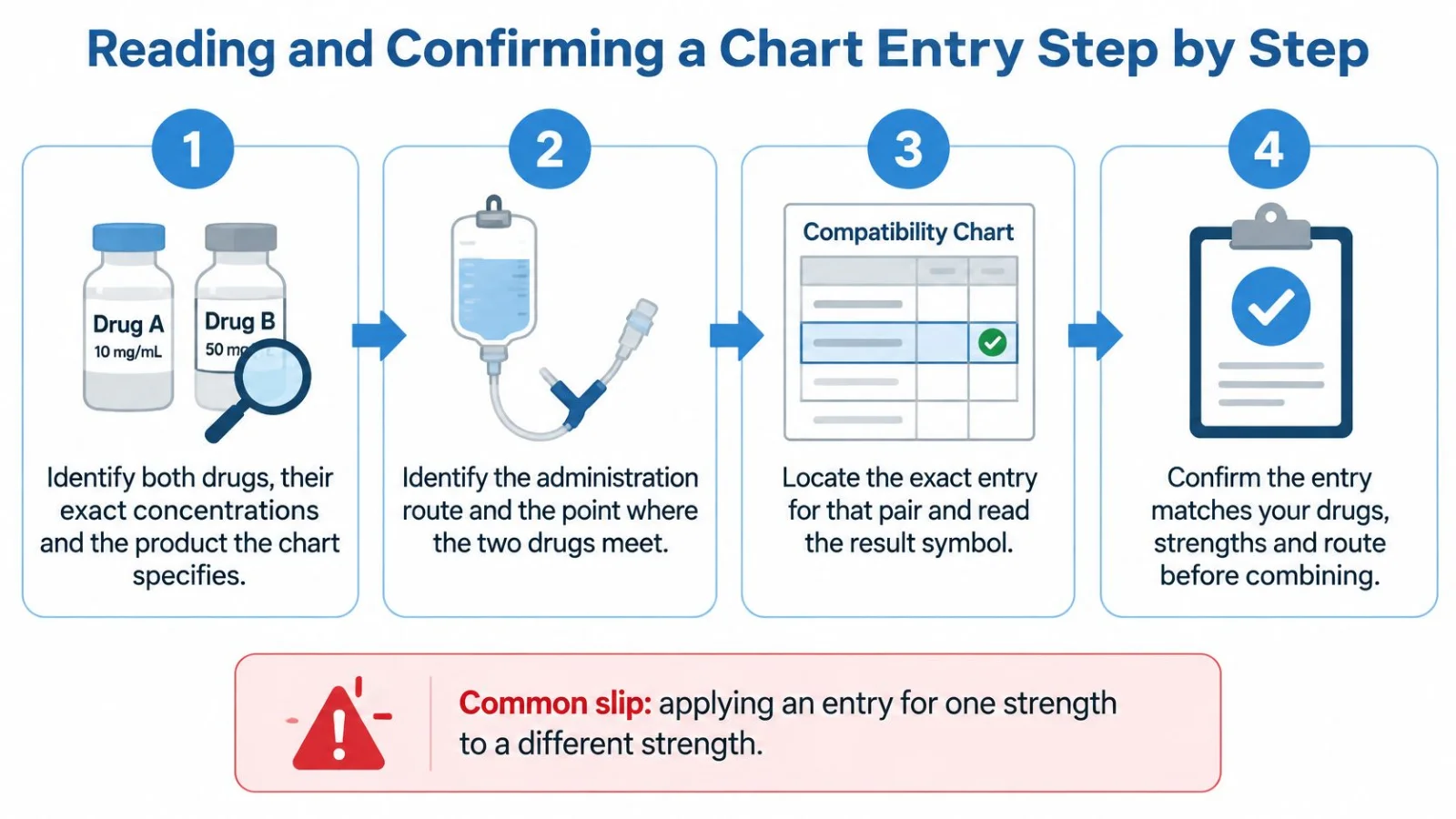
Work from identification to documentation
Identify both drugs and their concentrations. Include the manufacturer or formulation when the chart specifies one. The common error is matching the drug name while overlooking a different prepared strength.
Identify the administration method. Establish whether the medicines meet at a Y-site, in a syringe, in an additive solution, or in another shared container. Applying a Y-site finding to a syringe changes the question being answered.
Locate the matching preparation conditions. Compare diluent, container, and temperature with the proposed setup. Don't substitute a nearby entry just because its fluid or product looks similar.
Read the symbol and its qualifications together. Check the legend, contact duration, mixing conditions, and any footnotes. A favorable symbol without its accompanying restriction is an incomplete reading.
Inspect the cited primary source and date. Determine whether the evidence concerns the available formulation and the relevant endpoint. Newer publication alone doesn't make a study more applicable to a different product.
Escalate a missing or mismatched entry. If no entry covers the intended administration, classify the proposed use as unknown pending pharmacy review. Don't convert uncertainty into permission because administration is inconvenient to rearrange.
Confirm the final plan. Use a current compatibility database and relevant manufacturer stability information. If uncertainty remains, arrange separate access, a validated alternative, or pharmacist-approved staggered administration; don't interrupt a critical infusion merely to create access.
Document the decision. Record the reference, relevant conditions, pharmacist or manufacturer confirmation, and chosen administration arrangement in the appropriate medication record. A later clinician should be able to understand what was verified.
What a usable entry contains
A complete entry should make the verification reproducible:
Identity: Named medicines, products when relevant, and concentrations.
Method: Diluent, container, delivery configuration, and contact conditions.
Evidence: Observed result, cited source, and compatibility category.
Decision: Any restrictions and the approved bedside arrangement.
The chart remains a verification tool within institutional medication-administration procedures. A locally approved process should also specify where staff record advice and how unresolved questions are escalated.
For nurses developing pharmacology and medication-safety knowledge, ProMed Nursing Continuing Education offers a continuing-education option. ProMed doesn't guarantee that its courses will meet the customer's needs; customers are responsible for verifying that courses meet applicable licensing or regulatory requirements.
Signs of Physical and Chemical Incompatibility
Some incompatibility is invisible. A solution can remain clear even when a reaction degrades or inactivates a medication, so appearance can't establish that shared administration is safe.
The NCBI Bookshelf nursing reference on IV therapy distinguishes physical, chemical, and therapeutic incompatibility and emphasizes checking the running solution and medications before administration. That check must precede visual monitoring rather than be replaced by it.
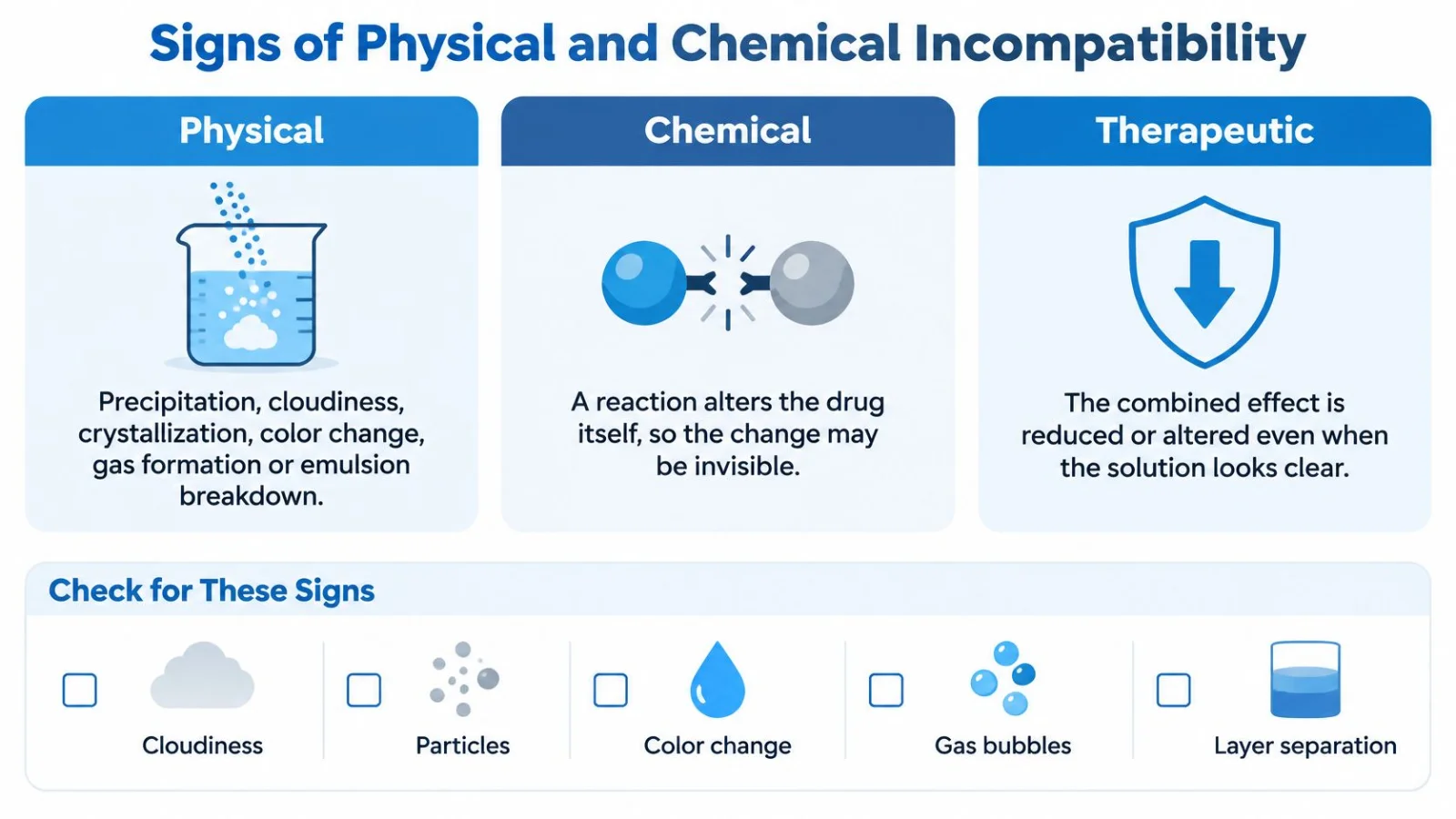
Recognize what each category means
Physical incompatibility may produce precipitation, cloudiness, crystallization, color change, gas formation, or emulsion separation. These findings concern the mixture's physical behavior, but their absence doesn't rule out smaller particles or chemical change.
Chemical incompatibility alters the medicine itself. It may cause degradation, inactivation, or formation of another compound without an obvious bedside sign.
Therapeutic incompatibility concerns an altered intended clinical effect. A physicochemically acceptable combination doesn't independently establish that the medicines are clinically appropriate together.
Differences in pH and formulation can contribute to physical instability. The Leeds guidance on parenteral nutrition and drug compatibility also describes concerns including microclots, treatment failure, and potentially toxic degradation products when incompatibility occurs with parenteral nutrition.
Observe before, during, and after administration
Suppose an emergency patient has a continuous infusion running and receives a new IV-push order. Before using the existing line, the clinician checks an authoritative database for the actual setup, establishes an approved administration plan, and then monitors the line during and after the push.
Use a focused observation routine:
Before administration: Inspect the medication, fluid, tubing, and connectors for unexpected particles, haze, discoloration, or separation.
During administration: Watch shared tubing and connection points for new changes; assess the patient and access site according to the medication and local protocol.
After administration: Reinspect the line and confirm that the intended infusion arrangement has been restored.
If a change appears: Stop the suspected administration, assess the patient, and notify the responsible clinician and pharmacist under local procedures. Don't flush suspected precipitate into the patient.
Document the event: Record the products, concentrations, fluids, timing, observed changes, patient assessment, actions, and advice received.
Handling Unlisted, Variable and Shortage Situations
A blank cell is a result, not a reassuring silence. A 2020 ICU review found usable information for only 475 of 945 possible two-drug combinations; among documented combinations, 77.1% were compatible, 16.8% incompatible, and 6.1% compatible only under specific conditions. The remaining pairs, nearly half of what a clinician might ask about, carried no published answer at all.
The danger lies in how a chart displays that gap. An unlabeled empty cell invites a hurried reader to infer reassurance where the reference offers none. A chart that marks the gap, with an explicit "untested" designation or a scope note, turns dead air into an instruction: verify before mixing.
Make uncertainty explicit
A local chart should distinguish an actual untested designation from a pair that wasn't included in the chart's scope. Both need further verification, but the distinction helps pharmacy identify whether another reference may answer the question or whether the pair is undocumented. Recording the stated conditions of any result that does exist matters just as much, since two entries reading "compatible" may describe different concentrations, diluents, or containers.
Shortage safeguard: Replacing an IV fluid or bag product requires verification of the replacement preparation, not just confirmation that the medication order is unchanged.
IV-fluid and bag-product shortages occur, and supply positions shift over time. Confirm the current local supply position before assuming the usual product will be available.
Switching from sodium chloride to another diluent changes the preparation. Changing the IV-bag product can also require review because both solution composition and container material may affect the medicine.
Verify the substitute before use
When the usual product isn't available, use a defined workflow rather than an informal bedside substitution:
Identify the replacement precisely: Record the exact fluid, manufacturer, bag or container material, and available presentation.
Recalculate the final preparation: Confirm the intended final concentration and administration duration, not merely the volume of substitute fluid.
Check the applicable evidence: Ask whether the substitute preparation is covered by product-specific stability information or an authoritative reference.
Label restrictions clearly: Carry forward any temperature, storage, contact-time, or administration limitations.
Obtain and document confirmation: Record the pharmacist's or manufacturer's advice before the replacement is used.
A hospital may receive a different bag product while the medication and prescribed dose remain unchanged. The correct question is whether evidence supports that exact preparation, not whether staff have used the medicine previously.
If verification remains incomplete, pharmacy and the treating team should select an alternative plan appropriate to the patient's access and treatment urgency. Compatibility is a product- and process-specific result, not a permanent property of a drug name.
Choosing Verification Sources Beyond the Chart
Choose a source according to the question that needs answering. A quick chart can identify a potential problem, while a database, manufacturer document, or pharmacist may be needed to resolve the preparation details.
Verification sources and their limits
Source | Best used for | Main limitation |
|---|---|---|
Compatibility database such as Micromedex | Drug-pair results with cited conditions | Results apply to tested conditions; a blank entry may mean untested |
ASHP evidence-structured tables | Solution, additive, syringe, and Y-site findings with primary sources | Concentration and delivery configuration must match |
Manufacturer stability information | Product-specific diluent and container questions | Labeling may not cover mixtures with other drugs |
Hospital pharmacist or local protocol | Variable, untested, and shortage-substitute situations | Advice must account for the local formulary, available products, and access to specialist support |
Peer-reviewed studies | Emerging findings on specific drugs and test conditions | Narrow scope; not a standing reference for routine decisions |
Match the reference to the uncertainty
Use a compatibility database when the immediate question concerns co-administration of named medicines. Open the supporting details rather than relying only on a summary symbol, especially when the preparation isn't routine.
Manufacturer information is particularly useful when the uncertainty concerns an exact formulation, approved diluent, or container. However, silence about another medicine shouldn't be interpreted as permission to mix it into the product.
A hospital pharmacist can connect these sources to the actual formulary and administration setup. Peer-reviewed publications may resolve a narrow gap, but applying a study requires assessing its method, products, and outcome measures, an important part of evidence based practice in healthcare.
Keep patient information separate from technical authorization
Patients may browse IV hydration treatments from Ideal Face & Body and ask about named infusion options. Such descriptions can help clarify what treatment the patient means, but they aren't injectable-drug compatibility references.
Similar pH, shared drug class, familiar branding, or prior uneventful administration doesn't settle an unsupported combination. No single reference answers every question; the final decision needs evidence that fits the planned use and a clinically appropriate administration plan.
Applying the Chart in Three Clinical Scenarios
The following hypothetical scenarios show how clinicians can translate chart findings into bedside decisions. Each requires a concrete administration plan rather than a result label alone.
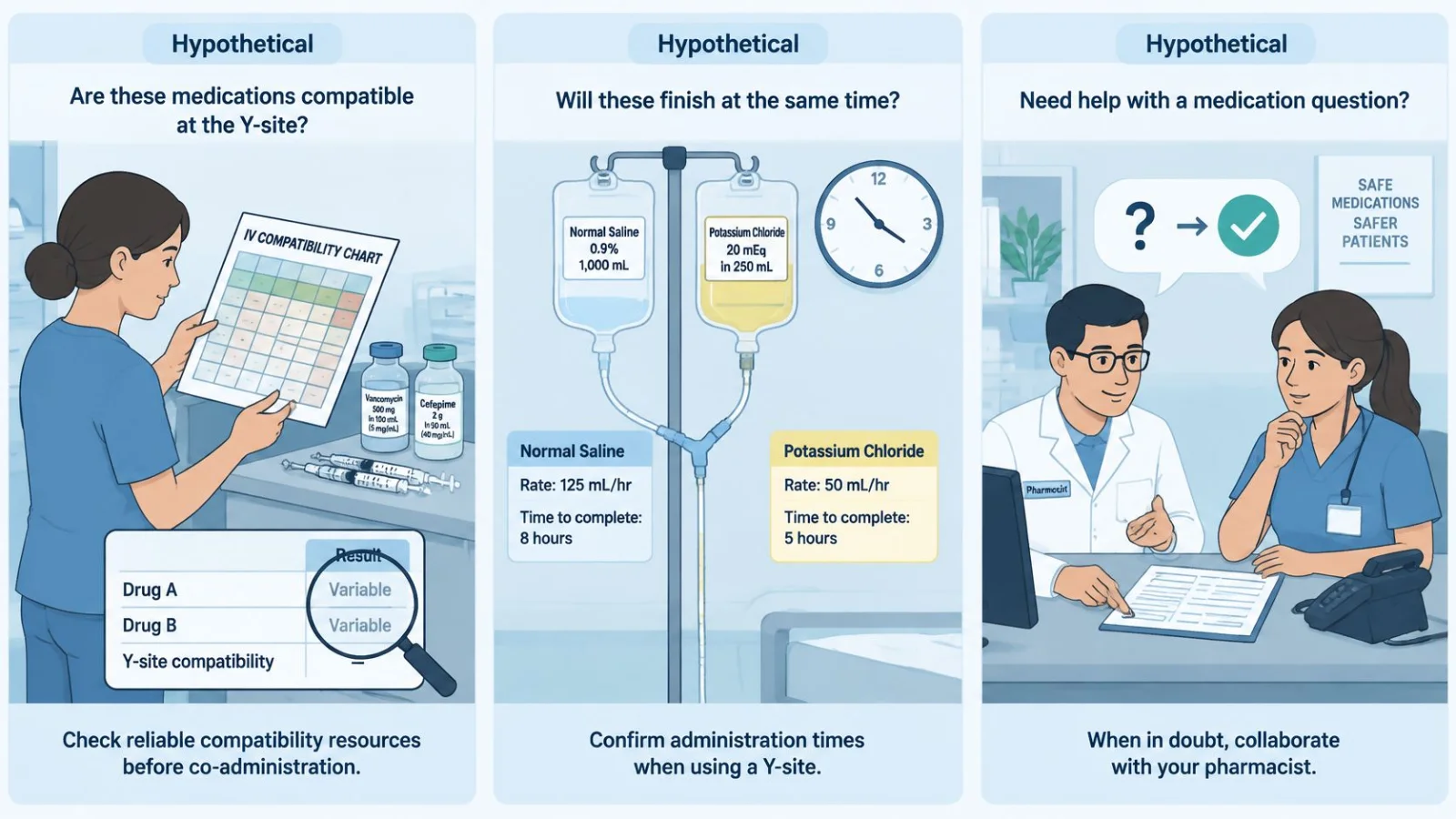
Hypothetical scenario one, A variable entry and a different concentration
A nurse preparing an IV bolus finds a variable entry for the bolus medication and a running infusion. The infusion's labeled concentration differs from the strength described in the chart.
The nurse provides pharmacy with the drug names, prepared concentrations, diluents, and shared-line configuration. Pharmacy assesses whether applicable evidence supports the intended administration; if the question remains unresolved, the team arranges separate access or another approved plan.
Decision: Don't use the existing shared line on the strength of a partially matching entry.
Hypothetical scenario two, An antibiotic during parenteral nutrition
A patient receiving parenteral nutrition needs an intermittent IV antibiotic, but the available reference doesn't provide a reliable result for the actual nutrition formulation. The nurse identifies the nutrition product and antibiotic preparation before contacting pharmacy.
A separate lumen is used when feasible. If that isn't possible, pharmacy and the treating team determine whether nutrition can appropriately be interrupted and whether a compatible flushing and staggered-administration plan is validated.
Monitoring for precipitation or color change remains necessary, but it isn't the basis for authorizing empirical co-infusion. Decision: Use an approved separation strategy rather than mixing first and watching for a reaction.
Hypothetical scenario three, A Y-site finding applied to a syringe
A patient receives several medicines through an infusion setup, and a new order calls for syringe administration of a medicine already represented in the chart. The nurse notices that the favorable entry describes Y-site testing, not a syringe mixture or the full multi-drug arrangement.
The nurse clarifies whether the order means a single medicine delivered by syringe or medicines mixed together in the syringe. Pharmacy reviews the actual point of contact, and the nurse documents the approved method and restrictions.
In emergency care, preparation verification must accompany dose verification. Resources on epinephrine and amiodarone dosing protocols address a different safety question from compatibility and shouldn't be treated as mixing instructions.
Decision: Follow the conditions of administration, not the drug names alone. Across these scenarios, the defensible action is the one supported for the actual products and setup.
ProMed Certifications offers online healthcare certification and continuing education for nurses and physicians. Visit ProMed Certifications to explore learning options that complement medication-safety practice, and use the next IV administration check to document both the compatibility result and the conditions that support it.