

Free ACLS Practice Exam: How to Prep Smarter
You've probably heard that only an American Heart Association or American Red Cross in-person class really counts. That belief is out of date. Peer-reviewed evidence keeps landing on the same answer: online learning matches classroom instruction for knowledge, and with spaced reinforcement it can beat a single intensive day. A Cochrane review of five studies involving 632 participants found no meaningful difference in knowledge scores between pure e-learning and face-to-face teaching, with a standardized mean difference of -0.03. Hospitals, clinics, and training organizations are updating their policies to match.
So here's a better first move than booking a seat three weeks out. Use a free ACLS practice exam to baseline your knowledge, drill the core algorithms and pharmacology, and find the weak spots before exam day.
ACLS Certification
A practice exam is a diagnostic tool, not a finish line. The finish line is a certification exam you sit once and pass, and the work between the two is where some people either coast or scramble. Here's the page you'll come back to when the gaps are closed.
Why the Stakes Make Practice Non-Negotiable
Out-of-hospital cardiac arrest isn't a once-a-career event. The CDC reports that more than 356,000 people experience out-of-hospital cardiac arrest in the United States each year (CDC cardiac arrest overview), and AHA reporting for 2024 adult out-of-hospital cardiac arrest puts survival to hospital discharge at 10.5%.
That number explains why ACLS questions lean on sequencing instead of recall. Naming a drug is easy. Deciding what you do next, after the second shock, while compressions continue, is the skill being tested.
Treat every missed question as a rehearsal of a mistake you don't want to make on a real patient.
Read the Blueprint Before You Read the Questions
A free practice test is only diagnostic if it's long enough to measure something. AHA course materials specify that the ACLS exam contains 50 questions and requires a minimum score of 84% to pass, which works out to at least 42 correct answers on a 50-question equivalent.
Scale your practice to the stakes. Use short sets as warm-ups, and hold back one full-length 50-question run for the week before you book.
Score Yourself by Domain, Not Just Pass or Fail
One percentage hides more than it reveals. In a multicenter survey of 379 healthcare professionals, only 47.0% met the study's threshold for good ACLS knowledge, defined as at least 7 correct answers out of 14 (International Journal of Emergency Medicine survey). Every respondent worked in a clinical setting.
So break your own results into five buckets: rhythm recognition, airway and ventilation, defibrillation and cardioversion, pharmacology, and the arrest algorithms. A 78% overall score built on flawless pharmacology and half-right rhythms calls for a different study plan than the reverse.
Practical rule: if you miss two or more questions in one bucket, that bucket becomes your next study session, not your next practice test.
Drill Under the Clock
Time pressure is where knowledge either holds or collapses. In a controlled study of high-fidelity ACLS simulation, learners with prior training performed better on 6 of 8 observed ACLS skills within 120 days, and they calculated an accurate vasopressor infusion rate in 83 seconds against 113 seconds for those without prior training (BMC Medical Education simulation study).
Set a timer, then. Answer rhythm, next intervention, dose, and reassessment questions inside a fixed window, and note what slowed you down. Speed with accuracy is what a megacode station grades.
Flag safety-critical errors separately from ordinary misses. A wrong defibrillation sequence or a shock delivered on a non-shockable rhythm matters more than a fuzzy memory of a second-line antiarrhythmic.
Check the Guideline Version Behind the Answer Key
This is the quiet failure mode of free test sites. The AHA released updated CPR and ECC guidance in 2025, with specific ACLS changes including revised advanced-airway ventilation language, material involving durable LVAD assessment, and medication or algorithm updates (2025 AHA CPR and ECC guidelines announcement).
A quiz that never names its framework can teach you a dose or a sequence that no longer matches current instruction. Plenty of pages don't label their version at all.
Look for a question count, a guideline version, and a publication date before you trust a score. If a site shows none of the three, treat it as a flashcard set rather than an assessment.
The 2025 materials also sharpen distinctions that one-line questions handle badly, such as synchronized cardioversion versus defibrillation by rhythm and device-specific energy recommendations. A written explanation of why an answer is right beats ten more questions.
Turn the Results Into a Study Plan That Sticks
Practice works better as a loop than as a single sitting. A 2024 systematic review and meta-analysis of spaced digital education for pre- and postregistration health professionals found that spacing online instruction improved knowledge retention, with a pooled standardized mean difference of 0.38 and a 95% confidence interval of 0.10 to 0.65 (Journal of Medical Internet Research).
Build the loop like this:
Baseline cold. Take one full-length timed set with no notes and no pauses.
Fix one bucket at a time. Review the algorithm or drug family, then retake only that domain.
Space the retakes. Return to a weak domain after a day or two, not ten minutes later.
Re-test the whole blueprint. Close with a second full run to prove the gaps shut.
Delivery format isn't the weak link. A systematic review of digital education for clinical practice guidelines, covering 17 trials and 2,382 participants, concluded that digital education was at least as effective as traditional learning for improving knowledge (digital education for guideline implementation). A separate 2024 review in Human Resources for Health found asynchronous, synchronous, blended, and self-directed e-learning all effective for continuing professional development (Human Resources for Health).
Where the Practice Exam Leads
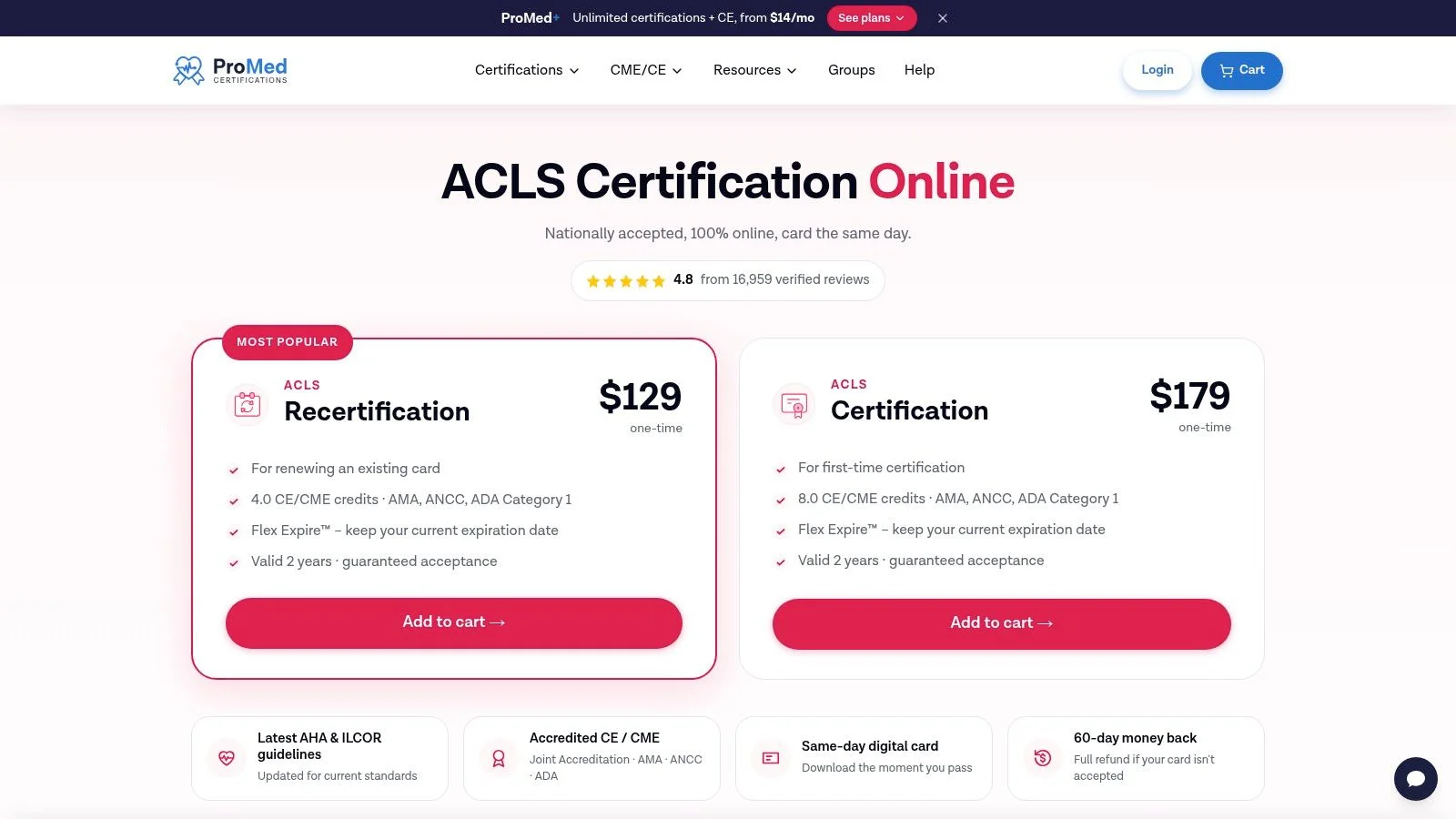
Everything above points at one finish line. ACLS Certification from ProMed Certifications is a self-paced online course you can open on any device, work through around shifts, and complete with your card in as little as an hour once you pass. The courses follow the latest published cognitive guidelines endorsed by the AHA's International Liaison Committee on Resuscitation, and the certification is nationally accepted.
Three details change how you use it:
Unlimited exam attempts. You can retake the exam until you pass, so one rough night doesn't reset your timeline.
Algorithm references in one place. Work the cardiac arrest treatment algorithms next to your practice results, so every missed question turns into a closed gap.
Expiration reminders. A free reminder arrives before your card lapses, which matters once renewals stack across BLS, PALS, and ACLS.
The practice exam finds the gap. The course closes it. That order beats a classroom seat booked weeks in advance.
Free ACLS Practice Exam Resources at a Glance
Resource | Format | Best For | How It Maps to the Real Exam |
|---|---|---|---|
ACLS Certification | Online ACLS course and exam | Learners seeking a convenient, self-paced certification option | Includes an online certification exam; alignment details are not specified |
From Practice Exam to Certification: Your Next Step
Free ACLS practice exams are the fastest way to see where you stand. Twenty minutes with a timed set tells you more about your readiness than an hour of rereading a provider manual, and it tells you where to spend the next hour.
Pairing that practice with a self-paced online course is a fully valid path to certification, and a widely accepted one. Online formats save travel time and course fees while delivering learning outcomes that match or beat classroom delivery, which is why hospitals, clinics, and training organizations keep widening what they accept. ProMed Certifications offers free practice tests for ACLS alongside its accredited, nationally accepted online program, built on the latest ILCOR-endorsed guidelines, with unlimited exam attempts so you can retake until you pass.
Start with a practice test this week, review the algorithms you missed, then take the ACLS Certification course on your own schedule and get your card without rearranging your shifts.
ProMed Certifications gives you the full prep loop in one place: free practice tests, algorithm references, and a self-paced ACLS course you can finish with your card in hand the same day you pass. Every course follows the latest ILCOR-endorsed guidelines, comes with unlimited exam attempts, and is nationally accepted, so you're not trading convenience for credibility. Start with a practice exam at ProMed Certifications and see exactly which algorithms need another pass before you certify.