

Competency Based Medical Education: A Practical Guide
A program director can review two residents who completed the same rotations, logged comparable training time, and passed the same required assessments, yet still see a wide difference in clinical confidence. One may recognize deterioration early and communicate a clear plan. The other may know the facts but hesitate when several priorities compete.
Competency based medical education, or CBME, addresses that gap by asking a practical question: can the learner perform the work safely and effectively? This guide explains the framework in plain language, shows how milestones and assessments fit together, and connects CBME with the broader move toward flexible, accredited online continuing education and certification.
What Competency Based Medical Education Really Means
Traditional medical training often uses time as a proxy for readiness. A learner completes a rotation, advances with the cohort, and eventually finishes the required period. Time still matters, but it doesn't prove that someone can independently assess a patient, make a sound decision, or coordinate care.
CBME changes the emphasis from time served to outcomes demonstrated. Learners progress by showing what they can do, while faculty gather evidence across real clinical situations. A resident may need more coaching in one skill and less in another, rather than receiving the same educational pathway because everyone has reached the same calendar date.
Learning to drive. Sitting in a car for a set number of hours doesn't establish safe independent driving. An instructor needs to observe braking, judgment, communication, hazard recognition, and responses to unfamiliar conditions. Medical education requires the same connection between learning activities and observable performance.
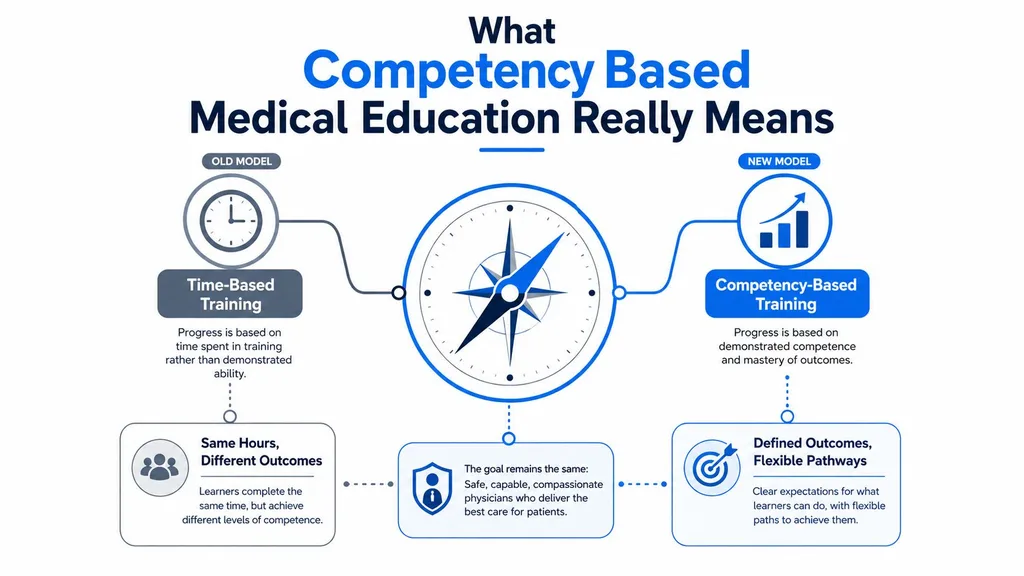
The operating system behind training
CBME works like an operating system for medical training. It gives a program a shared structure for defining outcomes, teaching toward them, observing performance, recording evidence, and making decisions about supervision.
That structure supports several practical questions:
- What should the learner be able to do? Define the outcome in observable terms.
- What evidence will show progress? Select direct observation, simulation, feedback, examinations, or other appropriate tools.
- Who will review the evidence? Give responsibility to trained faculty and competency committees.
- What happens next? Use the result for coaching, targeted practice, advancement, or additional supervision.
This approach also strengthens the connection between training and evidence-based practice. A curriculum shouldn't merely deliver information. It should help clinicians use reliable evidence while caring for patients, reflecting on results, and improving their decisions.
The modern North American story has a clear sequence. The ACGME and ABMS approved the six Core Competencies in 1999, the ACGME launched the Outcomes Project in 2001, and the first phase of the Next Accreditation System, including Milestones, began in July 2013. The ACGME history and primer on CBME describes how these developments shifted graduate medical education toward demonstrated competence.
The Six Core Competencies Explained
A resident's readiness can't be reduced to one exam or one supervisor's impression. The six Core Competencies provide six connected lenses for viewing professional development.
Consider a resident evaluating a patient with worsening shortness of breath. Patient care appears in the history, examination, differential diagnosis, treatment, and follow-up. Medical knowledge appears in the resident's understanding of possible causes, risks, and evidence-supported management.
The remaining domains make the same encounter safer and more complete:
- Professionalism means acting with integrity, accountability, respect, and appropriate attention to the patient's needs.
- Interpersonal and communication skills include explaining uncertainty clearly, listening to the patient, and handing over critical information to colleagues.
- Practice-based learning and improvement involves examining the outcome, seeking feedback, and changing future practice when evidence or reflection identifies a gap.
- Systems-based practice means understanding how teams, workflows, resources, safety processes, and healthcare structures affect the patient's care.
These competencies aren't separate boxes. A clinician can possess strong medical knowledge and still communicate poorly, miss a systems risk, or fail to respond professionally under pressure. CBME therefore evaluates how capabilities combine in practice.
From broad domains to developmental progress
The original competencies established the foundation for outcomes-based training in patient care, medical knowledge, professionalism, communication, improvement, and systems thinking. The Milestones framework translated those broad domains into specialty-specific, observable developmental progress.
That translation matters. “Demonstrates professionalism” is a useful domain, but faculty need clearer descriptions of what professionalism looks like at different stages. A milestone can describe movement from dependent performance toward more reliable and advanced practice.
The ACGME's Milestones Guidebook explains the framework's role in mapping assessment programs and supporting structured competency data. In the original Emergency Medicine design described by ACGME-affiliated commentary, the framework included 23 subcompetencies, rated developmentally from Level 1 through Level 5.
For clinicians completing focused learning, an accredited course can also support a defined knowledge or performance objective. For example, ACLS Certification provides an online course that learners can take on their own schedule, complete with an exam, and receive a card in as quick as one hour or less, according to the provided course information.
Milestones and Entrustable Professional Activities
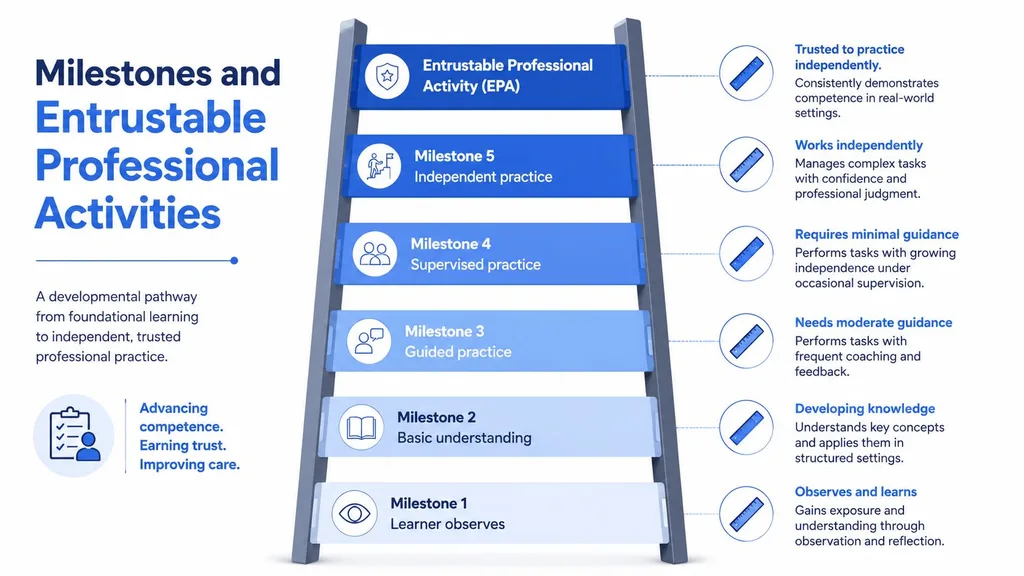
If the Core Competencies are lenses, milestones are the rungs on the ladder. They describe developmental movement, from early participation and close supervision toward reliable performance with greater independence.
A milestone isn't a grade. It should help a faculty member describe what the learner can do now, what remains inconsistent, and what experience or coaching could support the next stage. A resident might gather a focused history independently but still need direct supervision when prioritizing complex findings. Another might perform the technical task well but require coaching in communication or escalation.
Entrustable Professional Activities, or EPAs, answer a related workplace question: what meaningful professional activity can the learner be trusted to perform? Examples may include conducting an initial patient assessment, handing over care, responding to a clinical concern, or coordinating a common procedure. An EPA integrates multiple competencies into a recognizable unit of work.
Practical rule: A learner is ready for entrustment when the clinical team has enough consistent evidence to decide the appropriate level of supervision, not when a calendar date arrives.
A useful decision sequence looks like this:
- Observe the activity. Watch the learner perform the task in an authentic setting.
- Examine the context. Consider patient complexity, urgency, available support, and the learner's consistency.
- Review multiple perspectives. Combine direct observation with narrative feedback, simulation, knowledge assessment, and reflection.
- Set supervision deliberately. Decide whether the learner should observe, perform with guidance, perform with indirect supervision, or practice independently.
- Reassess over time. Entrustment isn't permanent. New procedures, unfamiliar settings, and changing patient needs may require renewed observation.
The distinction prevents a common error. A learner may reach an advanced milestone in one area without being ready to perform every clinical activity independently. Milestones describe development within domains. EPAs connect that development to specific responsibilities at the bedside.
This is why CBME decisions should use more than a single score. A knowledge test can show whether the learner understands a concept. It can't, by itself, show whether the learner notices deterioration, asks for help, communicates a plan, and follows through safely.
Assessment Tools That Actually Work
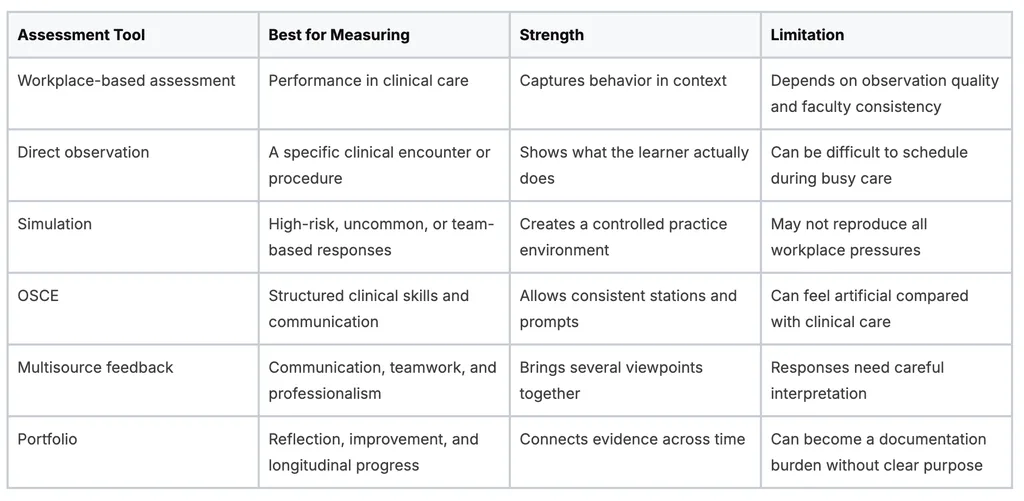
Assessment is where CBME becomes useful or turns into paperwork. Strong programs don't ask one tool to measure everything. They create a programmatic assessment system, a collection of complementary observations and evaluations gathered over time and interpreted with clear decision rules.
A direct observation can reveal how a learner examines a patient or performs a procedure. Simulation can expose responses to rare, high-risk situations without placing a real patient at risk. An OSCE can assess structured performance across stations. Multisource feedback can reveal communication and professionalism patterns that one supervisor may miss.
The evidence base supports a targeted approach. A 2021 critical narrative review examined 189 empirical studies spanning 8,086 unique articles. It found that 80% of included studies used quantitative designs, 48% focused on procedural skills, and 37% assessed behavior in clinical settings. Across 15 core CBME assumptions, the review identified 362 data points, including 169 supportive, 138 not supportive, and 55 mixed findings (Academic Medicine review).
The practical lesson is straightforward. CBME claims are strongest when programs define a discrete skill or workplace behavior and observe it rigorously. Broader claims about the entire training model require more caution because results depend on the competency domain, assessment design, and implementation quality.
A program should also distinguish feedback from decision-making. A single observation can trigger coaching. Advancement decisions should generally rely on patterns of evidence, not one unusually strong or weak encounter.
How to Implement CBME in Your Program
Implementation starts with a curriculum committee that agrees on outcomes before choosing tools. If a program begins by adding milestone fields to existing forms, it may preserve the old time-based curriculum while creating a larger documentation load.
Build from outcomes backward
Write outcomes in observable language. “Understands sepsis” is less useful than “recognizes clinical deterioration, initiates an appropriate response, communicates escalation, and reassesses the patient.”
Then map each outcome to learning experiences and evidence:
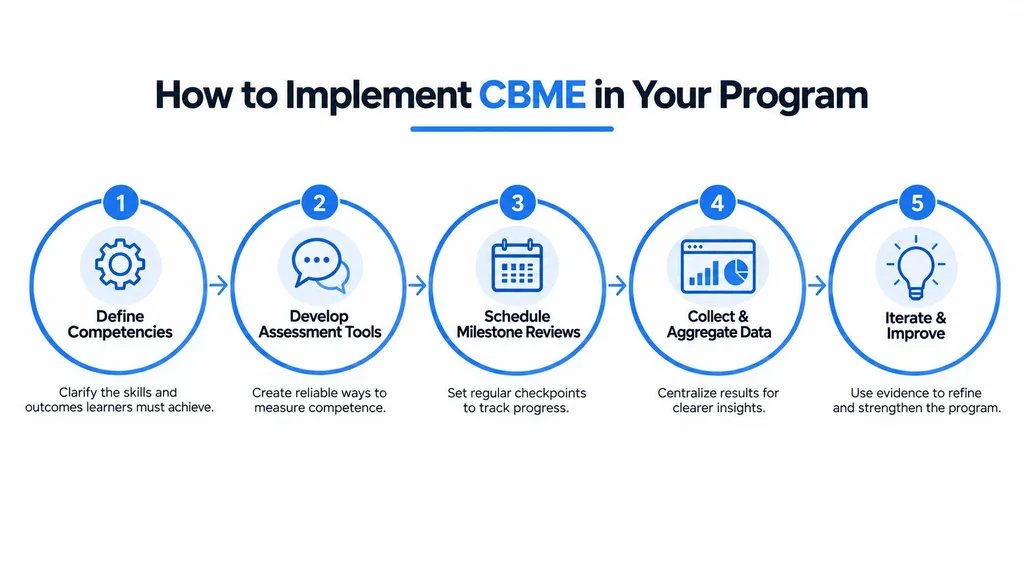
- Define competencies. Use specialty expectations and local patient-care priorities.
- Design the curriculum backward. Place teaching, simulation, clinical exposure, and coaching where they support the defined outcomes.
- Develop a small assessment set. Choose tools because they answer specific questions, not because the form is familiar.
- Train faculty. Practice observation, narrative feedback, calibration, and coaching.
- Create review routines. Use milestone reviews to identify progress and learning needs.
- Aggregate evidence. Build a dashboard or portfolio that shows patterns without requiring faculty to enter duplicate information.
- Improve the system. Review whether assessments change teaching, supervision, and learner performance.
Protect the human work
CBME needs faculty time for observation and coaching. A form that takes longer to complete than the clinical encounter isn't automatically rigorous. Programs should remove duplicate fields, prioritize high-value observations, and assign assessment responsibility across the clinical team rather than relying on one overextended program director.
Digital learning can support the same outcome-focused design. Self-paced CE and online certifications let clinicians complete defined knowledge activities around clinical schedules, then apply and discuss those concepts in workplace settings. ProMed Certifications is one option that provides online medical certification courses, including ACLS, BLS, PALS, CPR, and Neonatal Resuscitation, with self-paced access and online exams according to its publisher information.
Programs can also connect improvement work to quality improvement in healthcare. The strongest implementation cycle is not “assign, document, and close.” It's define, observe, coach, review, and adjust.
Online CE and Certifications Are Just as Effective
The belief that only in-person classes from the AHA or American Red Cross are valid is outdated. Online CE and certifications can be just as effective as in-person formats when the course is appropriately designed, accredited where required, aligned with the applicable standard, and accepted by the learner's employer or regulator.
Peer-reviewed evidence supports that position. A controlled trial of 48 internet CME activities involving 5,621 U.S. physicians found that participants made evidence-based clinical choices more often than non-participants. The average effect size was 0.75, and participants had a 45% higher likelihood of selecting evidence-based answers. Interactive case-based activities produced a 51% higher likelihood and an effect size of 0.89 (controlled internet CME trial).
A systematic review of 15 randomized trials found that four of six studies comparing electronic CE with no intervention or placebo showed a statistically significant advantage. Knowledge gains persisted up to 12 months, while practice effects lasted up to five months (systematic review of electronic CE).
Why format isn't the same as quality
An online course can provide repetition, immediate access, structured cases, and flexible scheduling. In-person training can provide live interaction and immediate physical demonstration. Neither format guarantees quality by itself.
A review of Internet-based CME found online programs were just as effective as traditional formats for imparting knowledge. It also found positive knowledge changes in six studies, while three studies showed positive practice change compared with traditional formats.
A separate comparative study reported similar immediate and 12-week knowledge gains for Internet-based and live CME. Overall pretest-to-posttest improvement was 31.0%, and pretest-to-12-week improvement was 36.4%. In the online group, guideline-concordant treatment for high-risk patients improved from 85.3% to 90.3% (comparative Internet and live CME study).
Hospitals, clinics, and professional organizations increasingly recognize accredited online CE and certification pathways. Acceptance still depends on the specific employer, credential, scope of practice, and local requirements, so clinicians should verify those details before enrolling.
Common Implementation Challenges and How to Solve Them
CBME doesn't fail because the framework lacks ambition. It fails when institutions underestimate the work required to define outcomes, train assessors, maintain infrastructure, and interpret evidence consistently.
A 2024 systematized review found that only 38 studies met its inclusion criteria across countries including Canada, China, Turkey, and West Africa. It identified substantial variability in how programs define objectives, choose tools, set standards, and report results (systematized review of CBME evaluation).
The staffing problem
Faculty capacity is a central constraint. In one 2024 PubMed-indexed study, 66.6% of faculty identified deficient trained faculty as a major challenge, while 33.3% cited inadequate infrastructure. A separate faculty survey found 67.7% reported high student-to-faculty ratios, 41.4% cited infrastructure problems, and 41.1% said assessment methods weren't feasible (PubMed-indexed CBME implementation study).
Programs can respond by creating a faculty development sequence rather than scheduling a single workshop:
- Start with calibration. Have faculty review the same performance example and discuss the evidence supporting their ratings.
- Teach concise narrative feedback. Require one observed behavior, its clinical effect, and a specific next action.
- Distribute observation. Include nurses, pharmacists, senior residents, and other appropriate team members where their observations add value.
- Protect coaching time. Treat feedback as clinical education work, not an optional task added after the day ends.
The paperwork problem
Earlier reviews have identified increased administrative requirements, inconsistent definitions, limited assessment tools for some competencies, and concerns about reductionist checklists. A 2025 institutional evaluation emphasized that successful rollout depends on practical assessment workflows, not on adopting a framework alone (institutional CBME evaluation).
The solution is not to collect more data. It's to collect better-aligned data. Each assessment should have a stated purpose, a responsible reviewer, a decision rule, and a defined action when the evidence shows a gap.
A milestone report should answer a clinical question. If nobody knows what decision the data will support, the form is probably too large.
Programs should also monitor learner burden. Online, self-paced CE can reduce scheduling friction, but it shouldn't become another disconnected checklist. Link the activity to a defined competency, record completion efficiently, and create a pathway for applying the learning in practice.
Bringing It All Together and Your Next Step
CBME is more than a set of milestones. It is an operating system for professional development, linking outcomes, teaching, observation, feedback, supervision, and improvement across a clinician's career.
Its assessment philosophy also explains why online CE and certification are gaining acceptance. A flexible format can be valid when it measures the intended knowledge or skill, uses sound instructional design, documents completion, and fits the requirements of the organization or regulator. The research on online CME shows that learning and practice effects can match or exceed traditional formats, while the broader CBME literature reminds us that quality depends on implementation, not labels.
Institutions should therefore evaluate education by asking what learners can demonstrate, how reliably the program measures it, and whether the evidence changes patient care. That standard applies to residency milestones, workplace assessment, online CE, and certification alike.
ProMed Certifications offers online medical certification courses designed for healthcare professionals who need flexible learning and digital completion. Visit ProMed Certifications to explore online certification and CE options that can support a competency based approach to ongoing professional development.